
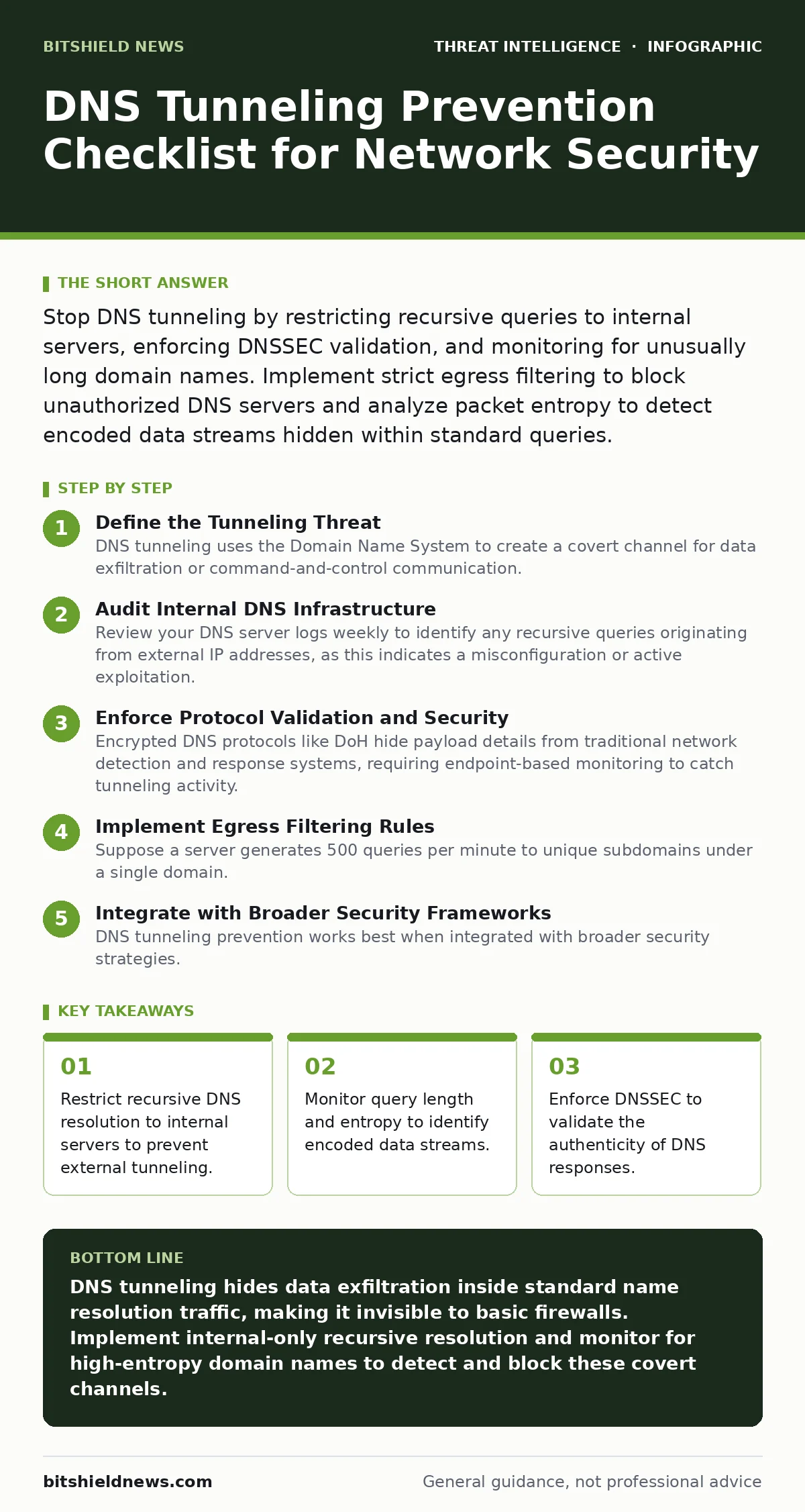
Stop DNS tunneling by restricting recursive queries to internal servers, enforcing DNSSEC validation, and monitoring for unusually long domain names. Implement strict egress filtering to block unauthorized DNS servers and analyze packet entropy to detect encoded data streams hidden within standard queries.
Define the Tunneling Threat
DNS tunneling uses the Domain Name System to create a covert channel for data exfiltration or command-and-control communication. Attackers encode data within DNS queries and responses, bypassing firewalls that allow port 53 traffic. You face a threat where standard network security tools see only normal name resolution activity. The protocol’s design allows small data payloads, which attackers chain together to transfer large files. This method exploits the necessity of DNS for internet connectivity. Organizations often overlook this vector because blocking DNS breaks basic network functionality. You must balance operational needs with strict inspection policies.
Audit Internal DNS Infrastructure
- Disable recursive resolution on public-facing DNS servers: External servers should only answer queries for zones they host, preventing attackers from using your infrastructure to tunnel data.
- Restrict DNS forwarding to trusted upstream providers: Forwarding to unknown resolvers creates an unmonitored exit path for encoded data streams.
- Implement split-horizon DNS configurations: Internal and external queries follow different paths, reducing the attack surface for lateral movement and data theft.
- Audit DNS zone transfer permissions: Unauthorized zone transfers can reveal internal network structure, aiding attackers in crafting targeted tunneling payloads.
Enforce Protocol Validation and Security
- Deploy DNSSEC on all critical domains: Digital signatures verify that responses come from the authoritative source, preventing response spoofing used in tunneling.
- Block DNS queries to non-standard ports: Standard DNS uses port 53; traffic on other ports often indicates tunneling tools trying to bypass port-based filters.
- Enforce DNS over HTTPS or TLS: Encrypting DNS traffic prevents intermediate observers from inspecting payload content, though it also hides tunneling from passive monitors.
- Validate DNS message sizes: Standard queries are small; unusually large messages often contain encoded data payloads rather than simple name lookups.
Monitor Traffic Patterns for Anomalies
- Alert on high-entropy domain names: Random-looking subdomains often indicate base64 or hex-encoded data, which is a hallmark of DNS tunneling tools.
- Track query frequency per host: A single host making thousands of queries in minutes suggests automated data exfiltration rather than normal user behavior.
- Monitor for TXT record abuse: Attackers frequently use TXT records to transport larger data blocks, so high volumes of TXT queries warrant immediate investigation.
- Analyze response sizes for consistency: Legitimate DNS responses vary slightly; tunneling responses often have uniform sizes due to fixed-length data encoding.
Implement Egress Filtering Rules
- Block direct DNS queries to external servers: Force all DNS traffic through internal resolvers where you can inspect and log every query and response.
- Restrict outbound port 53 to known resolvers: Only allow your designated DNS servers to send queries outward, closing off unauthorized exit points.
- Implement rate limiting on DNS queries: Throttling query rates slows down data exfiltration, making it easier to detect and block ongoing tunneling sessions.
- Block DNS traffic from untrusted network segments: Guests and IoT devices should use restricted DNS policies to prevent them from becoming tunneling vectors.
See also: Stop DNS Amplification Attacks: Practical Prevention Steps · How Do Honeypots Work: Mechanism, Failures, and Detection Data
Respond to Detected Tunneling Activity
- Isolate affected hosts immediately: Disconnect compromised machines from the network to stop data exfiltration and prevent lateral movement to other systems.
- Capture full packet captures for forensic analysis: Detailed logs help identify the specific tunneling tool and the data being exfiltrated.
- Update DNS firewall rules to block observed domains: Immediately block the malicious domains used in the tunnel to disrupt the command-and-control channel.
- Review incident triage procedures for DNS-specific indicators: Ensure your team knows how to distinguish between tunneling and normal high-volume DNS activity.
Integrate with Broader Security Frameworks
DNS tunneling prevention works best when integrated with broader security strategies. You should correlate DNS logs with endpoint detection data to identify compromised hosts. Understanding fast flux DNS techniques helps you recognize domains that change IP addresses frequently to evade blocking. While hacktivism often uses public-facing attacks, DNS tunneling is a stealthy method for maintaining persistent access. Ensure your security telemetry includes DNS metrics alongside network flow data. This holistic approach ensures you catch tunneling attempts that slip past perimeter defenses.
Key takeaways
- Restrict recursive DNS resolution to internal servers to prevent external tunneling.
- Monitor query length and entropy to identify encoded data streams.
- Enforce DNSSEC to validate the authenticity of DNS responses.
DNS tunneling hides data exfiltration inside standard name resolution traffic, making it invisible to basic firewalls. Implement internal-only recursive resolution and monitor for high-entropy domain names to detect and block these covert channels.
Frequently asked questions
How do I detect DNS tunneling without specialized software?
Monitor for unusually long domain names and high query volumes from single hosts, as these patterns often indicate encoded data transfer.
Does DNSSEC prevent DNS tunneling?
DNSSEC validates the authenticity of responses but does not inspect payload content, so it does not stop tunneling unless combined with traffic analysis.
Can encrypted DNS hide tunneling activity?
Yes, protocols like DoH encrypt DNS traffic, preventing network monitors from seeing the encoded data, so you must rely on endpoint monitoring.
What is the first step in blocking DNS tunneling?
Disable recursive resolution on public-facing DNS servers and force all internal traffic through monitored, internal resolvers.
How this guide was produced: written by the BitShield News editorial team with AI assistance, checked against the public references listed below, and reviewed when the facts change. See our editorial policy or report an error.