Security telemetry is the continuous collection of digital footprints from your infrastructure. It transforms raw logs into structured data. You must ingest, normalize, and correlate this data to spot anomalies. Without proper context, the volume creates blind spots rather than visibility.
The Illusion of Visibility
Collecting data is not the same as gaining visibility. Many organizations assume that turning on logging equates to security. This assumption fails because raw logs are unstructured and siloed. You have a firewall log, a server event log, and an endpoint detection record. None of these speak the same language. Without a unified framework, you cannot connect the dots.
Telemetry is the measurement of data transmitted from remote sources. In cybersecurity, this means capturing signals from endpoints, networks, and applications. The goal is not just storage. The goal is detection. You need to know when a normal action becomes malicious. This requires processing power and logical structure.
The Ingestion Pipeline
The first stage is ingestion. You must pull data from every potential source. This includes operating systems, network devices, and cloud services. If a device is not sending logs, it is invisible. You cannot protect what you cannot see.
However, ingestion is not passive. You must configure agents or connectors. These tools capture events and send them to a central repository. The repository is often a Security Information and Event Management (SIEM) system or a data lake. The speed of ingestion matters. If there is a lag, you are reacting to history, not current threats.
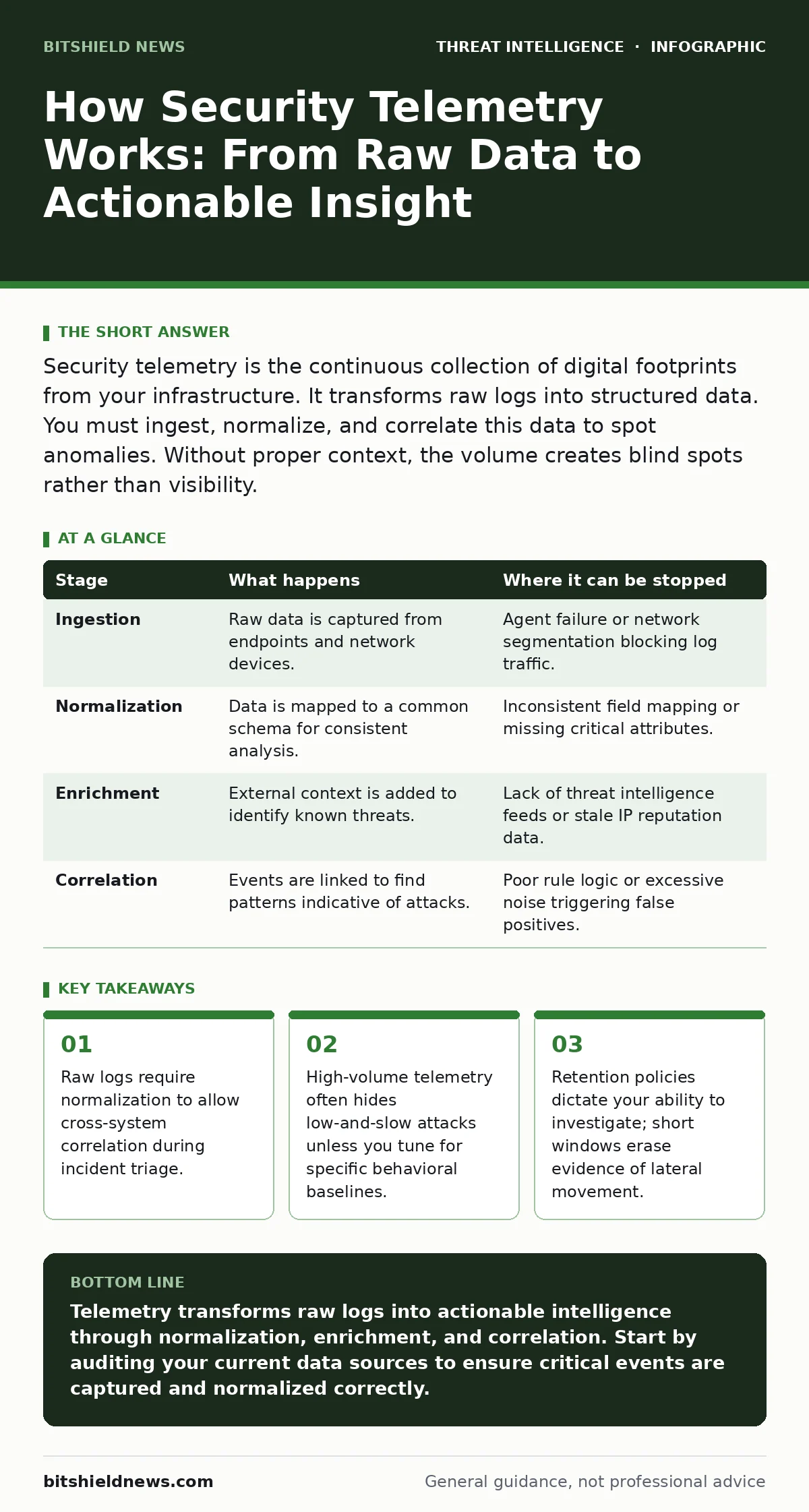
| Stage | What happens | Where it can be stopped |
|---|---|---|
| Ingestion | Raw data is captured from endpoints and network devices. | Agent failure or network segmentation blocking log traffic. |
| Normalization | Data is mapped to a common schema for consistent analysis. | Inconsistent field mapping or missing critical attributes. |
| Enrichment | External context is added to identify known threats. | Lack of threat intelligence feeds or stale IP reputation data. |
| Correlation | Events are linked to find patterns indicative of attacks. | Poor rule logic or excessive noise triggering false positives. |
Normalization and Context
Raw logs are messy. One system might record a timestamp in UTC, while another uses local time. One might list an IP address, while another lists a hostname. Normalization fixes this. It maps disparate fields to a common schema. This allows you to compare an event from a Windows server with an event from a Linux web server.
Without normalization, your search queries fail. You cannot ask "show me all failed logins" if half the systems call it "login failure" and the other half call it "authentication error." This step is mechanical but vital. It turns chaos into order.
Enrichment with Threat Intelligence
Normalization gives you structure. Enrichment gives you meaning. You take your normalized data and compare it against external sources. These sources provide context. Is the IP address associated with a known command-and-control server? Is the file hash listed in a malware database?
This step reduces noise. You can filter out benign traffic that looks suspicious but is actually safe. For example, a connection to a known software update server might look like data exfiltration. Enrichment tells you it is routine. This prevents alert fatigue.
Correlation and Detection
This is where detection happens. You look for patterns across multiple data sources. A single event is rarely a threat. A login from a new country is suspicious. A login from a new country followed by a privilege escalation and a file download is an attack.
Correlation rules define these patterns. You set thresholds and time windows. If three events happen within ten minutes, trigger an alert. This requires understanding how attackers operate. You must know the steps of lateral movement to detect it. You must understand network enumeration to spot the scanning phase.
See also: Detect Network Enumeration: Signs, Logs, and Blind Spots · Detect Remote Access Trojans: Logs, Tools and Blind Spots
The Storage and Retention Trap
You cannot keep everything forever. Storage costs rise exponentially with data volume. You must define retention policies. These policies determine how long you keep raw logs versus aggregated data.
Short retention windows create blind spots. If an attacker waits three weeks before stealing data, and you only keep logs for seven days, you lose the trail. Long retention windows increase cost and search latency. You must balance cost against the need for historical context.
Application and Response
Telemetry is useless if no one acts on it. You must integrate your detection engine with response tools. This creates a feedback loop. When an alert fires, the system can isolate a host, block an IP, or disable a user.
This automation speeds up response. It reduces the burden on analysts. However, automation carries risk. A false positive can disrupt business operations. You must test your playbooks rigorously. Ensure that automated actions are reversible and logged.
Common Pitfalls in Telemetry
One major pitfall is over-collection. Collecting every possible log entry creates a data deluge. Most of this data is irrelevant. It dilutes the signal. You must curate your sources. Focus on high-fidelity data that indicates user behavior and system changes.
Another pitfall is under-enrichment. Relying solely on internal data limits your perspective. External threat intelligence provides context that internal logs lack. Without it, you are guessing at the intent behind an action.
Integrating with Broader Defense
Telemetry does not exist in a vacuum. It feeds into broader security operations. For instance, if you detect signs of AS-REP roasting, your telemetry should capture the specific Kerberos requests. This helps you identify the targeted accounts.
Similarly, if you suspect DCSync attacks, your telemetry must include directory service replication logs. These logs are often overlooked but contain critical evidence of credential theft. By aligning your telemetry collection with known attack paths, you ensure you have the data needed to investigate.
You must also consider network detection and response capabilities. These tools use telemetry to identify suspicious traffic patterns in real-time. They complement endpoint data by providing a view of the network layer. This layered approach ensures that if one detection method fails, another may catch the threat.
Maintaining Data Quality
Data quality degrades over time. Sources change. Formats update. You must monitor the health of your data pipelines. If a server stops sending logs, you need to know immediately. A gap in data is a gap in security.
Regular audits of your telemetry sources are necessary. Verify that critical systems are still reporting. Check that normalization rules are still accurate. This maintenance is ongoing. It requires resources and attention.
The Human Element
Finally, remember that telemetry supports human decision-making. It does not replace it. Analysts must interpret alerts. They must determine if an alert is a true positive. They must decide on the appropriate response.
Training your team to read telemetry is as important as collecting it. They must understand the context. They must know how to follow the trail. Without skilled analysts, your telemetry is just expensive storage.
Key takeaways
- Raw logs require normalization to allow cross-system correlation during incident triage.
- High-volume telemetry often hides low-and-slow attacks unless you tune for specific behavioral baselines.
- Retention policies dictate your ability to investigate; short windows erase evidence of lateral movement.
Telemetry transforms raw logs into actionable intelligence through normalization, enrichment, and correlation. Start by auditing your current data sources to ensure critical events are captured and normalized correctly.
Frequently asked questions
How much storage do I need for security telemetry?
Storage needs depend on your data volume and retention policy. Start with a few weeks of raw logs and several months of aggregated data. Adjust based on investigation needs and cost constraints.
What is the difference between SIEM and telemetry?
Telemetry is the raw data collected from systems. A SIEM is the platform that ingests, stores, and analyzes this data. Telemetry is the input; the SIEM is the processing engine.
How do I reduce false positives in my alerts?
Refine your correlation rules. Use enrichment to filter out known benign activity. Tune thresholds based on your specific environment's baseline behavior. Regular review is key.
Can telemetry detect insider threats?
Yes, by monitoring user behavior. Look for anomalies in access patterns, data transfers, and login locations. Telemetry provides the evidence needed to identify suspicious internal activity.
How this guide was produced: written by the BitShield News editorial team with AI assistance, checked against the public references listed below, and reviewed when the facts change. See our editorial policy or report an error.