
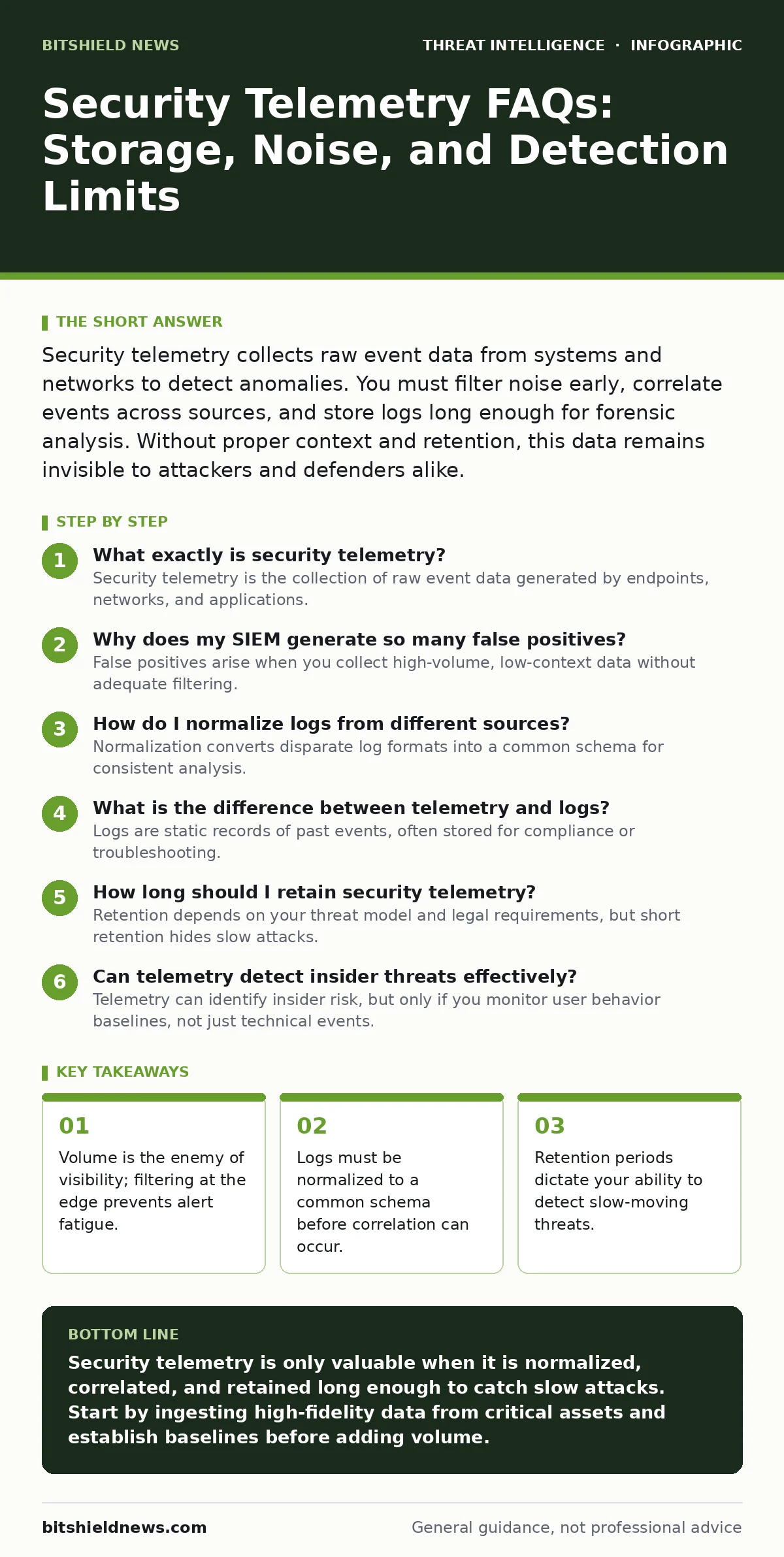
Security telemetry collects raw event data from systems and networks to detect anomalies. You must filter noise early, correlate events across sources, and store logs long enough for forensic analysis. Without proper context and retention, this data remains invisible to attackers and defenders alike.
What exactly is security telemetry?
Security telemetry is the collection of raw event data generated by endpoints, networks, and applications. It includes login attempts, file modifications, process executions, and network connections. This data exists independently of any alerting system. It is the raw material that security teams analyze to reconstruct past events. Without it, you are operating blind to what happens inside your infrastructure.
Why does my SIEM generate so many false positives?
False positives arise when you collect high-volume, low-context data without adequate filtering. A single failed login is normal; ten thousand from one IP is not. If your system treats every event as equally significant, you drown in noise. You must define baseline behavior for your environment. Deviations from this baseline trigger meaningful alerts rather than generic warnings.
How do I normalize logs from different sources?
Normalization converts disparate log formats into a common schema for consistent analysis. Windows Event Logs differ structurally from Linux syslog entries or firewall netflow data. You map fields from each source to standard categories like source IP, destination IP, and user identity. This allows you to correlate an endpoint alert with a network block. Without normalization, automated correlation rules fail to match related events.
What is the difference between telemetry and logs?
Logs are static records of past events, often stored for compliance or troubleshooting. Telemetry implies active, real-time monitoring and streaming of data for immediate analysis. Logs answer what happened yesterday. Telemetry answers what is happening right now. Both are necessary, but they serve different operational goals. Telemetry feeds detection engines; logs feed forensic investigations.
How long should I retain security telemetry?
Retention depends on your threat model and legal requirements, but short retention hides slow attacks. Advanced adversaries often dwell in networks for months before exfiltrating data. If you purge logs after thirty days, you erase the evidence of their initial access. You need long-term cold storage for forensic history. Keep high-fidelity data accessible for recent incident triage.
| Data Type | Retention Goal | Storage Cost | Primary Use Case |
|---|---|---|---|
| Real-time Streams | Days to Weeks | High | Active detection and alerting |
| Normalized Logs | Months | Medium | Correlation and trend analysis |
| Raw Archives | Years | Low | Forensic investigation and compliance |
See also: How Do Honeypots Work: Mechanism, Failures, and Detection Data · How Do I Know If Sysmon Is Installed: Verification and Blind Spots
Can telemetry detect insider threats effectively?
Telemetry can identify insider risk, but only if you monitor user behavior baselines, not just technical events. An insider knows the system, so they avoid triggering standard network alerts. You must look for anomalies in data access patterns, such as unusual file downloads or off-hours activity. Context matters more than the raw event here. A user accessing files at 3 AM is suspicious if they never work late.
What is the hidden cost of collecting more data?
The cost is not just storage; it is the cognitive load required to process the signal-to-noise ratio. More data requires more engineering resources to parse, normalize, and store. It also increases the attack surface for log injection attacks. Attackers may manipulate logs to hide their tracks if you trust the data blindly. You must validate the integrity of your telemetry pipeline. Collecting everything is a strategy that leads to paralysis.
How does telemetry help with lateral movement detection?
Lateral movement involves an attacker moving from one compromised host to another. Telemetry captures the authentication requests and network connections between these hosts. By correlating login events with network flow data, you can see the path of compromise. This is critical for stopping DCSync attacks, which abuse authentication protocols to extract credentials. Without endpoint and network telemetry combined, these moves look like normal admin activity.
Why do some attacks evade telemetry collection?
Some attacks operate below the level of standard logging, or they target the telemetry pipeline itself. If an attacker compromises the log collector, they can suppress or alter the data you receive. This is why you need redundant collection paths and immutable storage. You should also monitor the health of your telemetry agents. A gap in data collection is often a sign of an active breach.
How do I start building a telemetry strategy?
Begin by identifying your crown jewels and the data sources that protect them. Do not try to ingest every log available immediately. Start with high-fidelity data from endpoints and network boundaries. Establish a baseline of normal behavior before adding complex detection rules. Review your strategy regularly to ensure it covers new attack vectors. This approach prevents overwhelm and ensures actionable intelligence.
Key takeaways
- Volume is the enemy of visibility; filtering at the edge prevents alert fatigue.
- Logs must be normalized to a common schema before correlation can occur.
- Retention periods dictate your ability to detect slow-moving threats.
Security telemetry is only valuable when it is normalized, correlated, and retained long enough to catch slow attacks. Start by ingesting high-fidelity data from critical assets and establish baselines before adding volume.
Frequently asked questions
How is telemetry different from network detection and response?
Telemetry is the raw data collection layer, while network detection and response uses that data to actively identify and stop threats. One feeds the other.
Can telemetry help against fast flux DNS attacks?
Yes, by correlating DNS query logs with network connection data, you can identify rapid IP changes associated with fast flux DNS campaigns.
What is the risk of AS-REP roasting in telemetry?
AS-REP roasting generates specific authentication requests that leave traces in domain controller logs, allowing you to detect the attempt if monitored.
How does this relate to incident triage?
High-quality telemetry provides the context needed for efficient incident triage, reducing the time spent verifying false positives.
How this guide was produced: written by the BitShield News editorial team with AI assistance, checked against the public references listed below, and reviewed when the facts change. See our editorial policy or report an error.