DCSync is an attack that mimics legitimate replication between servers. It allows an attacker with specific permissions to request password hashes from any user account. This bypasses many traditional defenses because the traffic looks like standard system maintenance.
The Master Key Analogy
Imagine a large office building where every door requires a key. Instead of carrying thousands of individual keys, the building manager holds a master key that can open every lock. This master key is the directory service in your network. It stores the digital equivalents of every user’s credentials. DCSync is not a break-in. It is the act of walking up to the manager, showing a valid ID badge, and asking for a copy of the master key. The manager hands it over because the request appears legitimate. The attacker now has the ability to open every door, not by picking locks, but by possessing the authority to do so.
How Replication Becomes a Weapon
In a healthy environment, servers share data to stay synchronized. This process is called replication. One server asks another for updates, and the other provides them. DCSync abuses this trusted relationship. The attacker configures their machine to act like a legitimate server. They send a replication request to the domain controller. The controller, believing it is talking to a peer, sends the requested data. This data includes password hashes. A hash is a scrambled version of a password that the system uses for verification. With the hash, the attacker can authenticate as the user without knowing the actual password.
The Hidden Cost of Trust
The danger of DCSync lies in its invisibility. Because it uses standard protocols, it often bypasses basic firewall rules. Firewalls are designed to block unauthorized traffic. They are not designed to stop authorized traffic that is being misused. If an attacker has the right permissions, the replication traffic looks identical to normal system health checks. This is why network detection and response systems must be tuned to look for anomalies in replication frequency or source, not just open ports. Without this depth, the theft of credentials leaves no trace in standard logs.
Glossary of Terms
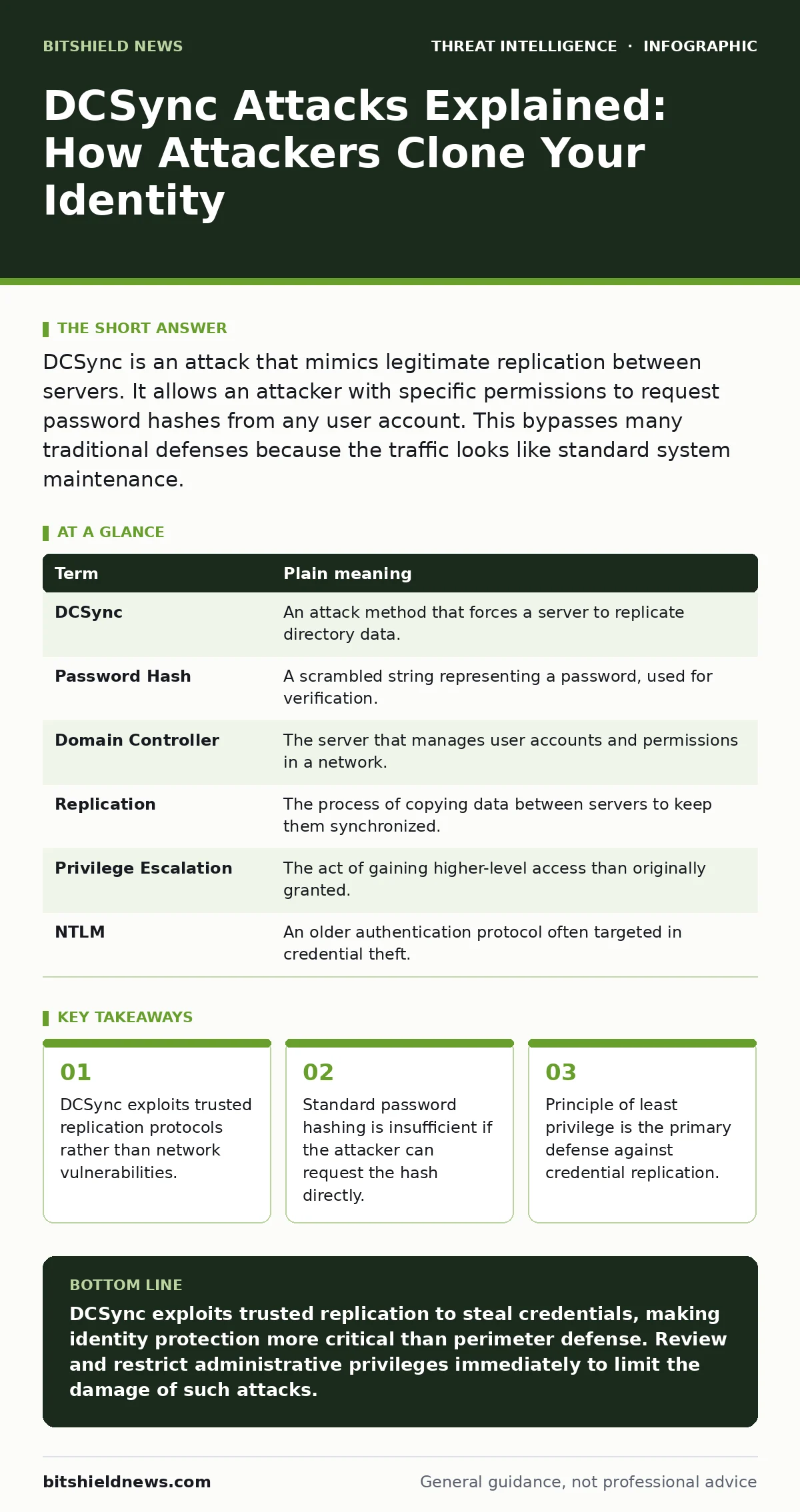
| Term | Plain meaning |
|---|---|
| DCSync | An attack method that forces a server to replicate directory data. |
| Password Hash | A scrambled string representing a password, used for verification. |
| Domain Controller | The server that manages user accounts and permissions in a network. |
| Replication | The process of copying data between servers to keep them synchronized. |
| Privilege Escalation | The act of gaining higher-level access than originally granted. |
| NTLM | An older authentication protocol often targeted in credential theft. |
Why Ordinary Users Feel the Impact
You might wonder how a server-level attack affects your daily work. The impact is indirect but severe. If an attacker steals the hash of a high-level administrator, they can move freely through the network. This is known as lateral movement. They can access email, file shares, and sensitive databases. For the ordinary user, this means your data is exposed. Your identity can be used to approve fraudulent transactions or exfiltrate confidential information. You may not see the attack, but you will feel the consequences when access is revoked or data is lost.
See also: Conditional Access Policies: How Zero Trust Controls Work in Practice · Credential Stuffing Risks and Protection for Small Businesses
Simple Safety Habits
You can reduce your risk by adopting specific habits. First, ensure your accounts follow the principle of least privilege. You should only have access to the systems necessary for your job. Second, enable multi-factor authentication. Even if an attacker has your password hash, they cannot bypass the second factor, such as a hardware token or biometric check. Third, monitor for unusual login locations. If you see activity from a country you have never visited, report it immediately. These steps do not stop DCSync, but they limit what an attacker can do with stolen credentials.
Try This Now
- Audit your permissions. Check if you have administrative rights on your local machine. If you do not need them, request their removal.
- Enable multi-factor authentication. Ensure it is active on all accounts that access sensitive data, especially email and cloud services.
- Review recent login activity. Look for sessions from unfamiliar devices or locations and report them to your security team.
The Limits of Technical Controls
No single tool stops DCSync completely. Security telemetry helps you see if replication is happening too often, but it does not prevent it. Incident triage is needed after the fact to determine the scope of the breach. Even advanced measures like AS-REP roasting protections do not address the core issue of excessive privileges. The most effective control is administrative. Regularly review who has the right to replicate directory data. Remove any accounts that do not need this capability. This reduces the attack surface significantly.
Key takeaways
- DCSync exploits trusted replication protocols rather than network vulnerabilities.
- Standard password hashing is insufficient if the attacker can request the hash directly.
- Principle of least privilege is the primary defense against credential replication.
DCSync exploits trusted replication to steal credentials, making identity protection more critical than perimeter defense. Review and restrict administrative privileges immediately to limit the damage of such attacks.
Frequently asked questions
Can antivirus software detect a DCSync attack?
Traditional antivirus software often misses DCSync because it looks like legitimate system behavior. You need specialized endpoint detection tools.
Does changing passwords stop DCSync?
Changing passwords does not stop the attack itself. The attacker steals the hash, which remains valid until the next replication or password change.
Is DCSync legal to test on my own network?
Yes, if you own the network and have explicit permission. Unauthorized testing is illegal and can cause system instability.
How is DCSync different from other credential theft?
DCSync does not intercept traffic or exploit software bugs. It abuses the legitimate replication mechanism of the directory service.
How this guide was produced: written by the BitShield News editorial team with AI assistance, checked against the public references listed below, and reviewed when the facts change. See our editorial policy or report an error.