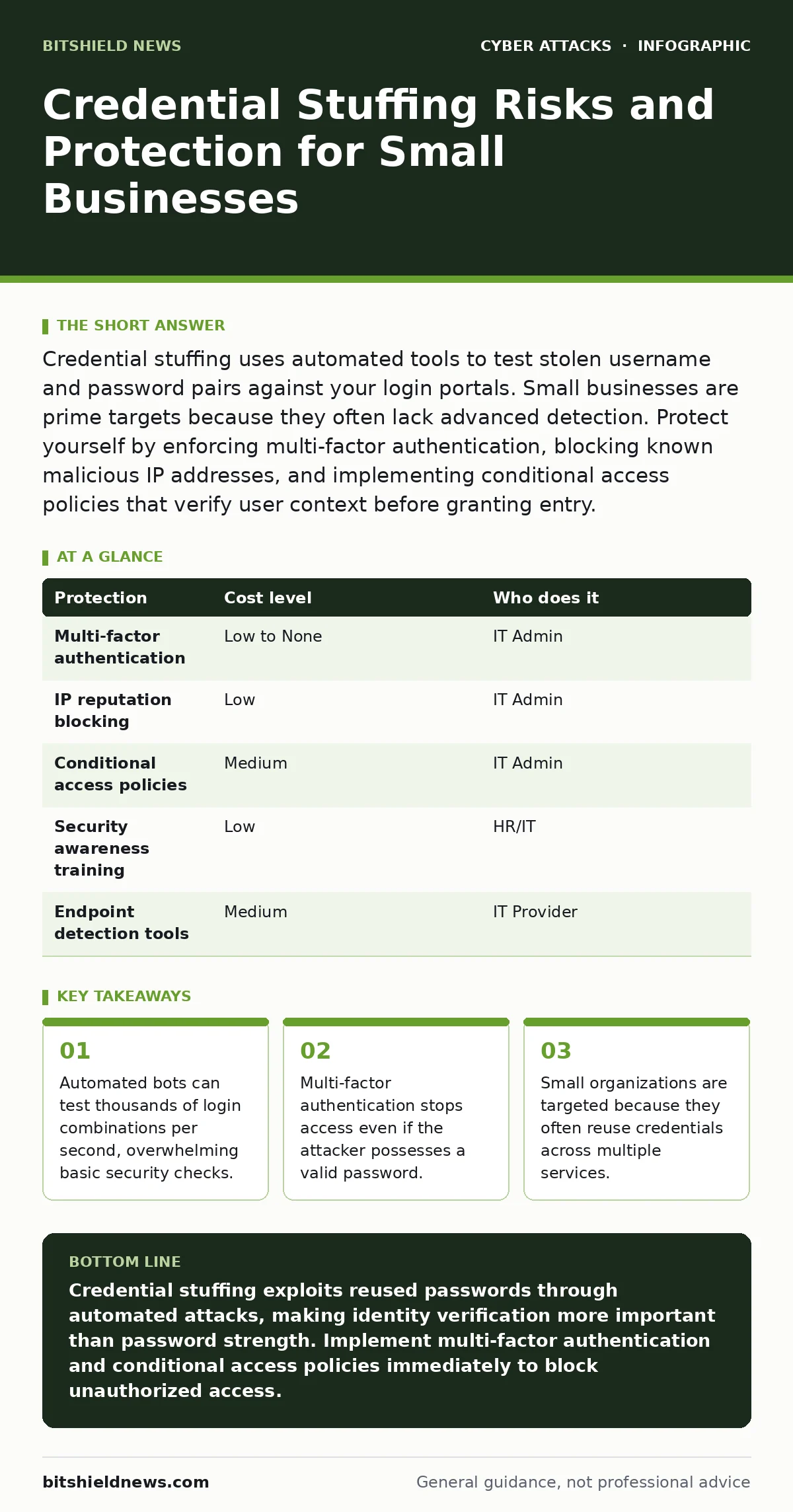
Credential stuffing uses automated tools to test stolen username and password pairs against your login portals. Small businesses are prime targets because they often lack advanced detection. Protect yourself by enforcing multi-factor authentication, blocking known malicious IP addresses, and implementing conditional access policies that verify user context before granting entry.
The Silent Entry Point
This scenario illustrates credential stuffing, a technique where attackers use automated software to test large numbers of stolen username and password pairs against a target website or application. The term "stuffing" refers to the rapid, mechanical insertion of these credential sets into login forms. Unlike brute force attacks, which guess passwords randomly, credential stuffing relies on the fact that many users reuse the same credentials across different platforms.
If a user’s email was compromised in a distant data breach, the attacker already has the key. They do not need to break your security; they only need to verify that the key works on your door. This method is particularly effective against small organizations that may not monitor for unusual login patterns or enforce strict identity verification.
Why Small Organizations Are Exposed
Small businesses often operate under the assumption that they are too insignificant to attract sophisticated cybercriminals. This belief creates a dangerous blind spot. Attackers use automated tools that do not discriminate based on company size or revenue. They cast a wide net, testing credentials against thousands of websites simultaneously.
The exposure stems from three primary factors. First, resource constraints often mean small teams lack dedicated security operations centers to monitor login traffic in real time. Second, there is a high reliance on shared credentials or simple password management practices among staff. Third, many small organizations fail to implement conditional access policies, which are rules that evaluate the context of a login attempt, such as the device used or the geographic location, before granting access.
Without these contextual checks, a login from a new country or an unrecognized device looks identical to a legitimate login from the office. The system sees a valid password and opens the door. This lack of friction allows attackers to maintain persistence within the network for extended periods.
The Mechanics of the Attack
Understanding the mechanism helps you appreciate the speed at which these attacks occur. Credential stuffing bots are designed to mimic human behavior to avoid basic detection triggers. They rotate IP addresses, use residential proxy networks, and simulate normal mouse movements and typing speeds.
This sophistication means that simple rate limiting, which restricts the number of login attempts from a single IP address, is often insufficient. Attackers distribute their attempts across thousands of unique IP addresses, ensuring that no single source exceeds the threshold. This distribution makes the traffic appear organic and legitimate to basic security filters.
Furthermore, these bots often target less secure entry points. They may not attack the main corporate portal but instead target customer-facing applications, partner portals, or third-party integrations. These secondary systems often have weaker security postures, providing a foothold for lateral movement into the core network. Once inside, the attacker can harvest data, deploy ransomware, or initiate financial fraud.
Low-Cost Protections That Work
You do not need an enterprise-grade security budget to mitigate credential stuffing. Several high-impact controls are available at little to no cost. The most effective defense is multi-factor authentication. This requires users to provide a second form of verification, such as a code from an authenticator app or a hardware token, in addition to their password.
Even if the attacker has the correct password, they cannot complete the login without the second factor. This single measure neutralizes the vast majority of credential stuffing attacks. Another low-cost strategy is to block logins from known malicious IP ranges. Many free threat intelligence feeds provide lists of IP addresses associated with botnets and credential stuffing campaigns.
Implementing account lockout policies can also help, but this must be balanced carefully. If the threshold is too low, legitimate users may lock themselves out, creating support tickets and frustration. If it is too high, it offers little protection. A balanced approach involves temporary lockouts that require identity verification to reset, rather than permanent bans that can be exploited for denial of service.
| Protection | Cost level | Who does it |
|---|---|---|
| Multi-factor authentication | Low to None | IT Admin |
| IP reputation blocking | Low | IT Admin |
| Conditional access policies | Medium | IT Admin |
| Security awareness training | Low | HR/IT |
| Endpoint detection tools | Medium | IT Provider |
What to Ask an IT Provider
If you outsource your IT management, you must ensure your provider is actively defending against automated attacks. Many managed service providers focus on keeping systems running rather than securing identity. You need to verify that identity protection is part of their standard offering.
Ask your provider specific questions about their monitoring and response capabilities. Do not accept vague assurances about "standard security." You need to know the specific mechanisms they use to detect and block credential stuffing.
- How do you distinguish between a legitimate user logging in from a new location and a credential stuffing bot?
- Do you implement conditional access policies that require multi-factor authentication for risky sign-ins?
- What is your process for identifying and blocking IP addresses associated with known credential stuffing campaigns?
- How quickly can you detect a successful compromise and revoke access across all connected services?
- Do you provide regular security awareness training to help staff recognize signs of account takeover?
These questions reveal whether your provider is using modern identity security practices or relying on outdated perimeter defenses. If they cannot answer these specifically, you may be exposed to risks that are easy to mitigate but require proactive configuration.
See also: DCSync Attacks Explained: How Attackers Clone Your Identity · Conditional Access Policies: How Zero Trust Controls Work in Practice
Beyond the Login Screen
Securing the login is only the first step. Once an attacker gains access, they often move laterally to other systems. This is where the principle of least privilege becomes critical. Ensure that user accounts have only the permissions necessary for their role. A marketing intern should not have administrative access to the financial system.
Regularly review user permissions and remove access for former employees immediately. Dormant accounts are a common entry point for attackers who gain access and wait for an opportunity. Additionally, consider conducting tabletop exercises to simulate a credential stuffing attack. This helps your team understand the response process and identify gaps in your detection and recovery plans.
The Hidden Cost of Inaction
The cost of a credential stuffing attack extends beyond immediate data loss. It includes the time spent investigating the incident, resetting credentials, and restoring trust with customers. For small businesses, this disruption can be existential.
Furthermore, if your customers’ data is exposed due to reused credentials, you may face regulatory penalties and reputational damage. The assumption that "nothing bad will happen to us" is a liability. Proactive investment in identity security is far less expensive than the aftermath of a breach.
Key takeaways
- Automated bots can test thousands of login combinations per second, overwhelming basic security checks.
- Multi-factor authentication stops access even if the attacker possesses a valid password.
- Small organizations are targeted because they often reuse credentials across multiple services.
Credential stuffing exploits reused passwords through automated attacks, making identity verification more important than password strength. Implement multi-factor authentication and conditional access policies immediately to block unauthorized access.
Frequently asked questions
Can a VPN stop credential stuffing?
No, a VPN encrypts traffic but does not verify identity. If an attacker has valid credentials, they can still log in through a VPN. You need multi-factor authentication to stop this.
Does changing passwords frequently help?
Frequent password changes are less effective than using unique passwords for each service. If a password is not reused, credential stuffing fails regardless of how often you change it.
What is the difference between credential stuffing and brute force?
Brute force guesses passwords randomly, while credential stuffing uses known stolen credentials. Stuffing is faster and more likely to succeed because it relies on real, valid password pairs.
Should I block all international logins?
Blocking all international logins can disrupt legitimate business operations. Instead, use conditional access to require additional verification for logins from unexpected locations or devices.
How this guide was produced: written by the BitShield News editorial team with AI assistance, checked against the public references listed below, and reviewed when the facts change. See our editorial policy or report an error.