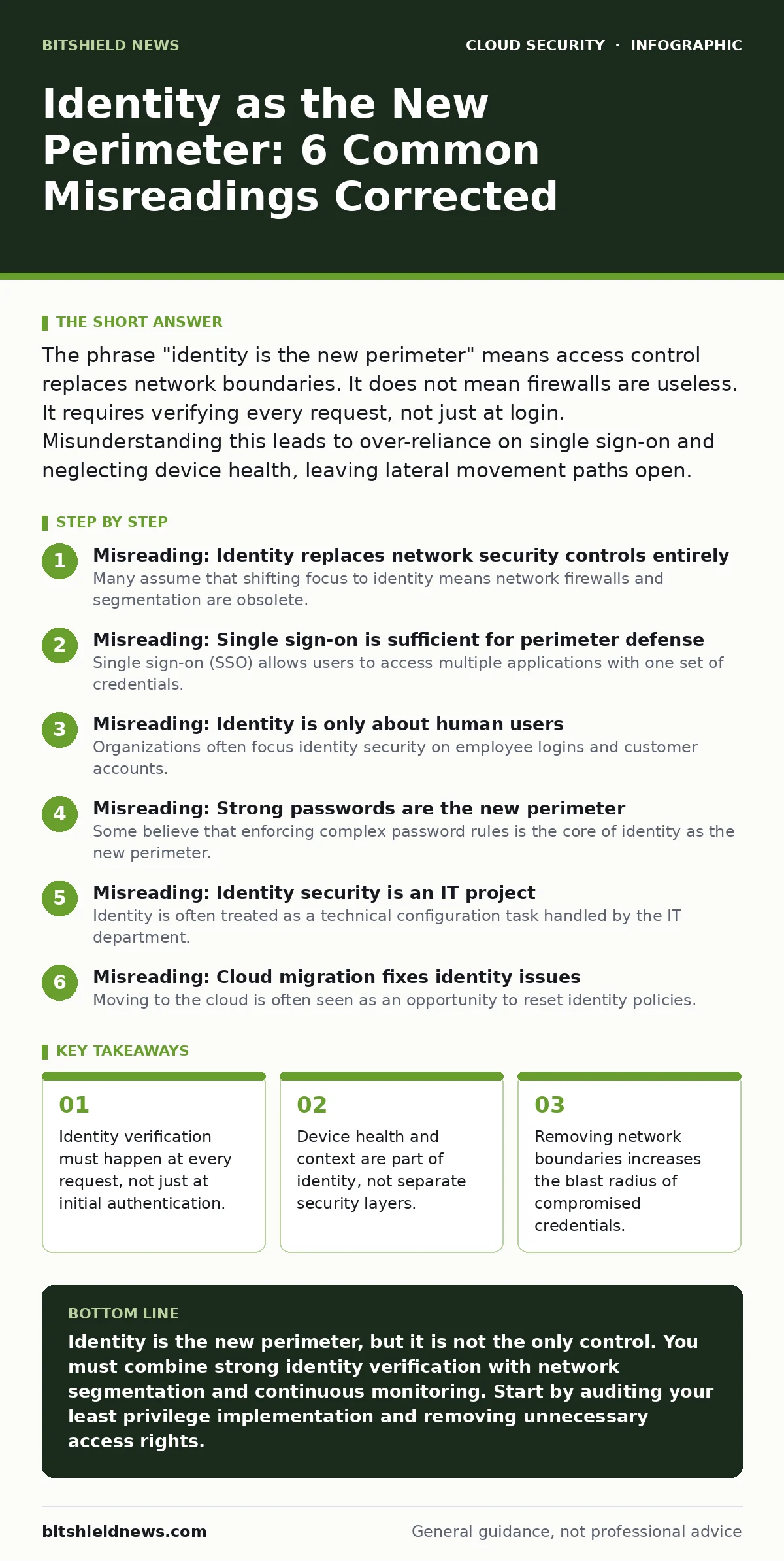
The phrase "identity is the new perimeter" means access control replaces network boundaries. It does not mean firewalls are useless. It requires verifying every request, not just at login. Misunderstanding this leads to over-reliance on single sign-on and neglecting device health, leaving lateral movement paths open.
Misreading: Identity replaces network security controls entirely
Many assume that shifting focus to identity means network firewalls and segmentation are obsolete. This is a dangerous reduction. Identity management determines who is authorized to act. Network controls determine where that action can reach. If you remove network segmentation because you trust the identity, you give a compromised account unrestricted movement across your entire infrastructure. The perimeter has moved to the identity, but the network remains the highway that identity travels on. You must secure both.
Correct reading: Identity is the primary gatekeeper, but network segmentation remains the damage containment mechanism. When a credential is stolen, strong identity policies stop unauthorized entry. If that entry occurs, network controls limit how far the attacker can travel. You need zero trust principles to verify the request and network isolation to limit the impact.
Misreading: Single sign-on is sufficient for perimeter defense
Single sign-on (SSO) allows users to access multiple applications with one set of credentials. Many treat SSO as the complete solution for identity security. SSO improves user experience and centralizes authentication logs. It does not enforce conditional access or verify device health. An attacker with valid SSO credentials can access all connected applications if no further checks exist. SSO is a convenience layer, not a security boundary. It centralizes the target rather than dispersing risk.
Correct reading: SSO must be paired with multi-factor authentication and conditional access policies. The identity perimeter requires verifying the context of the login, not just the password. This includes checking the device posture, geographic location, and time of access. Without these layers, SSO becomes a single point of failure that amplifies the value of stolen credentials.
Misreading: Identity is only about human users
Organizations often focus identity security on employee logins and customer accounts. They neglect service accounts, automated scripts, and application-to-application communication. These non-human identities often have elevated privileges and lack behavioral monitoring. A compromised service account can exfiltrate data silently because it does not trigger human-centric alerts. The volume of non-human identities often exceeds human ones in cloud environments. Ignoring them leaves a massive blind spot in your perimeter.
Correct reading: Every entity that accesses your resources has an identity. This includes servers, APIs, and automation tools. You must apply the same least privilege principles to non-human identities as you do to humans. Rotate credentials regularly, monitor for anomalous usage patterns, and ensure these identities cannot access resources they do not need for their specific function.
Misreading: Strong passwords are the new perimeter
Some believe that enforcing complex password rules is the core of identity as the new perimeter. Passwords are static secrets that can be stolen, guessed, or phished. They provide a one-time check at the beginning of a session. They do not verify that the same user is still present or that the device has not been compromised during the session. Relying on passwords ignores the reality of credential stuffing and replay attacks. The perimeter must be dynamic, not static.
Correct reading: Move beyond static secrets to continuous authentication. Use factors that are harder to steal, such as hardware keys or biometrics tied to the device. Implement session monitoring that checks for changes in behavior or context. If a user suddenly accesses sensitive data from a new country or a new device, the system should challenge the identity again. The perimeter is a continuous conversation, not a single handshake.
Misreading: Identity security is an IT project
Identity is often treated as a technical configuration task handled by the IT department. This leads to siloed policies that do not reflect business risk. Security teams implement controls, but business units define which data is sensitive. If IT does not understand the business context, they may over-permit access to critical assets. Conversely, they may block legitimate workflows, causing users to bypass security controls. Identity security requires alignment between technical implementation and business value.
Correct reading: Treat identity management as a business process. Define data classification and access needs by business unit. IT implements the technical controls to enforce these business rules. Regular reviews ensure that access rights match current job functions. This collaboration ensures that the identity perimeter protects what matters without hindering productivity.
See also: Conditional Access Policies: How Zero Trust Controls Work in Practice · Credential Stuffing Risks and Protection for Small Businesses
Misreading: Cloud migration fixes identity issues
Moving to the cloud is often seen as an opportunity to reset identity policies. Organizations assume cloud providers handle identity security automatically. Cloud providers secure the infrastructure, not your data or your access policies. Misconfigured identity permissions in the cloud are a leading cause of data exposure. The shift to cloud increases the complexity of identity management due to the scale and dynamic nature of resources. You cannot assume the cloud environment is secure by default.
Correct reading: Cloud environments require stricter identity controls than on-premises systems. Use cloud guardrails to enforce consistent security standards across all accounts. Implement least privilege access for every user and service. Regularly audit permissions to remove unnecessary access. The cloud scales your identity surface area, so your controls must scale with it.
Misreading: Zero trust is a product you buy
Many look for a "zero trust" appliance or software suite to solve identity issues. Zero trust is an architectural framework, not a product. It is a set of principles: verify explicitly, apply least privilege, and assume breach. No single vendor provides a complete zero trust solution. Trying to buy it leads to fragmented implementations and gaps in coverage. You must design your systems to enforce these principles continuously.
Correct reading: Adopt the zero trust mindset across your entire technology stack. Evaluate every tool and process against the principle of never trusting, always verifying. Integrate identity verification into application logic, network access, and data storage. This approach ensures that even if one control fails, others remain in place to protect your assets.
Misreading: Identity is static and unchanging
Identity is often viewed as a fixed attribute: a user has a role, and that role grants access. In reality, identity is dynamic. A user’s risk level changes based on their behavior, device health, and location. A static identity model cannot adapt to these changes. It grants permanent access until an administrator manually revokes it. This lag allows attackers to operate within the perimeter for extended periods. Your security controls must react to real-time changes.
Correct reading: Implement adaptive identity policies. Use machine learning to detect anomalies in user behavior. Adjust access levels dynamically based on risk scores. If a user’s device shows signs of malware, restrict their access automatically. This dynamic approach ensures that the perimeter adjusts to the current threat level, not the historical norm.
How to check your understanding
Review your current identity policies. Ask yourself: Do I verify identity at every request, or just at login? Do I monitor non-human identities? Are my access controls based on business risk? If the answer to any of these is no, you are misreading the perimeter. Adjust your strategy to focus on continuous verification and least privilege.
Key takeaways
- Identity verification must happen at every request, not just at initial authentication.
- Device health and context are part of identity, not separate security layers.
- Removing network boundaries increases the blast radius of compromised credentials.
- Least privilege must be applied to data objects, not just user accounts.
Identity is the new perimeter, but it is not the only control. You must combine strong identity verification with network segmentation and continuous monitoring. Start by auditing your least privilege implementation and removing unnecessary access rights.
Frequently asked questions
Does identity as the new perimeter mean I can remove my firewall?
No. Firewalls and network segmentation provide critical defense-in-depth. They limit lateral movement if an identity is compromised. Identity controls prevent unauthorized entry, but network controls contain the damage.
How do I protect service accounts in the cloud?
Apply least privilege principles to service accounts. Rotate credentials frequently and monitor for unusual activity. Avoid using long-lived static keys where possible. Use short-lived tokens generated by identity providers.
Is multi-factor authentication enough for identity security?
MFA is a strong control, but it is not sufficient on its own. You must also implement conditional access, least privilege, and continuous monitoring. MFA verifies who you are at login, but other controls verify what you are allowed to do.
How often should I review user access rights?
Review access rights regularly, ideally quarterly or upon role changes. Automated tools can help identify unused permissions. Remove access that is no longer needed to reduce the attack surface.
How this guide was produced: written by the BitShield News editorial team with AI assistance, checked against the public references listed below, and reviewed when the facts change. See our editorial policy or report an error.