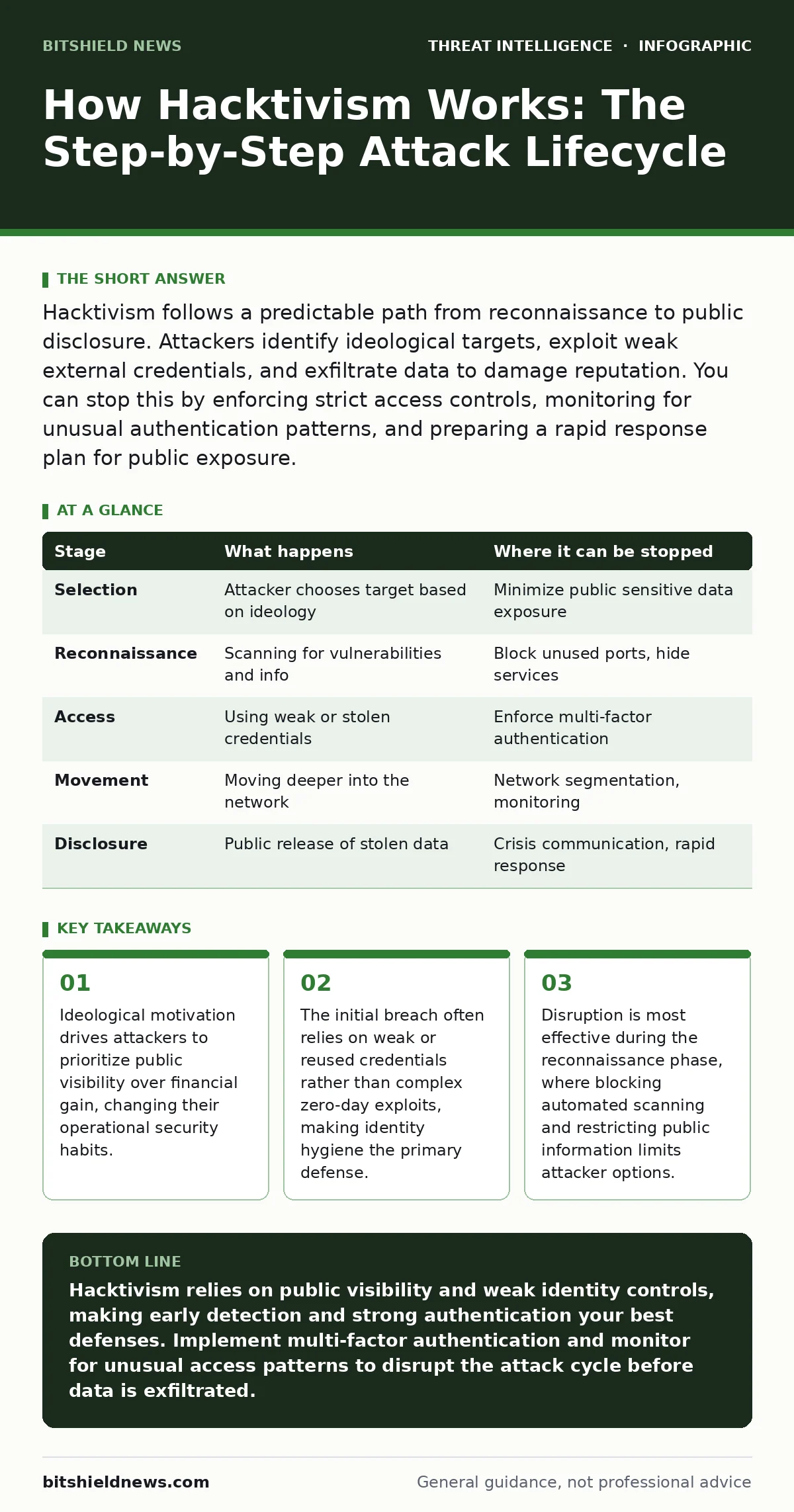
Hacktivism follows a predictable path from reconnaissance to public disclosure. Attackers identify ideological targets, exploit weak external credentials, and exfiltrate data to damage reputation. You can stop this by enforcing strict access controls, monitoring for unusual authentication patterns, and preparing a rapid response plan for public exposure.
Defining the Ideological Attack Vector
Hacktivism differs from cybercrime because the objective is political or social change, not financial theft. This motivation alters the attacker’s behavior significantly. They often operate in plain sight, using public channels to coordinate and announce their actions. You must understand that these actors prioritize speed and visibility over stealth. They want you to know they were there.
This transparency creates a unique defensive opportunity. Because they announce their methods and targets, you can often detect their presence before the full impact lands. However, their willingness to use publicly available tools means they can scale attacks quickly. They do not need sophisticated infrastructure. They rely on the openness of the internet and the complacency of target organizations.
Stage 1: Ideological Target Selection
The process begins with the attacker choosing a victim that aligns with their cause. They scan news outlets, social media, and public records to find organizations involved in controversial activities. This is not random. They look for entities with a large public footprint and a history of public relations vulnerabilities.
During this phase, the attacker gathers intelligence on the organization’s digital presence. They map out key executives, public statements, and technical infrastructure. This information helps them tailor their message and select the most damaging data to expose. You can disrupt this stage by minimizing the amount of sensitive information available in public directories.
Stage 2: Technical Reconnaissance
Once a target is selected, the attacker moves to technical discovery. They use automated tools to scan the organization’s external network for open ports, misconfigured services, and outdated software. This is where network enumeration becomes critical for the defender. The attacker is looking for any entry point that requires minimal effort.
They often focus on web applications and email servers. These systems are exposed to the public internet and frequently contain vulnerabilities. The attacker may also look for employee information to craft targeted phishing messages. They check for leaked credentials on dark web forums. If they find a valid username and password, they may skip further technical probing entirely.
You can interrupt this stage by hiding unnecessary services from the public internet. Use firewalls to block unused ports and ensure all public-facing applications are patched. Limit the exposure of employee data in public directories. This reduces the surface area available for automated scanning.
Stage 3: Initial Access and Credential Exploitation
Hacktivists rarely use complex, custom malware for initial access. They prefer low-effort, high-success methods. They often use AS-REP roasting or similar techniques to harvest credentials from directory services. If the organization has weak password policies, the attacker can crack these hashes offline.
They may also use stolen credentials from other breaches. Password reuse is a common vulnerability. Once they have a valid login, they access the system as a legitimate user. This bypasses many perimeter defenses. The attacker does not need to break in; they simply walk through an unlocked door.
This stage relies on the flaw of human behavior and poor policy enforcement. You can stop this by enforcing multi-factor authentication everywhere. Even if the attacker has the password, they cannot log in without the second factor. Regularly audit user accounts and remove access for employees who no longer need it.
Stage 4: Lateral Movement and Data Staging
After gaining initial access, the attacker moves deeper into the network. They look for systems with more privileges or sensitive data. This is lateral movement. They may use DCSync attacks to replicate domain controller data, allowing them to create new administrative accounts.
They stage the data they want to leak. They look for documents, emails, or internal communications that will cause reputational damage. They often compress and encrypt this data before exfiltration. This makes it harder for defenders to detect the theft in real-time. The attacker may spend days or weeks in this phase, gathering enough material for a significant impact.
You can interrupt this stage by implementing strict network segmentation. Limit which systems can communicate with each other. Monitor for unusual access patterns, such as a user accessing files they never touch. Network detection and response tools can help identify these anomalies.
See also: Conditional Access Policies: How Zero Trust Controls Work in Practice · Credential Stuffing Risks and Protection for Small Businesses
Stage 5: Exfiltration and Public Disclosure
The final stage is the release of the stolen data. The attacker uploads the data to a public website or social media platform. They often include a manifesto explaining their motives. This is the moment of maximum visibility. The goal is to cause reputational harm and force the organization to change its behavior.
The attacker may also deface the organization’s website or disrupt services. This adds pressure and draws more attention. The speed of this phase varies. Some attackers release data immediately, while others hold it for leverage. The public nature of this stage means you will know quickly if you are targeted.
You cannot always prevent the disclosure if the data is already stolen. However, you can mitigate the impact. Have a crisis communication plan ready. Prepare statements that address the situation calmly and factually. Acknowledge the breach and outline the steps you are taking to secure the environment.
Disruption and Incident Response
Stopping hacktivism requires a proactive approach. You must assume that your external systems are under constant surveillance. Harden your identity management. Enforce strong authentication policies. Monitor for signs of reconnaissance and unauthorized access.
When an incident occurs, speed is critical. Begin incident triage immediately. Isolate affected systems to prevent further lateral movement. Preserve evidence for forensic analysis. Communicate with your stakeholders promptly. Transparency can help maintain trust, even in a crisis.
| Stage | What happens | Where it can be stopped |
|---|---|---|
| Selection | Attacker chooses target based on ideology | Minimize public sensitive data exposure |
| Reconnaissance | Scanning for vulnerabilities and info | Block unused ports, hide services |
| Access | Using weak or stolen credentials | Enforce multi-factor authentication |
| Movement | Moving deeper into the network | Network segmentation, monitoring |
| Disclosure | Public release of stolen data | Crisis communication, rapid response |
The Hidden Cost of Visibility
A non-obvious consequence of hacktivism is the erosion of trust. Even if you recover your data, the public perception may remain damaged. The attacker’s goal is not just to steal data, but to shame the organization. This reputational harm can have long-lasting effects on customer loyalty and partnerships.
Another hidden cost is the distraction. Responding to a hacktivist attack consumes significant resources. Your team must focus on containment and communication rather than innovation. This operational drag can slow down business growth. You must balance security investments with business continuity.
Building a Resilient Defense
You cannot stop all hacktivist attacks. They are motivated, resourceful, and often numerous. However, you can make your organization a harder target. Focus on identity security. Use network detection and response to identify anomalies. Prepare for the worst-case scenario.
Regularly test your incident response plans. Conduct tabletop exercises that simulate a hacktivist attack. Identify gaps in your detection and response capabilities. Update your plans based on the lessons learned. Security is a continuous process, not a one-time fix.
By understanding the lifecycle of hacktivism, you can anticipate the attacker’s moves. You can interrupt the cycle at multiple stages. You can reduce the impact of a breach. Stay calm, act quickly, and communicate clearly.
Key takeaways
- Ideological motivation drives attackers to prioritize public visibility over financial gain, changing their operational security habits.
- The initial breach often relies on weak or reused credentials rather than complex zero-day exploits, making identity hygiene the primary defense.
- Disruption is most effective during the reconnaissance phase, where blocking automated scanning and restricting public information limits attacker options.
Hacktivism relies on public visibility and weak identity controls, making early detection and strong authentication your best defenses. Implement multi-factor authentication and monitor for unusual access patterns to disrupt the attack cycle before data is exfiltrated.
Frequently asked questions
How do I know if I am being targeted by hacktivists?
Look for unusual scanning activity, failed login attempts, and public announcements targeting your organization. Monitor social media and news for ideological campaigns against your industry.
Can multi-factor authentication stop hacktivists?
Yes, multi-factor authentication significantly reduces the success rate of credential-based attacks. It adds a layer of security that is difficult for attackers to bypass without physical access to the user’s device.
What is the difference between hacktivism and ransomware?
Hacktivists seek political or social change and often publish stolen data. Ransomware groups seek financial gain and encrypt data for a ransom. The motivations and methods differ significantly.
Should I take my website offline during an attack?
Only if the website is actively being used to spread malicious content or if it is completely compromised. Otherwise, keep it online to maintain communication and demonstrate resilience.
How this guide was produced: written by the BitShield News editorial team with AI assistance, checked against the public references listed below, and reviewed when the facts change. See our editorial policy or report an error.