
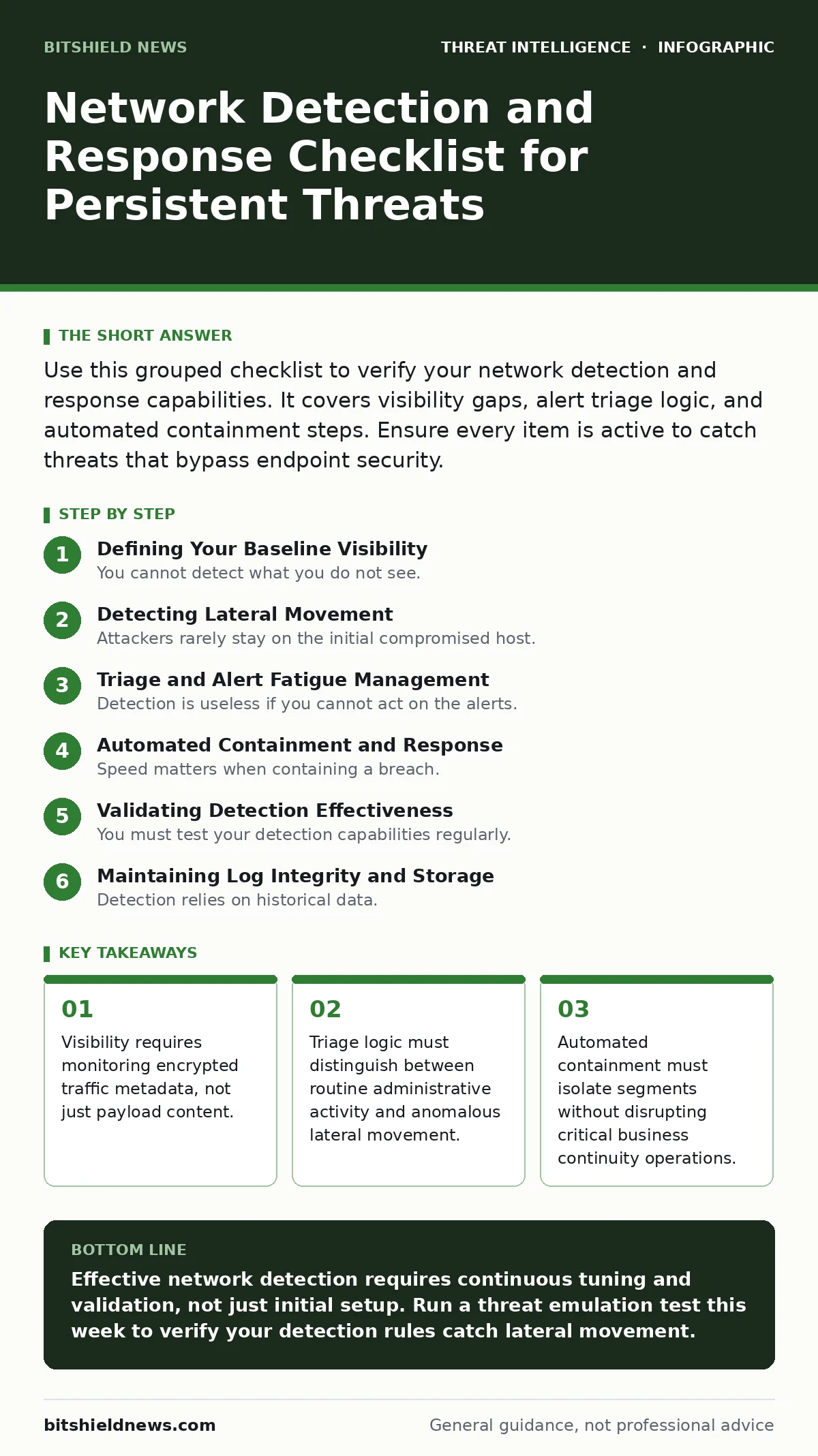
Use this grouped checklist to verify your network detection and response capabilities. It covers visibility gaps, alert triage logic, and automated containment steps. Ensure every item is active to catch threats that bypass endpoint security.
Defining Your Baseline Visibility
You cannot detect what you do not see. Most organizations assume their firewalls provide full visibility, but modern traffic often hides within legitimate protocols. You must establish a baseline of normal behavior for every user, device, and application. This baseline allows your systems to flag deviations that indicate compromise.
- Ingest NetFlow or IPFIX data: These protocols provide metadata about traffic volume and direction without decrypting payloads, revealing unusual data transfers.
- Monitor DNS query logs: Command and control servers often use domain generation algorithms that create random-looking hostnames.
- Capture full packet captures for critical segments: Metadata reveals trends, but only packet data reveals the specific malware signature or exploit payload.
- Integrate endpoint logs with network data: Network alerts gain context when correlated with process creation events on the host.
Detecting Lateral Movement
Attackers rarely stay on the initial compromised host. They move laterally to reach high-value assets like domain controllers or databases. Your detection rules must focus on internal-to-internal traffic, which is often trusted and less scrutinized.
Imagine an attacker who has gained access to a workstation. They will attempt to map the internal network and authenticate to other systems. If your alerts only trigger on external threats, you will miss this phase entirely.
- Alert on uncommon SMB or RDP connections: These protocols are standard for administration but rare for casual users, signaling potential remote access.
- Monitor for pass-the-hash attacks: These attacks reuse credential hashes to authenticate without passwords, bypassing traditional login monitoring.
- Detect brute force patterns internally: Repeated failed logins from a single internal source indicate credential dumping or guessing.
- Flag large internal data transfers: Moving terabytes of data between internal servers often precedes exfiltration.
Triage and Alert Fatigue Management
Detection is useless if you cannot act on the alerts. High-volume, low-fidelity alerts cause alert fatigue, leading analysts to ignore real threats. You must tune your detection engine to reduce noise. Prioritize alerts based on the asset’s criticality and the severity of the action.
- Implement user and entity behavior analytics: This machine learning approach identifies anomalies based on historical patterns rather than static signatures.
- Correlate alerts across multiple sources: A single DNS query is noise; a DNS query followed by an unusual outbound connection is a threat.
- Define clear severity levels: Ensure every alert has a predefined response time and required action to streamline prioritization.
- Automate initial enrichment: Automatically pull threat intelligence data and host details to save analyst time during triage.
Automated Containment and Response
Speed matters when containing a breach. Manual response takes too long for fast-moving threats. Your network detection and response system should automate specific containment actions when confidence in an alert is high.
- Isolate compromised hosts automatically: Disconnect the host from the network to prevent lateral movement while preserving forensic data.
- Block malicious IPs at the firewall: Prevent further communication with command and control servers immediately upon detection.
- Disable compromised user accounts: Stop the attacker from using stolen credentials to access other resources.
- Quarantine suspicious files: Move identified malware to a secure location for analysis without deleting evidence.
Validating Detection Effectiveness
You must test your detection capabilities regularly. Assuming your rules work because they were written correctly is a dangerous fallacy. Attackers change their tactics, and your rules must evolve. Use threat emulation to simulate real attacks against your environment.
- Conduct purple team exercises: Collaborate between offensive and defensive teams to identify gaps in detection and response.
- Review false positives regularly: Tune rules to reduce noise and ensure analysts focus on genuine threats.
- Update threat intelligence feeds: Ensure your system recognizes the latest known malicious indicators and tactics.
- Document incident response playbooks: Clear procedures ensure consistent and rapid response during actual incidents.
See also: Detect Ransomware-as-a-Service: Log Signals and Blind Spots
Maintaining Log Integrity and Storage
Detection relies on historical data. If logs are deleted, corrupted, or inaccessible, you lose the ability to investigate past events. You must ensure your logging infrastructure is secure and retains data for sufficient periods.
- Centralize log storage: Aggregate logs from all sources into a single, secure repository for easier correlation and analysis.
- Implement log integrity checks: Ensure logs have not been tampered with by attackers who may attempt to cover their tracks.
- Retain logs for forensic analysis: Keep detailed logs for a period that allows for thorough investigation of complex, slow-moving threats.
- Secure access to log management systems: Restrict access to only authorized personnel to prevent log deletion or manipulation.
Key takeaways
- Visibility requires monitoring encrypted traffic metadata, not just payload content.
- Triage logic must distinguish between routine administrative activity and anomalous lateral movement.
- Automated containment must isolate segments without disrupting critical business continuity operations.
Effective network detection requires continuous tuning and validation, not just initial setup. Run a threat emulation test this week to verify your detection rules catch lateral movement.
Frequently asked questions
How do I reduce false positives in network detection?
Correlate alerts from multiple sources and use behavioral analytics to distinguish between normal administrative tasks and malicious activity.
Can network detection replace endpoint security?
No, they are complementary. Endpoint security prevents execution, while network detection identifies movement and communication that endpoints might miss.
What is the most critical log source for detection?
DNS logs are often the most critical because they reveal communication with command and control servers that other logs might not capture.
How often should I update my detection rules?
Update rules regularly, especially after new threat intelligence is available or after conducting purple team exercises to identify gaps.
How this guide was produced: written by the BitShield News editorial team with AI assistance, checked against the public references listed below, and reviewed when the facts change. See our editorial policy or report an error.