
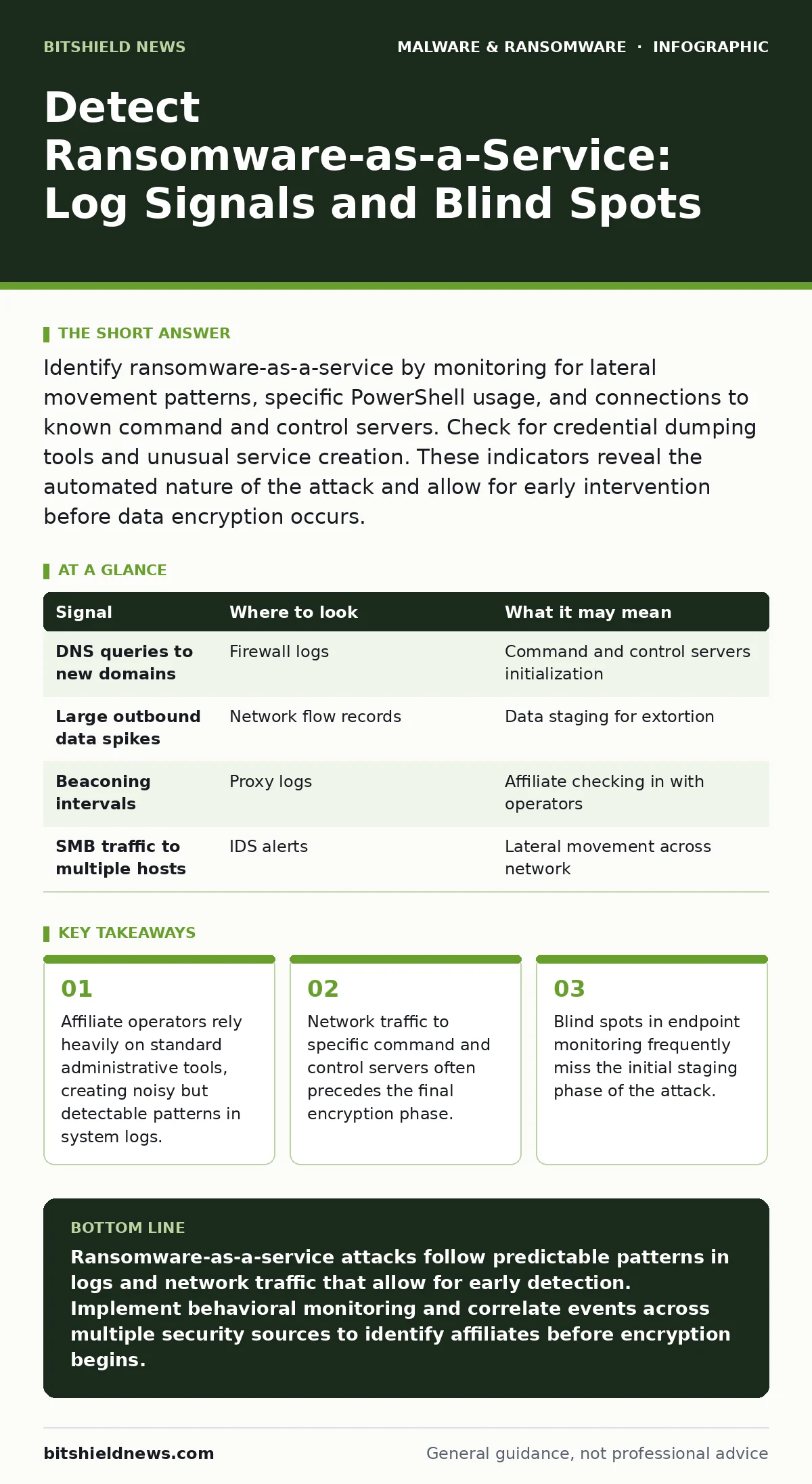
Identify ransomware-as-a-service by monitoring for lateral movement patterns, specific PowerShell usage, and connections to known command and control servers. Check for credential dumping tools and unusual service creation. These indicators reveal the automated nature of the attack and allow for early intervention before data encryption occurs.
Network Traffic Anomalies
Ransomware-as-a-service campaigns generate distinct network signatures during the reconnaissance phase. Operators need to establish communication with their infrastructure before deploying encryption modules. You will see increased outbound traffic to unknown domains or IP addresses. This traffic often uses standard ports to blend in with legitimate activity.
The connection patterns differ from user-initiated web browsing. Traffic flows are short, frequent, and directed at specific endpoints. These connections facilitate data exfiltration or command retrieval. Monitoring for unencrypted connections to new external hosts reveals early-stage activity. You must inspect traffic that bypasses standard web filters.
| Signal | Where to look | What it may mean |
|---|---|---|
| DNS queries to new domains | Firewall logs | Command and control servers initialization |
| Large outbound data spikes | Network flow records | Data staging for extortion |
| Beaconing intervals | Proxy logs | Affiliate checking in with operators |
| SMB traffic to multiple hosts | IDS alerts | Lateral movement across network |
Endpoint Execution Patterns
The execution phase relies on legitimate system utilities to avoid detection. Operators use scripts to automate the deployment of their tools. You will see PowerShell or Bash commands executing without interactive user context. These scripts often decode payloads from encoded strings or remote resources.
Look for process injection techniques where malicious code runs within trusted processes. This method hides the true identity of the executing program. System process trees will show unexpected child processes spawning from standard services. You must monitor for the creation of new scheduled tasks or services.
Affiliates often disable security software before encryption. This appears as commands targeting specific service names or registry keys. The timing of these disabling actions is critical. If security services stop shortly after unusual network activity, an attack is likely in progress.
Credential Access Indicators
Credential theft is a prerequisite for widespread ransomware deployment. Operators need administrative access to move laterally. You will see evidence of credential dumping tools accessing the security account manager. This activity leaves specific registry modifications and file accesses.
Look for processes accessing sensitive memory regions of system services. This behavior extracts passwords and hashes from active sessions. Network authentication logs will show successful logins from unexpected source machines. You must track account usage that deviates from normal administrative patterns.
Lateral Movement Signatures
Once credentials are obtained, affiliates move across the network. This movement follows predictable paths based on permission levels. You will see remote execution commands targeting multiple hosts simultaneously. These commands often use standard protocols like WinRM or SSH.
The speed of lateral movement distinguishes service-based attacks. Automated tools scan for open ports and vulnerable services rapidly. Log files will show numerous failed login attempts followed by success. You must monitor for unusual service creation on remote machines.
Affiliates may use web shells to maintain persistent access. These scripts reside on web servers and allow remote command execution. Check web server logs for unusual POST requests to standard endpoints. This activity often goes unnoticed in traditional endpoint monitoring.
Blind Spots in Detection
Many detection systems focus on the encryption phase itself. This approach misses the earlier stages of the attack. You must look for indicators before data is modified. Early detection allows for containment before significant damage occurs.
Network segments without monitoring provide safe havens for attackers. IoT devices often lack security controls and can be used as pivots. Ensure all critical network zones have visibility. Blind spots in logging configuration prevent correlation of events.
See also: Smart home privacy risks prevention checklist for your network · Citrix NetScaler Mistakes That Leave Your Network Open
Tooling and Configuration
Effective detection requires specialized tools configured for behavioral analysis. Endpoint detection and response platforms provide visibility into process activity. You must tune these tools to alert on specific script behaviors. Configuration determines the effectiveness of the monitoring.
Network detection systems analyze traffic patterns for anomalies. Intrusion detection systems can flag known malicious signatures. You should integrate logs from multiple sources for correlation. Centralized logging allows for holistic analysis of events.
Real-time protection mechanisms can block known threats automatically. However, they cannot stop novel techniques used by sophisticated affiliates. You must combine automated blocking with manual investigation capabilities. Regular updates to threat intelligence feeds improve detection accuracy.
Operational Response Steps
Detection triggers immediate response actions. Isolate affected systems from the network to prevent spread. Preserve forensic evidence for analysis. Document the timeline of events for later review.
Identify the scope of the compromise. Determine which accounts were accessed and which data was exfiltrated. Reset credentials for all affected users. Review access logs for other potential compromise points.
Malware analysis techniques help understand the specific variant used. This information aids in tuning detection rules. Share indicators of compromise with security communities. Continuous improvement of detection methods is necessary.
Refer to our guide on command and control servers for deeper network analysis techniques. See also our coverage of web shells for understanding persistent access mechanisms.
Key takeaways
- Affiliate operators rely heavily on standard administrative tools, creating noisy but detectable patterns in system logs.
- Network traffic to specific command and control servers often precedes the final encryption phase.
- Blind spots in endpoint monitoring frequently miss the initial staging phase of the attack.
Ransomware-as-a-service attacks follow predictable patterns in logs and network traffic that allow for early detection. Implement behavioral monitoring and correlate events across multiple security sources to identify affiliates before encryption begins.
Frequently asked questions
How do I distinguish ransomware-as-a-service from independent attacks?
Service-based attacks often show more automated lateral movement and use standardized toolsets across multiple victims. Independent attacks may be more customized and slower.
What logs are most critical for early detection?
PowerShell execution logs, DNS query logs, and network flow records provide the earliest indicators of reconnaissance and command and control activity.
Can standard antivirus detect ransomware-as-a-service?
Standard antivirus may detect known variants but often misses the initial stages and novel techniques used by affiliates. Behavioral analysis is required.
How do I reduce blind spots in my monitoring?
Ensure comprehensive logging across all network segments, including IoT devices and cloud services. Integrate logs into a centralized security information and event management system.
How this guide was produced: written by the BitShield News editorial team with AI assistance, checked against the public references listed below, and reviewed when the facts change. See our editorial policy or report an error.