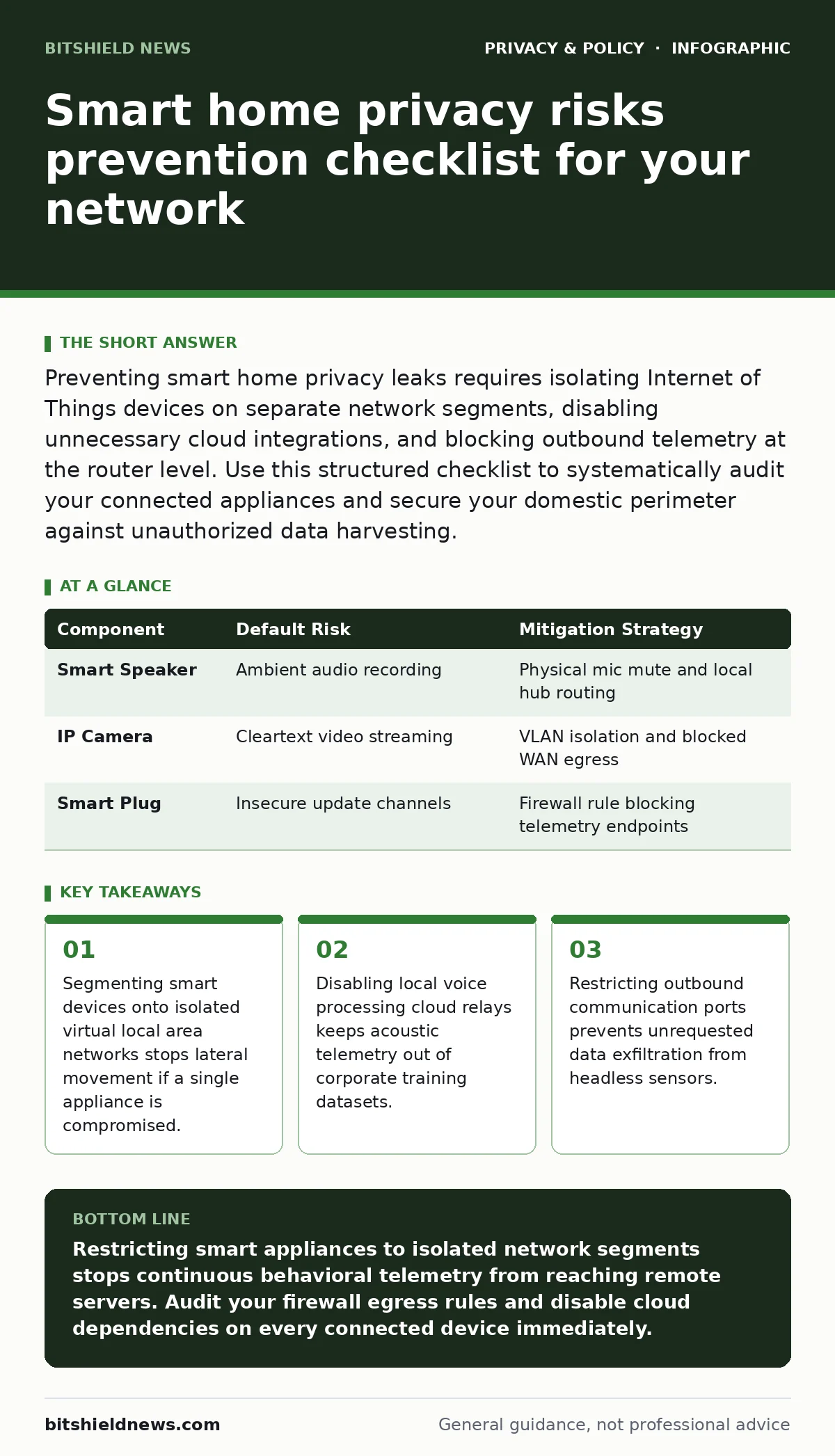
Preventing smart home privacy leaks requires isolating Internet of Things devices on separate network segments, disabling unnecessary cloud integrations, and blocking outbound telemetry at the router level. Use this structured checklist to systematically audit your connected appliances and secure your domestic perimeter against unauthorized data harvesting.
This operational checklist is built for technical maintainers managing residential networks packed with connected hardware. Apply these verification steps sequentially during initial deployment or quarterly maintenance to harden your domestic environment against telemetry extraction.
Network Isolation And Segmentation Controls
Network isolation prevents smart appliances from communicating with vulnerable personal computers on your primary local area network. Virtual local area networks and firewall rules enforce strict boundaries around untrusted hardware.
- separate vlan: isolates untrusted Internet of Things devices from personal computers to stop lateral movement after a breach.
- inter-vlan firewall rules: block smart appliances from initiating connections to your Network Attached Storage devices.
- guest network assignment: forces streaming media players onto isolated SSIDs with client isolation enabled.
- static lease mapping: ties hardware addresses to specific IP allocations for reliable anomaly detection.
Local Protocol And Cloud Minimization
Cloud minimization reduces continuous data streaming by forcing devices to operate entirely within local boundaries whenever possible. Many connected appliances function adequately without external server dependencies.
- local control protocols: eliminate cloud server dependencies by routing smart bulb and switch commands through on-premise hubs.
- vendor account unlinking: severs persistent telemetry collection pipelines tied to third-party identity providers.
- proprietary app removal: deletes smartphone companion applications that harvest location data and device lists.
- firmware auto-update disablement: prevents silent capability expansions that introduce new data collection telemetry.
Telemetry And Audio Stream Mitigation
Telemetry mitigation stops appliances from recording and uploading environmental data, ambient audio, and usage patterns to remote machine learning pipelines. Ambient microphones and motion sensors generate high-value behavioral profiles.
- acoustic trigger word muting: disables wake-word engine processing on smart speakers that lack physical microphone disconnect switches.
- outbound dns sinkholing: intercepts hardware telemetry domain requests and returns null routing destinations.
- video stream encryption enforcement: prevents unencrypted local RTSP feeds from broadcasting over cleartext channels.
- telemetry opt-out toggles: disables diagnostic data sharing hidden deep inside secondary configuration menus.
Hardware Audit And Physical Hardening
Hardware auditing uncovers forgotten connected devices and physically secures ports that could otherwise provide direct access to your local network infrastructure. Physical inspection complements remote network monitoring.
- ethernet drop inspection: identifies hardwired appliances lacking proper network segmentation tags.
- bluetooth advertisement disabling: stops smart locks and sensors from broadcasting persistent beacon identifiers to passersby.
- default credential replacement: substitutes factory administrative passwords with unique high-entropy passphrases.
- device retirement disposal: performs factory cryptopwipes on decommissioned hardware before resale or recycling.
| Component | Default Risk | Mitigation Strategy |
|---|---|---|
| Smart Speaker | Ambient audio recording | Physical mic mute and local hub routing |
| IP Camera | Cleartext video streaming | VLAN isolation and blocked WAN egress |
| Smart Plug | Insecure update channels | Firewall rule blocking telemetry endpoints |
Routine Verification And Maintenance Audits
Routine verification ensures that firmware updates, network configuration drift, and newly added appliances do not silently reintroduce privacy vulnerabilities. Automated logging helps maintain posture integrity over time.
- egress firewall logging: reviews blocked outbound connection attempts from smart appliances weekly.
- device inventory reconciliation: compares active network leases against physically installed hardware annually.
- certificate validation checks: ensures local management interfaces reject untrusted self-signed TLS certificates.
- DNS query inspection: monitors resolver logs for unexpected external domain lookups originating from headless sensors.
See also: 7 ARP Spoofing Mistakes That Expose Your Network Traffic
Complementary Privacy Engineering Practices
Complementary privacy engineering practices extend your domestic threat model beyond connected appliances into broader personal data protection vectors. Securing your wider digital footprint prevents correlation attacks that link smart home telemetry to your physical identity.
- secure dns configuration: encrypts resolver queries to prevent local internet service providers from mapping your connected device ecosystem through plaintext lookups.
- tracker blockers deployment: neutralizes web-based script elements that attempt to correlate smart home purchase histories with browsing behavior.
- file metadata scrubbing: strips location coordinates from digital photographs before sharing media captured inside smart-enabled residences.
Key takeaways
- Segmenting smart devices onto isolated virtual local area networks stops lateral movement if a single appliance is compromised.
- Disabling local voice processing cloud relays keeps acoustic telemetry out of corporate training datasets.
- Restricting outbound communication ports prevents unrequested data exfiltration from headless sensors.
Restricting smart appliances to isolated network segments stops continuous behavioral telemetry from reaching remote servers. Audit your firewall egress rules and disable cloud dependencies on every connected device immediately.
Frequently asked questions
Can smart appliances function normally after blocking their internet access?
Many connected devices retain local control capabilities through automation hubs even when firewall rules block all outbound WAN communication.
Why do smart plugs require internet access if they only turn power on and off?
Manufacturers route basic switching commands through remote cloud servers to enable remote smartphone control and harvest usage telemetry.
How do I find hidden smart devices operating on my wireless network?
Network scanning tools and router client lists reveal active hardware addresses and traffic patterns for every connected appliance.
Does placing smart devices on a guest network provide complete security?
Guest networks prevent lateral movement to personal computers, but appliances can still exfiltrate telemetry if client isolation is disabled on the wireless access point.
How this guide was produced: written by the BitShield News editorial team with AI assistance, checked against the public references listed below, and reviewed when the facts change. See our editorial policy or report an error.