
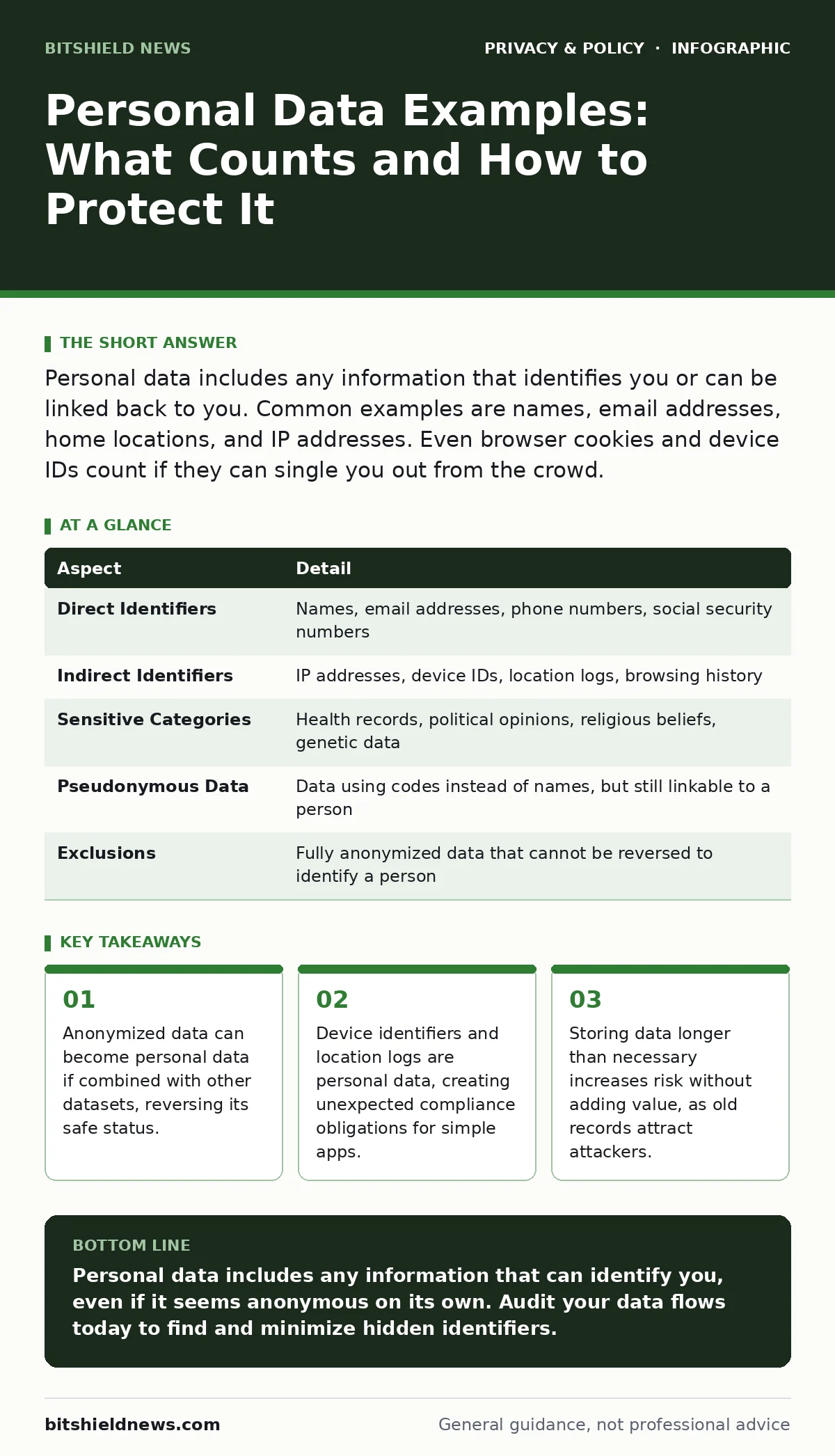
Personal data includes any information that identifies you or can be linked back to you. Common examples are names, email addresses, home locations, and IP addresses. Even browser cookies and device IDs count if they can single you out from the crowd.
What counts as personal data examples
Personal data is any information that identifies a living person or can be linked back to them. This definition covers obvious details like names and addresses, but it also includes subtle digital traces. The core mechanism is identifiability. If a dataset allows you to distinguish one individual from others, that data is personal.
Consider an IP address. It routes traffic to your device. If an internet service provider holds the log, they can map that address to your home. That makes the IP address personal data in that context. The same logic applies to cookie IDs. They track browsing habits. If a company links those habits to a user account, the cookie becomes personal data.
| Aspect | Detail |
|---|---|
| Direct Identifiers | Names, email addresses, phone numbers, social security numbers |
| Indirect Identifiers | IP addresses, device IDs, location logs, browsing history |
| Sensitive Categories | Health records, political opinions, religious beliefs, genetic data |
| Pseudonymous Data | Data using codes instead of names, but still linkable to a person |
| Exclusions | Fully anonymized data that cannot be reversed to identify a person |
You must evaluate data in context. A single piece of information might not identify anyone alone. Combine it with another source, and it often does. This combination effect is where many organizations fail. They treat isolated data points as safe, ignoring the risk of linkage.
How identification mechanisms work
Identification relies on unique attributes. Your name is unique in a small village but not in a large city. Your email address is globally unique. Digital identifiers behave similarly. A device ID is unique to your hardware. A session cookie is unique to your current browser instance.
The threat model changes when data is aggregated. Imagine a dataset containing purchase histories. No names are listed. It seems anonymous. Add a column for timestamps and store locations. Cross-reference that with public loyalty card data. You can now identify specific shoppers. The data has shifted from anonymous to personal.
This linkage happens automatically in modern analytics. Systems pull from multiple sources. They create profiles without asking for permission. The result is a detailed map of your behavior. This map is personal data. It carries the same legal weight as your name.
You face a hidden cost here. The effort to re-identify data is decreasing. Machine learning tools find patterns humans miss. What was safe five years ago may not be safe today. You must assume that any persistent identifier is personal data.
Who is affected by these rules
Every entity that collects user information is affected. This includes website owners, app developers, and service providers. The scope is broad. If you process data to deliver a service, you are a data controller. You determine why and how the data is used.
Third-party vendors complicate this picture. When you embed a chat widget, the vendor collects visitor data. You remain responsible for that collection. You cannot outsource compliance. The vendor is a data processor. They act on your instructions. You still answer for the outcome.
Employees are also affected. They access data to do their jobs. They must understand what counts as personal data. A simple mistake, like emailing a spreadsheet with customer IDs, can trigger a breach. Training is not optional. It is a control measure.
The impact extends to partners. If you share data with an affiliate, they inherit the risk. Your contract must define their responsibilities. They must protect the data to the same standard you do. Weak links in the chain break the whole system.
What to do about personal data
Start with a data inventory. You cannot protect what you do not know you have. Map the flow of data. Identify where it enters, where it sits, and where it leaves. This map reveals gaps in your controls. It also highlights unnecessary data.
Apply data minimization. Collect only what you need. If you do not need a phone number to deliver software, do not ask for it. Reducing the amount of data reduces the impact of a breach. It also simplifies compliance. Less data means fewer records to secure and fewer requests to handle.
Implement access controls. Limit who can see the data. Use role-based access. A support agent needs different access than a developer. Enforce least privilege. Users should only see what they need to do their job. This limits insider threats.
Encrypt data at rest and in transit. Encryption scrambles the data. Only authorized parties with the key can read it. If attackers steal encrypted files, they get useless noise. This is a critical defense. It protects data even if perimeter defenses fail.
Common mistakes in handling data
Many organizations assume that deleting the name is enough. This is false. As shown earlier, other fields can re-identify the person. You must remove all identifiers. This process is called anonymization. True anonymization is difficult. It requires statistical techniques to ensure no link remains.
Another mistake is ignoring metadata. File metadata contains hidden information. It might include the author’s name, location coordinates, or device type. When you share a document, you often share this metadata too. Strip it before distribution. Check your related guide on file metadata for specific removal steps.
Third-party integrations are a blind spot. You trust the vendor to handle data safely. You rarely verify their practices. Assume they will fail. Isolate their access. Monitor their activity. Do not give them direct access to your core database. Use APIs with strict limits.
Digital footprints and tracking
Your online behavior leaves a trail. This trail is personal data. Browser fingerprinting creates a unique ID based on your screen size, fonts, and plugins. It tracks you without cookies. Ad blockers can mitigate some tracking, but fingerprinting persists.
Social media platforms collect vast amounts of data. They build profiles based on your likes, shares, and connections. These profiles are highly detailed. They can reveal your political views, health conditions, and relationships. You have limited control over this data.
Understanding digital privacy rights helps you navigate this. You may have the right to access, correct, or delete your data. Exercise these rights. Regularly review your privacy settings. Limit the data you share publicly. The less you post, the less they know.
Sensitive data requires extra care
Some data carries higher risks. Health information, financial records, and biometric data are sensitive. Biometric data, like fingerprints or facial scans, is unique and permanent. You cannot change your face if it is stolen.
This data demands stronger protections. Encryption is mandatory. Access logs must be detailed. You must justify every access. The consequences of a breach are severe. Identity theft is easier with biometric data. Recovery is harder.
Do not collect this data unless absolutely necessary. If you do, store it separately. Isolate it from other systems. Use dedicated hardware security modules if possible. The goal is to make it as hard as possible for attackers to reach.
Managing third-party risks
Your vendors are your weak points. They access your data. They may have weaker security. You must assess them before engagement. Check their security certifications. Review their incident response plans. Demand regular audits.
Contracts must be specific. Define data handling requirements. Specify breach notification timelines. Require them to delete data after the contract ends. Do not accept vague promises. Get it in writing.
Monitor their performance. Look for signs of compromise. Unusual activity in their systems may indicate a breach. Respond quickly. Isolate their access immediately. Investigate the scope. Notify affected users if required.
Key takeaways
- Anonymized data can become personal data if combined with other datasets, reversing its safe status.
- Device identifiers and location logs are personal data, creating unexpected compliance obligations for simple apps.
- Storing data longer than necessary increases risk without adding value, as old records attract attackers.
Personal data includes any information that can identify you, even if it seems anonymous on its own. Audit your data flows today to find and minimize hidden identifiers.
Frequently asked questions
Is an IP address considered personal data?
Yes, because it can be linked to a specific device and, through the ISP, to a person.
Can aggregated data be personal data?
Yes, if the aggregation allows re-identification of individuals through cross-referencing with other datasets.
Does deleting names make data anonymous?
No, other fields like timestamps or locations may still allow identification. True anonymization requires removing all links.
Who is responsible if a vendor leaks data?
The original data controller remains responsible for the breach, even if a third-party processor caused it.
How this guide was produced: written by the BitShield News editorial team with AI assistance, checked against the public references listed below, and reviewed when the facts change. See our editorial policy or report an error.