
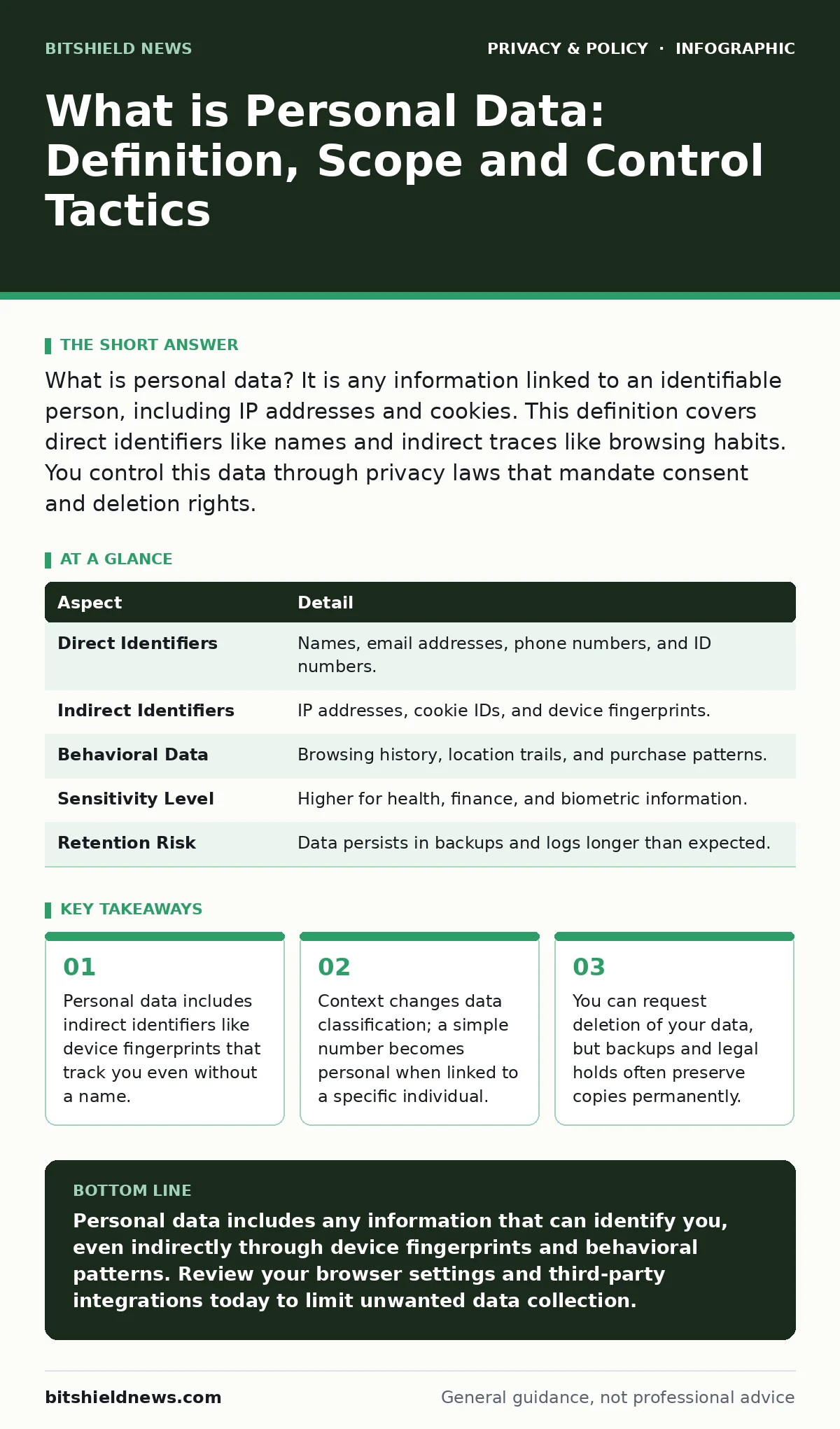
What is personal data? It is any information linked to an identifiable person, including IP addresses and cookies. This definition covers direct identifiers like names and indirect traces like browsing habits. You control this data through privacy laws that mandate consent and deletion rights.
Everyday Analogy for Data Identity
Imagine leaving a trail of unique footprints while walking through a field. Each print alone might look generic, but the pattern, spacing and depth reveal exactly who walked there, where they went and how fast they moved. Your digital life works the same way. A single email address is a clear footprint. A browser cookie is a faint smudge. Together, they form a complete map of your movements, habits and preferences.
This analogy explains why isolated data points matter. A random number is not sensitive. That same number becomes sensitive when it sits next to a timestamp and a location. The combination creates a profile. You leave these digital footprints every time you visit a website, use an app or connect to a network. The collection happens silently in the background.
What is Personal Data
What is personal data? It is any information that relates to an identified or identifiable natural person. An identifiable person is one who can be identified, directly or indirectly, by reference to an identifier. This definition is broader than most people expect. It includes obvious identifiers like your full name, home address and government ID numbers. It also includes less obvious identifiers like your IP address, cookie identifiers and device fingerprints.
A device fingerprint is a unique signature created from your browser settings, operating system and hardware. Websites collect this signature to recognize you across sessions. Even if you do not log in, this fingerprint links your activity to a specific device. That device is linked to you. Therefore, the data is personal. This legal reality forces organizations to treat browsing data with the same care as financial records.
| Aspect | Detail |
|---|---|
| Direct Identifiers | Names, email addresses, phone numbers, and ID numbers. |
| Indirect Identifiers | IP addresses, cookie IDs, and device fingerprints. |
| Behavioral Data | Browsing history, location trails, and purchase patterns. |
| Sensitivity Level | Higher for health, finance, and biometric information. |
| Retention Risk | Data persists in backups and logs longer than expected. |
How Identification Works in Practice
Organizations collect data through forms, but most tracking happens automatically. When you load a page, your browser sends headers that reveal your device type, language and time zone. These headers help the server optimize the experience, but they also contribute to your identifier profile. Third-party scripts embedded in the page send this data to external servers. This is where the complexity grows.
Suppose you visit a news site. The site uses a script from a social network to display a like button. That script runs in your browser and sends your visit data to the social network, even if you do not click the button. The social network now has a record of your visit. It links this visit to your social media account. The news site never saw your account details, but the data merged. Your activity on one platform informs your profile on another. This cross-site tracking builds a comprehensive view of your interests and behaviors.
Understanding this flow requires looking beyond the website you see. You must consider the invisible scripts running in the background. These scripts are the primary engine of modern data collection. They operate silently and continuously. Blocking them is difficult because they are embedded in the core functionality of many sites. This is why understanding file metadata is also relevant, as it can reveal similar tracking information in documents you download or share.
Who Is Affected by Data Rules
Privacy regulations affect any organization that processes personal data of residents within their jurisdiction. This includes small businesses, non-profits and individual bloggers. If you collect email addresses for a newsletter, you are processing personal data. If you use analytics tools that track IP addresses, you are processing personal data. The scale of your operation does not exempt you. The nature of the data does.
The impact extends to your suppliers and partners. If you share customer data with a cloud provider, that provider becomes a processor. They must adhere to strict security standards. They must also respect your instructions on how they handle the data. This creates a chain of responsibility. You remain liable for how your partners protect the information. This means you must vet every tool in your stack. You cannot outsource compliance entirely.
Common Misconceptions About Privacy
Many people believe that anonymous data is safe. This is a dangerous assumption. Anonymous data has had all identifiers removed and cannot be linked back to an individual. Pseudonymous data still contains a key that can re-identify the person. Most data collected online is pseudonymous, not anonymous. Re-identification attacks can link pseudonymous data to public records.
Another common error is assuming that deleting an account erases all data. Accounts are front-end interfaces. The backend databases and logs often retain copies for legal, operational or analytical reasons. Servers keep logs of network traffic for months. These logs contain IP addresses and timestamps. Even if the user profile is gone, the activity trail remains. This is why knowing your digital privacy rights is necessary to request actual deletion, not just account closure.
People also overlook email tracking pixels. These tiny images confirm when you open an email. They reveal your device type, location and time of reading. This data is personal because it links your physical presence to your email address. Blocking these pixels prevents this specific type of surveillance. It does not stop all tracking, but it removes a significant vector.
See also: What privacy impact assessments do for your data strategy · How Do Tracking Pixels Work: The Hidden Data Exchange
What You Can Do About It
You have several practical steps to reduce your digital footprint. First, use privacy-focused browsers or modes that block third-party cookies by default. This stops many cross-site tracking scripts from executing. Second, manage your consent preferences carefully. Most sites require you to opt-out of non-essential cookies. Do not accept all cookies blindly. This simple action reduces the amount of data sent to ad networks.
Third, review the privacy settings on your social media accounts. Limit the amount of personal information visible to the public. Disable location tagging in your photos. This reduces the amount of data available for scraping and profiling. Fourth, use a secure DNS service like DNS over HTTPS. This encrypts your domain lookups, preventing your internet provider from seeing which sites you visit. This is a significant step toward hiding your browsing habits from your network operator.
Finally, be aware of social media privacy risks. These platforms sell access to your data through their advertising networks. Your friends' posts and tags can also expose your information. Regularly audit your tags and posts. Remove old content that reveals sensitive details. These actions do not make you invisible, but they significantly raise the cost and effort required to track you.
Maintaining Long-Term Control
Privacy is not a one-time setup. It is a continuous process. Websites change their privacy policies. New tracking techniques emerge. Your own habits evolve. You must periodically review your digital hygiene. Check which apps have access to your contacts, camera and microphone. Revoke permissions for apps you no longer use. This prevents dormant apps from collecting data in the background.
You should also monitor your online presence. Search for your name and address to see what information is publicly available. Request removal from data broker sites that sell your contact details. These sites aggregate data from public records and online interactions. They make your personal data easily accessible to anyone. Removing yourself from these lists reduces your exposure to spam and phishing.
Understanding what is personal data is the first step. Acting on that understanding requires discipline. You must weigh the convenience of connected services against the cost of privacy. There is no free lunch in the digital world. Every click generates data. You decide who keeps that data and for how long. This choice defines your digital identity.
Key takeaways
- Personal data includes indirect identifiers like device fingerprints that track you even without a name.
- Context changes data classification; a simple number becomes personal when linked to a specific individual.
- You can request deletion of your data, but backups and legal holds often preserve copies permanently.
Personal data includes any information that can identify you, even indirectly through device fingerprints and behavioral patterns. Review your browser settings and third-party integrations today to limit unwanted data collection.
Frequently asked questions
Is my IP address considered personal data?
Yes, an IP address is considered personal data because it can be used to identify the approximate location and internet service provider of a user.
Can I delete all my data from the internet?
You can request deletion from specific companies, but complete removal is impossible due to backups, caches and data brokers that replicate your information.
Does using incognito mode hide my data from my internet provider?
No, incognito mode only prevents local storage of history on your device. Your internet provider still sees every website you visit unless you use a VPN or encrypted DNS.
Are anonymized datasets safe from re-identification?
Anonymized datasets are safer, but not completely immune. If enough contextual data remains, researchers can sometimes link the data back to specific individuals using external records.
How this guide was produced: written by the BitShield News editorial team with AI assistance, checked against the public references listed below, and reviewed when the facts change. See our editorial policy or report an error.