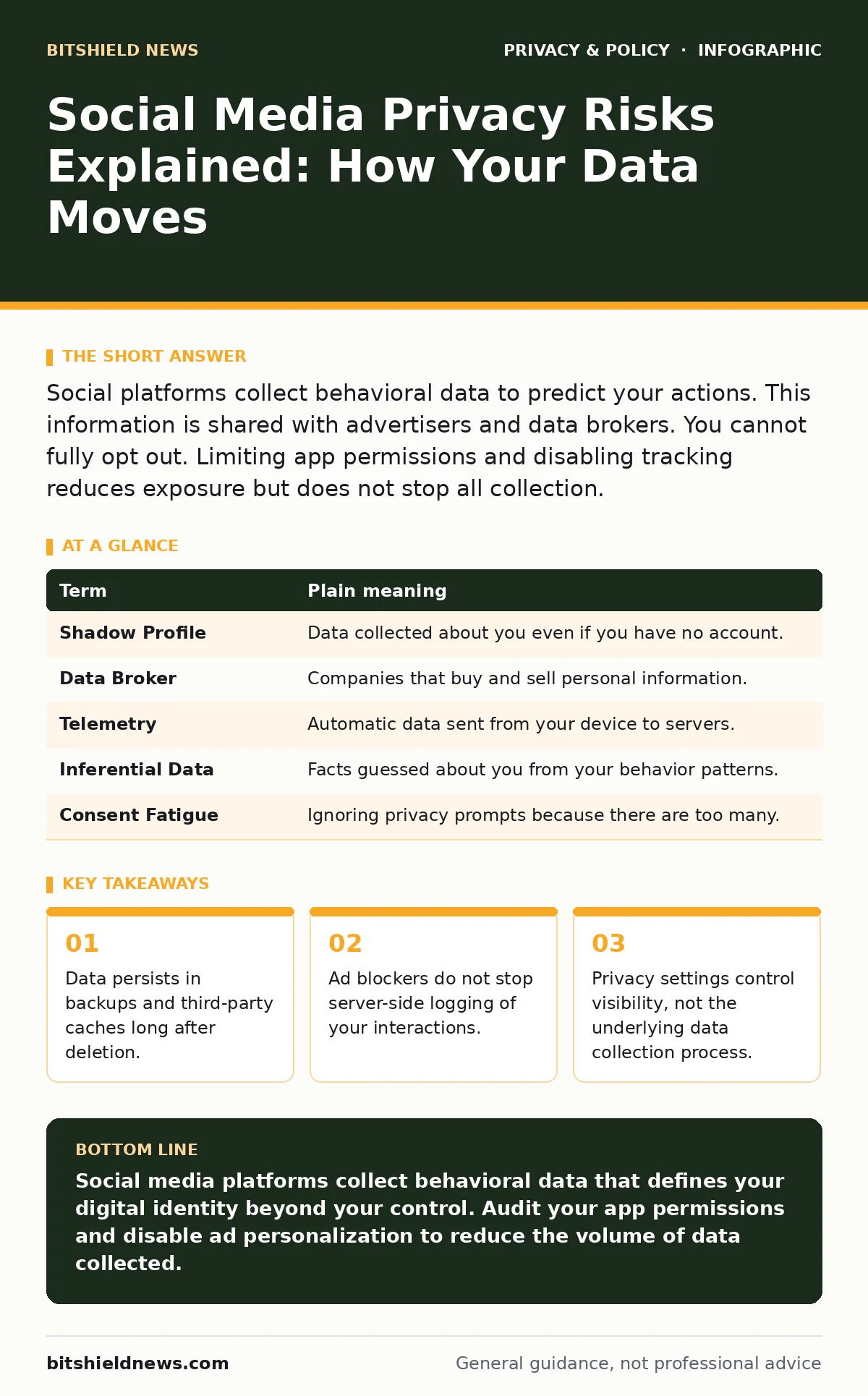
Social platforms collect behavioral data to predict your actions. This information is shared with advertisers and data brokers. You cannot fully opt out. Limiting app permissions and disabling tracking reduces exposure but does not stop all collection.
The Open House Analogy
Imagine your social media presence as an open house party. You invite friends to enter your living room. They look at your photos, listen to your conversations, and note who visits. You cannot control what they memorize or write down. When they leave, they take those notes and sell them to strangers.
This analogy holds because social platforms are not just hosting your content. They are recording every interaction. The platform acts as the host who logs every guest’s movement. You assume privacy behind closed doors. In this digital space, there are no closed doors.
What Happens Behind the Walls
The platform records more than your posts. It tracks how long you hover over an image. It notes which buttons you click and which you ignore. This behavioral data reveals your interests, political leanings, and health concerns.
You might think deleting a post removes the evidence. It does not. The platform keeps backups. Data brokers may have already purchased that snapshot. The information travels faster than you can scrub it.
| Term | Plain meaning |
|---|---|
| Shadow Profile | Data collected about you even if you have no account. |
| Data Broker | Companies that buy and sell personal information. |
| Telemetry | Automatic data sent from your device to servers. |
| Inferential Data | Facts guessed about you from your behavior patterns. |
| Consent Fatigue | Ignoring privacy prompts because there are too many. |
The Hidden Cost of Convenience
Convenience comes with a hidden tax. You pay with your behavioral data. The platform offers free access to content. You offer precise details about your life in return.
This exchange is rarely visible. You do not see the ledger. You see a clean interface. The cost is your predictability. Advertisers use this data to target you with surgical precision.
Imagine you like one post about running shoes. The platform infers you are interested in fitness. It then shows you ads for gyms, health insurance, and injury prevention. You never signed up for these categories. The inference was made for you.
Why Standard Defenses Fail
Many users install ad blockers to protect their privacy. These tools stop visual ads from loading. They do not stop the platform from logging your activity. The server records that you visited a page. It records how long you stayed.
Browser extensions like tracker blockers help reduce cross-site tracking. They prevent third-party scripts from following you across different websites. They do not stop the social platform itself from collecting data within its own domain.
You must understand the difference between visibility and collection. Hiding your profile stops peers from seeing your posts. It does not stop the platform from selling your behavioral patterns.
Managing App Permissions
Your smartphone is the primary source of leakage. Apps request access to your location, contacts, and microphone. You often grant these permissions to make the app work.
Review your app permission management settings regularly. Turn off location access for apps that do not need it. A social media app does not need to know your precise location to show you messages.
Check your smartphone privacy settings for ad tracking. Most operating systems now offer options to limit ad tracking. Enabling these options makes it harder for advertisers to build a consistent profile of you.
See also: Private file sharing services: how to build a secure transfer system · Removing your data from people-search sites and reclaiming privacy
The Persistence of Metadata
When you share a photo, you share more than the image. The file contains file metadata. This data includes the date, time, and GPS coordinates of the shot.
Social platforms often strip some metadata. They do not always strip all of it. Third-party services might re-attach it. Always assume your location is exposed when you post media.
This is why generic safety advice fails. Changing your password does not remove old location data. Deleting an account does not remove cached copies held by data brokers. You must treat every post as permanent.
Try This Now
- Audit your connected apps. Revoke access for any third-party service you no longer use. This stops them from pulling your data.
- Disable personalized ads in your account settings. This does not stop tracking. It stops the platform from using your data to select ads.
- Limit photo permissions. Allow the app to choose photos from your library. Do not grant full library access. This reduces the amount of data the app can scan.
Controlling Your Digital Footprint
You cannot control everything. You can only reduce the surface area of exposure. Treat your social presence as a public record. Assume every post will be seen by someone unexpected.
Consider the right to be forgotten. This legal concept allows you to request data deletion. It is difficult to enforce. Platforms often deny requests citing public interest or legal obligations.
Relying on laws is a passive strategy. Active management is required. Read the NIST Privacy Framework for a structured approach to data risk. It helps you understand where your data flows and where it stops.
Key takeaways
- Data persists in backups and third-party caches long after deletion.
- Ad blockers do not stop server-side logging of your interactions.
- Privacy settings control visibility, not the underlying data collection process.
Social media platforms collect behavioral data that defines your digital identity beyond your control. Audit your app permissions and disable ad personalization to reduce the volume of data collected.
Frequently asked questions
Does deleting my social media account delete all my data?
No. Platforms retain backups and data shared with third parties for legal and operational reasons.
Can I stop social media from tracking me on other websites?
You can limit it using tracker blockers and browser settings, but server-side logging still occurs.
Is it safe to use the same password for social media and email?
No. If one service is breached, attackers can access both accounts. Use unique passwords.
Do private accounts protect me from data brokers?
No. Data brokers collect information from public records and third-party apps, not just your profile.
How this guide was produced: written by the BitShield News editorial team with AI assistance, checked against the public references listed below, and reviewed when the facts change. See our editorial policy or report an error.