
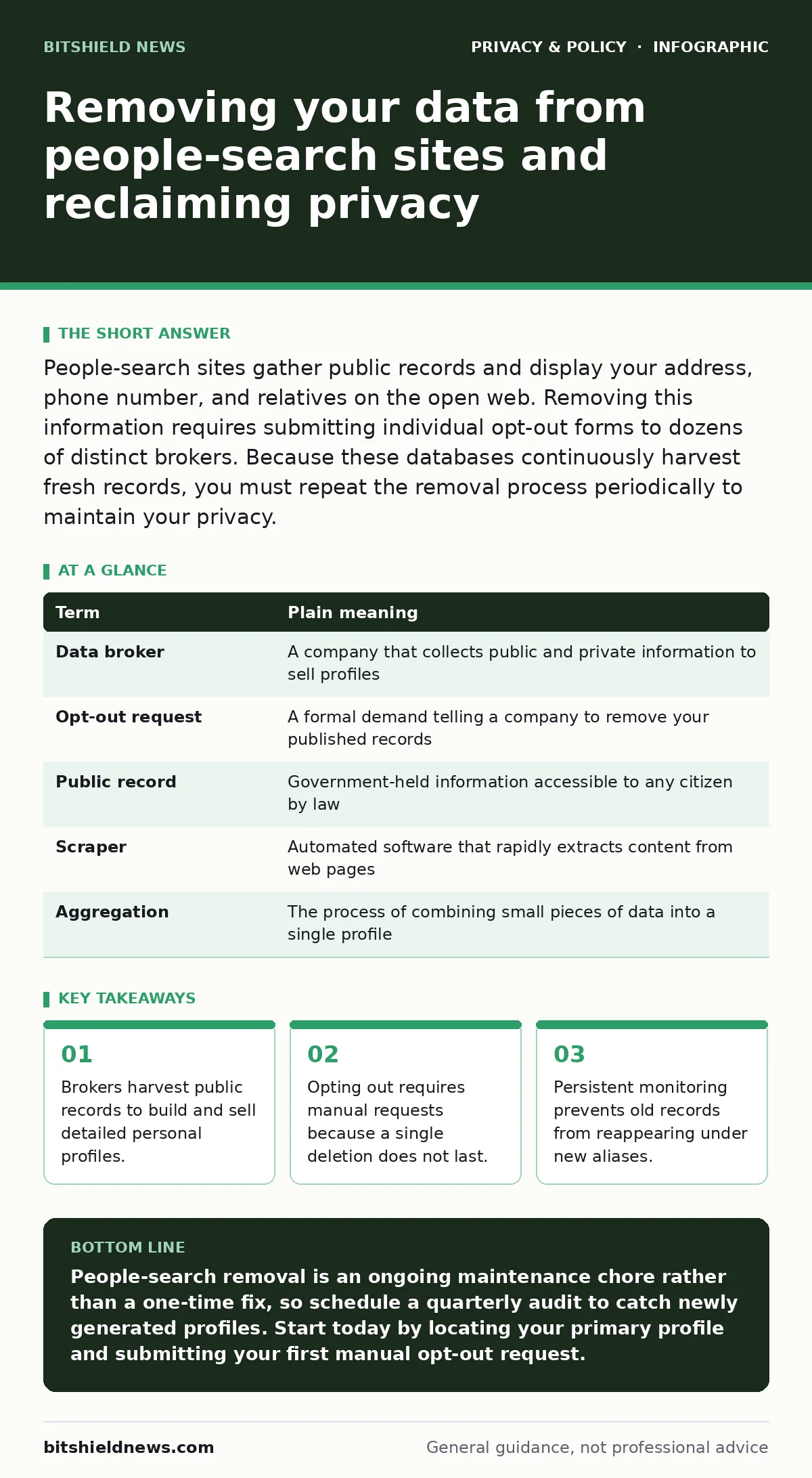
People-search sites gather public records and display your address, phone number, and relatives on the open web. Removing this information requires submitting individual opt-out forms to dozens of distinct brokers. Because these databases continuously harvest fresh records, you must repeat the removal process periodically to maintain your privacy.
The Town Square Filing Cabinet
Imagine walking through a bustling town square where a transparent filing cabinet stands open to the sky. Every time you register to vote, buy a property, or renew a vehicle registration, local clerks drop duplicate copies of your paperwork into this unlocked metal drawer. People-search brokers act as energetic bystanders who rifle through these folders, photocopy your details, and staple them to message boards for anyone passing by to inspect.
Brokers monetize your personal details by packaging public registry entries into readable profiles that target prospective employers, landlords, and curious neighbors. Your everyday life leaves a paper trail across municipal databases, court filings, and utility subscriptions. Automated scrapers sweep these official channels hourly, capturing fresh updates before local authorities even finish processing the paperwork. This constant harvesting turns routine civic participation into an involuntary public broadcast of your residential history and familial connections.
How Data Brokers Harvest Your Life
Data brokers operate massive aggregation engines that correlate disparate identifiers to link your current address with past residences. They connect phone numbers, email addresses, and employment records by matching unique data points across multiple public datasets. When you browse the web, similar aggregation techniques power online tracking networks that feed behavioral insights directly back into these matching algorithms. Once the software confirms a match, it generates a dedicated web page featuring your name and immediate family members.
Most people discover these listings only after a background check reveals a mismatch or an acquaintance uncovers an outdated phone number. The underlying problem stems from the decentralized nature of public recordkeeping. Government agencies legally must provide access to local documents, which gives commercial entities a lawful foundation to copy and redistribute public archives. Stopping this distribution requires dismantling the individual links connecting your historical records to the commercial databases displaying them.
Key Terms to Know
| Term | Plain meaning |
|---|---|
| Data broker | A company that collects public and private information to sell profiles |
| Opt-out request | A formal demand telling a company to remove your published records |
| Public record | Government-held information accessible to any citizen by law |
| Scraper | Automated software that rapidly extracts content from web pages |
| Aggregation | The process of combining small pieces of data into a single profile |
The Hidden Cost of Automated Removal
Automated removal services promise hands-off deletion, but they introduce unique risks by requiring broad permissions to act on your behalf. Granting a third-party service the authority to submit removal requests often means sharing your actual identity details with yet another private company. Furthermore, automated tools frequently miss smaller, newly launched broker sites that do not follow standard opt-out protocols. You trade one set of privacy exposures for another when you trust an automated platform to police the entire web for your personal data.
Another hidden consequence involves false matches where removal scripts accidentally target an innocent person who shares your exact name. Software cannot always distinguish between two individuals living in different states, leading to accidental redactions of legitimate public files. Manual oversight remains necessary to verify that removal requests target your specific records without disrupting unrelated administrative paperwork.
How to Submit Your First Opt-Out
- Search your full name in quotes followed by your current city inside a major search engine to locate active profiles.
- Open each broker listing in a separate browser tab and navigate to the bottom of the page to find the specific opt-out link.
- Complete the required form by supplying the exact URL of your profile while using a dedicated burner email address to prevent confirmation spam.
Submitting your initial batch of removal requests requires patience because many brokers intentionally bury their opt-out links behind multiple menu layers. Using a dedicated email address prevents your primary inbox from filling with verification links and promotional offers from the broker network. Once submitted, most operators legally or practically require several business days to flush your record from their active search indexes.
Managing Your Personal Data Over Time
Removing your records once provides only temporary relief because the underlying aggregation engines continue scanning public registries for fresh updates. You must periodically revisit the major broker domains to ensure your identity has not been re-indexed from a newly filed property deed or marriage license. Combining this routine maintenance with defenses against browser fingerprinting helps reduce the breadcrumbs you leave behind during everyday web browsing sessions.
Protecting your privacy requires a shift in how you interact with municipal agencies and online services alike. Whenever possible, use alternative contact methods that do not tie your physical address directly to your public voter registration or utility accounts. Diligence at the point of origin stops the cycle far more effectively than constantly chasing down published records after the fact.
Key takeaways
- Brokers harvest public records to build and sell detailed personal profiles.
- Opting out requires manual requests because a single deletion does not last.
- Persistent monitoring prevents old records from reappearing under new aliases.
People-search removal is an ongoing maintenance chore rather than a one-time fix, so schedule a quarterly audit to catch newly generated profiles. Start today by locating your primary profile and submitting your first manual opt-out request.
Frequently asked questions
Why do people-search sites keep putting my information back online after I remove it?
These sites continuously harvest fresh data from government registries and court filings, meaning any new public record will trigger the automated creation of a brand-new profile.
Can I legally force people-search sites to delete my records forever?
Privacy laws in certain jurisdictions mandate permanent deletion, but because new public documents are generated daily, most legal frameworks only require companies to honor current opt-out requests.
Do I need to use my real legal name when submitting an opt-out request?
You must provide enough matching information for the broker to identify your specific record, but you should always use a dedicated secondary email address to protect your personal inbox.
How long does it take for a removal request to take effect?
Most brokers process valid removal forms within several business days, though some regional databases can take up to a few weeks to fully purge cached search indexes.
How this guide was produced: written by the BitShield News editorial team with AI assistance, checked against the public references listed below, and reviewed when the facts change. See our editorial policy or report an error.