
Incident response plans fail when teams assume they cover every attack vector or treat them as static documents. You must focus on decision trees, not scripts. Plan for communication breakdowns, not just technical fixes. Regular table-top exercises reveal gaps that documentation hides.
Misreading: The plan covers every possible attack vector
Correct reading: You cannot script a response for every threat, so you must design for principles rather than specific scenarios. A comprehensive list of attack types becomes obsolete the moment a new variant emerges. Your plan should define how to contain unknown threats, not how to fix known ones. Focus on isolation mechanisms that work regardless of the payload. This approach aligns with the principles found in guides on intrusion prevention systems, where blocking known signatures is less effective than detecting anomalous behavior patterns.
Attempting to document every breach scenario creates false confidence. Teams skip reading the manual because it is too long. They default to muscle memory when pressure mounts. Muscle memory fails against novel attacks. Instead, define clear containment boundaries. Specify which network segments to isolate first. Define which data stores to snapshot before wiping. These actions are universal. They apply whether the threat is malware, ransomware, or insider abuse.
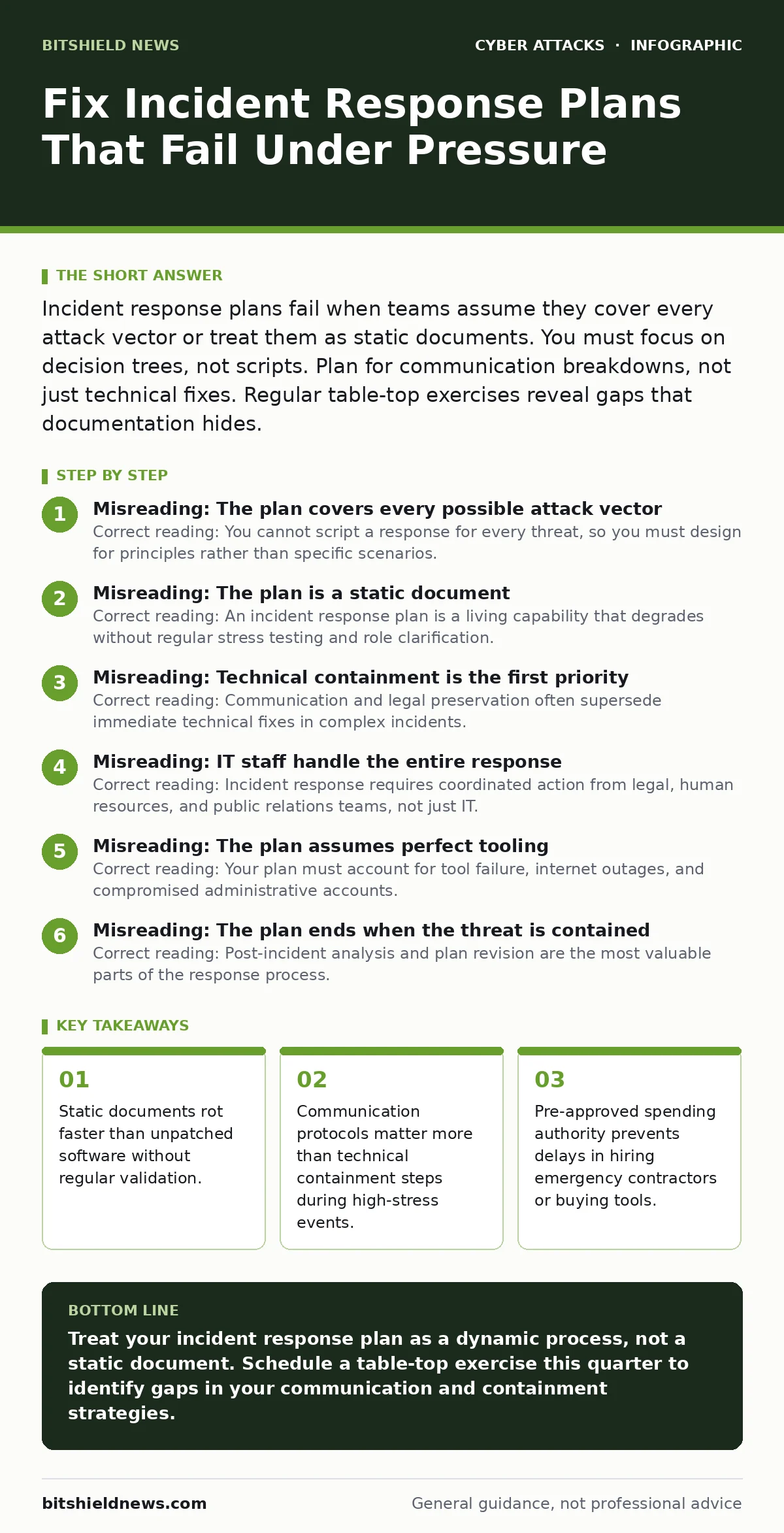
Misreading: The plan is a static document
Correct reading: An incident response plan is a living capability that degrades without regular stress testing and role clarification. Documents rot faster than unpatched software if they sit on a server unchanged. Contact lists become stale. Roles shift as staff leave or change titles. Technical architectures evolve, rendering old containment steps useless or dangerous. A plan that has not been tested in the last 12 months is likely incorrect.
You must treat the plan like code. It requires version control and regular commits. Update it after every major infrastructure change. Update it after every hire or departure in the security team. Schedule quarterly table-top exercises. These are not optional drills. They are the only way to verify that the steps actually work. Imagine a scenario where your primary email provider is compromised during an attack. If your plan relies on that email for coordination, you are locked out of your own response mechanism.
Misreading: Technical containment is the first priority
Correct reading: Communication and legal preservation often supersede immediate technical fixes in complex incidents. Stopping the bleed is important, but preserving evidence is critical for attribution and recovery. Deleting logs to "clean up" can destroy your ability to prove what happened. This can void insurance coverage and violate regulatory requirements. You must balance speed with forensics.
Define who holds the authority to preserve evidence. This person must act before technicians begin remediation. Specify which systems require disk imaging. Define the chain of custody for digital evidence. This protects the organization from liability. It also helps external experts understand the scope. A rushed cleanup that erases timestamps makes it impossible to determine the entry point. You might stop the active threat, but you leave the door open for future attacks.
Misreading: IT staff handle the entire response
Correct reading: Incident response requires coordinated action from legal, human resources, and public relations teams, not just IT. Technical teams fix systems, but they cannot manage reputational damage or regulatory notifications. Legal teams determine privilege and compliance obligations. Human resources handle insider threats and employee notifications. Public relations crafts the message to customers and stakeholders.
If your plan only lists IT contacts, you have failed. Define the decision-making hierarchy. Who approves external communications? Who contacts law enforcement? Who notifies the board? Delays in these decisions amplify the damage. Imagine a data breach affecting customer health records. IT isolates the server, but the legal team is still debating notification timelines. The public finds out via a blog post. Trust evaporates. The technical fix was perfect, but the response was a disaster.
Misreading: The plan assumes perfect tooling
Correct reading: Your plan must account for tool failure, internet outages, and compromised administrative accounts. Relying on a single security platform for detection and response is a single point of failure. If that platform is compromised or offline, your visibility vanishes. You need out-of-band communication channels. You need manual override procedures.
Suppose your primary monitoring dashboard is inaccessible. How do you confirm the scope of the incident? Do you have secondary logs? Can you query DNS servers directly? If your primary email is down, how do you coordinate with vendors? Have a backup communication method. Burner phones or encrypted messaging apps work. Pre-approve spending for emergency services. Do not wait for procurement approval during a crisis. This flexibility mirrors the need for conditional access policies, which must function even when primary identity providers are under attack.
See also: Authorization Bypass Response: Containment and Recovery Steps · AI Security Operations Checklist for Incident Response Teams
Misreading: The plan ends when the threat is contained
Correct reading: Post-incident analysis and plan revision are the most valuable parts of the response process. Containing the threat is only the beginning. You must understand why the defenses failed. Was it a configuration error? A lack of training? A software bug? Without this analysis, you will suffer the same breach again.
Conduct a blameless post-mortem. Focus on process failures, not individual errors. Document every decision made during the incident. Note where delays occurred. Identify which tools worked and which failed. Update the plan based on these findings. This continuous improvement cycle turns a negative event into organizational resilience. It also prepares you for more sophisticated threats, such as credential stuffing attacks that exploit weak authentication flows.
Misreading: Automation replaces human judgment
Correct reading: Automated responses can cause collateral damage if they misidentify benign activity as malicious. Over-reliance on automation leads to "alert fatigue" and missed nuances. Humans must validate critical actions, especially those that disrupt business operations. Automation is best for repetitive, low-risk tasks like blocking known bad IP addresses.
Use automation to gather evidence, not to make final containment decisions. Let scripts collect logs and isolate endpoints. Require a human to approve shutting down production servers. This prevents accidental outages caused by false positives. It also ensures that the response aligns with business priorities. A misconfigured rule could lock out all users, causing more harm than the original threat. This balance is similar to managing ARP spoofing defenses, where aggressive filtering can break legitimate network traffic.
Key takeaways
- Static documents rot faster than unpatched software without regular validation.
- Communication protocols matter more than technical containment steps during high-stress events.
- Pre-approved spending authority prevents delays in hiring emergency contractors or buying tools.
Treat your incident response plan as a dynamic process, not a static document. Schedule a table-top exercise this quarter to identify gaps in your communication and containment strategies.
Frequently asked questions
How often should we update our incident response plan?
Update the plan after every major infrastructure change, staff turnover in key roles, or after any security incident. Conduct a full review at least twice a year to ensure contact lists and procedures remain accurate.
Do we need separate plans for different types of breaches?
No, a single unified plan with modular annexes is more effective. This reduces confusion during high-stress situations. The core response steps for containment and communication remain the same, while specific technical details vary by threat type.
Who should lead the incident response team?
The lead should be a senior figure with authority across IT, legal, and communications. This person makes final decisions on containment and disclosure. Technical experts advise, but the lead owns the outcome.
How do we handle ransomware without paying the ransom?
Focus on rapid isolation and restoration from clean backups. Verify your backups are offline and immutable before an attack. Paying ransoms does not guarantee data recovery and may violate sanctions laws. Prioritize resilience and recovery speed.
How this guide was produced: written by the BitShield News editorial team with AI assistance, checked against the public references listed below, and reviewed when the facts change. See our editorial policy or report an error.