
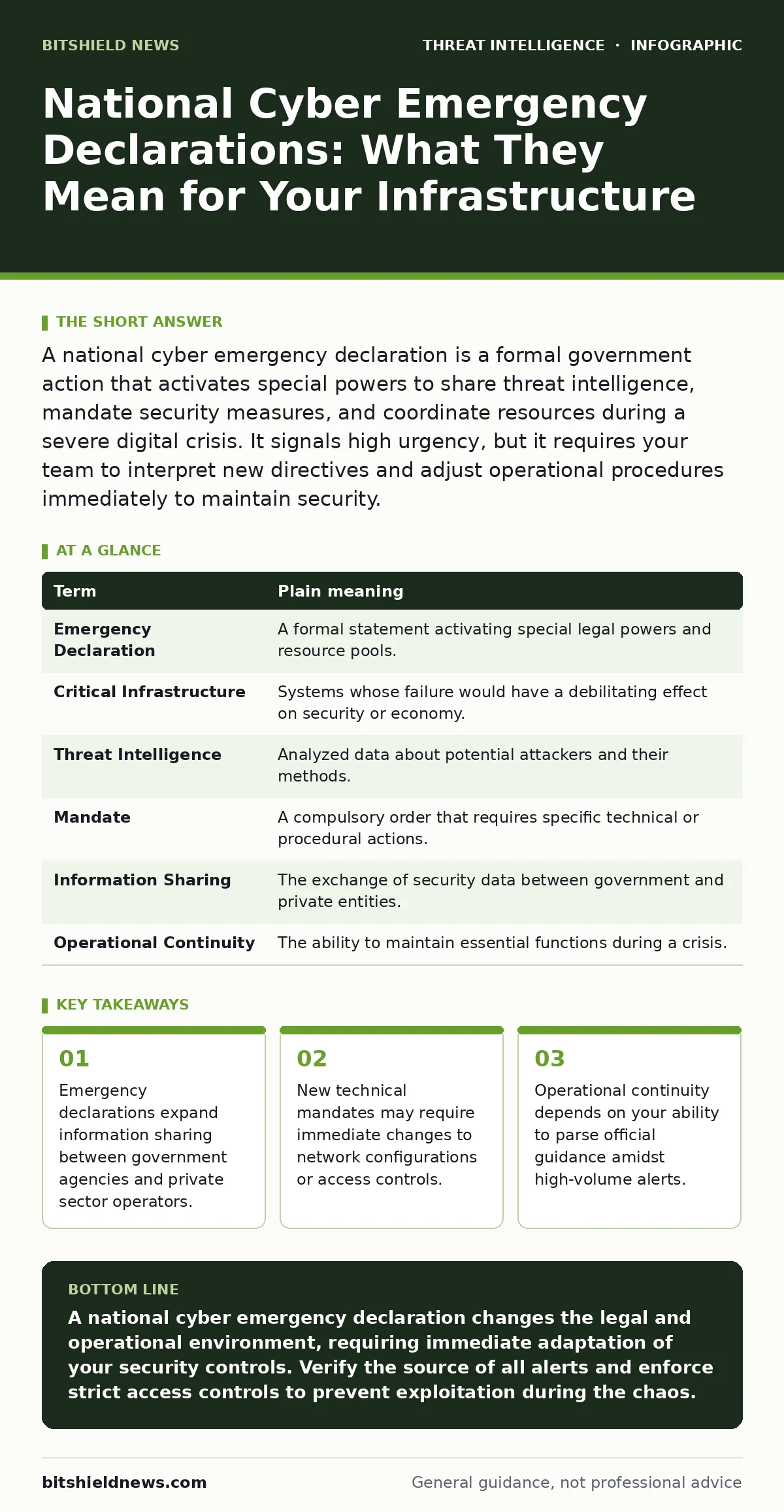
A national cyber emergency declaration is a formal government action that activates special powers to share threat intelligence, mandate security measures, and coordinate resources during a severe digital crisis. It signals high urgency, but it requires your team to interpret new directives and adjust operational procedures immediately to maintain security.
The Dam Breach Analogy
Imagine a city protected by a large dam. Under normal conditions, the water level is stable, and maintenance crews handle small leaks. A national cyber emergency declaration is equivalent to the water rising rapidly due to upstream storms. The city manager declares an emergency to mobilize extra pumps, open backup spillways, and coordinate with neighboring cities. The declaration itself does not stop the water. It authorizes the use of emergency resources and changes the rules for how citizens and workers respond to the rising threat.
Defining the Core Mechanism
A national cyber emergency declaration is a legal instrument. It allows the government to bypass standard procurement rules, share sensitive data with private companies, and mandate specific security actions. The primary goal is coordination. During a severe crisis, fragmented responses fail. Centralized direction ensures that all sectors move in the same direction. This mechanism relies on existing legal frameworks that grant emergency powers to specific agencies. It does not create new laws instantly. It activates pre-existing provisions that are dormant during peacetime operations.
Understanding the legal basis is critical for compliance. You must know which agency holds the authority. Different countries have different structures. In some regions, the declaration triggers automatic reporting requirements for critical infrastructure operators. In others, it merely advises best practices. The difference between a mandate and a recommendation changes your operational burden significantly.
Common Points of Confusion
Many operators confuse the declaration with the attack itself. The declaration is a policy response, not a technical event. It does not indicate a specific malware strain or a zero-day exploit. It indicates that the aggregate impact of multiple events exceeds normal thresholds. Another common error is assuming the government will provide real-time protection. The government provides intelligence and coordination. You provide the implementation. The gap between receiving an alert and applying a mitigation is where breaches occur.
The Mini Glossary of Terms
| Term | Plain meaning |
|---|---|
| Emergency Declaration | A formal statement activating special legal powers and resource pools. |
| Critical Infrastructure | Systems whose failure would have a debilitating effect on security or economy. |
| Threat Intelligence | Analyzed data about potential attackers and their methods. |
| Mandate | A compulsory order that requires specific technical or procedural actions. |
| Information Sharing | The exchange of security data between government and private entities. |
| Operational Continuity | The ability to maintain essential functions during a crisis. |
Hidden Costs of Compliance
The immediate cost is operational disruption. When a declaration occurs, alert volumes spike. Your security operations center may receive thousands of new indicators of compromise. Filtering noise from signal requires significant analyst time. You may need to divert resources from routine tasks like patching or user training to handle the surge. This creates a backlog of routine maintenance. Delayed patching increases risk. The hidden cost is the degradation of your baseline security posture while focusing on the emergency.
Another cost is legal exposure. Emergency rules often lower the threshold for data sharing. You might share logs that contain personally identifiable information. If you do not sanitize this data correctly, you violate privacy laws. The urgency of the situation tempts teams to skip validation steps. Skipping validation leads to compliance failures that persist long after the emergency ends.
See also: Fix Incident Response Plans That Fail Under Pressure
Integrating with Existing Defenses
Your existing security architecture must adapt. Network detection and response systems need updated rules to identify traffic patterns associated with the declared threat. If you rely on security telemetry, ensure your collection points are not overwhelmed by the increased logging requirements. You may need to adjust retention policies to capture evidence for forensic analysis.
Consider how DNS tunneling might be used by attackers to exfiltrate data during the chaos. Emergency periods often see increased use of covert channels. Your firewall rules should inspect DNS traffic more strictly. Additionally, review your honeypots to see if they are attracting new types of automated scanning. This data provides early warning of attacker interest in your specific sector.
Three Steps to Immediate Action
- Verify the Source: Confirm the declaration comes from the official government channel. Phishing attacks often mimic emergency announcements to trick users into revealing credentials. Check the domain and contact the issuing agency directly if unsure.
- Update Access Controls: Emergency declarations often lead to increased remote access. Enforce multi-factor authentication for all administrative accounts. Review privileged access management policies to ensure only necessary personnel have elevated rights.
- Review Backup Integrity: Ensure your backups are offline and immutable. Attackers often target backup systems during high-profile crises to ensure they can hold data hostage. Verify that you can restore critical systems from these backups before the crisis escalates.
Long-Term Strategic Shifts
Emergency declarations highlight systemic weaknesses. They reveal where coordination fails and where technology gaps exist. Use the aftermath to improve your network enumeration processes. Knowing exactly what assets you have is the first step in protecting them. If you cannot inventory it, you cannot secure it.
Review your incident response playbook. Did the declaration trigger the right teams? Were communication channels clear? Update the playbook based on these observations. The next emergency will not allow for improvisation. Your procedures must be rehearsed and refined. This turns a reactive event into a proactive improvement cycle.
Key takeaways
- Emergency declarations expand information sharing between government agencies and private sector operators.
- New technical mandates may require immediate changes to network configurations or access controls.
- Operational continuity depends on your ability to parse official guidance amidst high-volume alerts.
A national cyber emergency declaration changes the legal and operational environment, requiring immediate adaptation of your security controls. Verify the source of all alerts and enforce strict access controls to prevent exploitation during the chaos.
Frequently asked questions
Does a national cyber emergency declaration mean my internet service will be cut?
No, the declaration does not mandate service interruption. It may lead to traffic filtering or monitoring, but general connectivity usually remains intact unless specific infrastructure is compromised.
How quickly must I comply with new mandates?
Compliance timelines vary by jurisdiction and the severity of the threat. Some mandates are immediate, while others allow a short grace period. Monitor official channels for specific deadlines.
Can I share sensitive customer data with the government during an emergency?
Only if the emergency framework explicitly permits it and you have sanitized the data to remove personally identifiable information. Always consult legal counsel before sharing sensitive data.
What happens after the emergency declaration is lifted?
Standard legal procedures and procurement rules resume. You should revert to normal operational baselines and conduct a post-incident review to update your security posture.
How this guide was produced: written by the BitShield News editorial team with AI assistance, checked against the public references listed below, and reviewed when the facts change. See our editorial policy or report an error.