
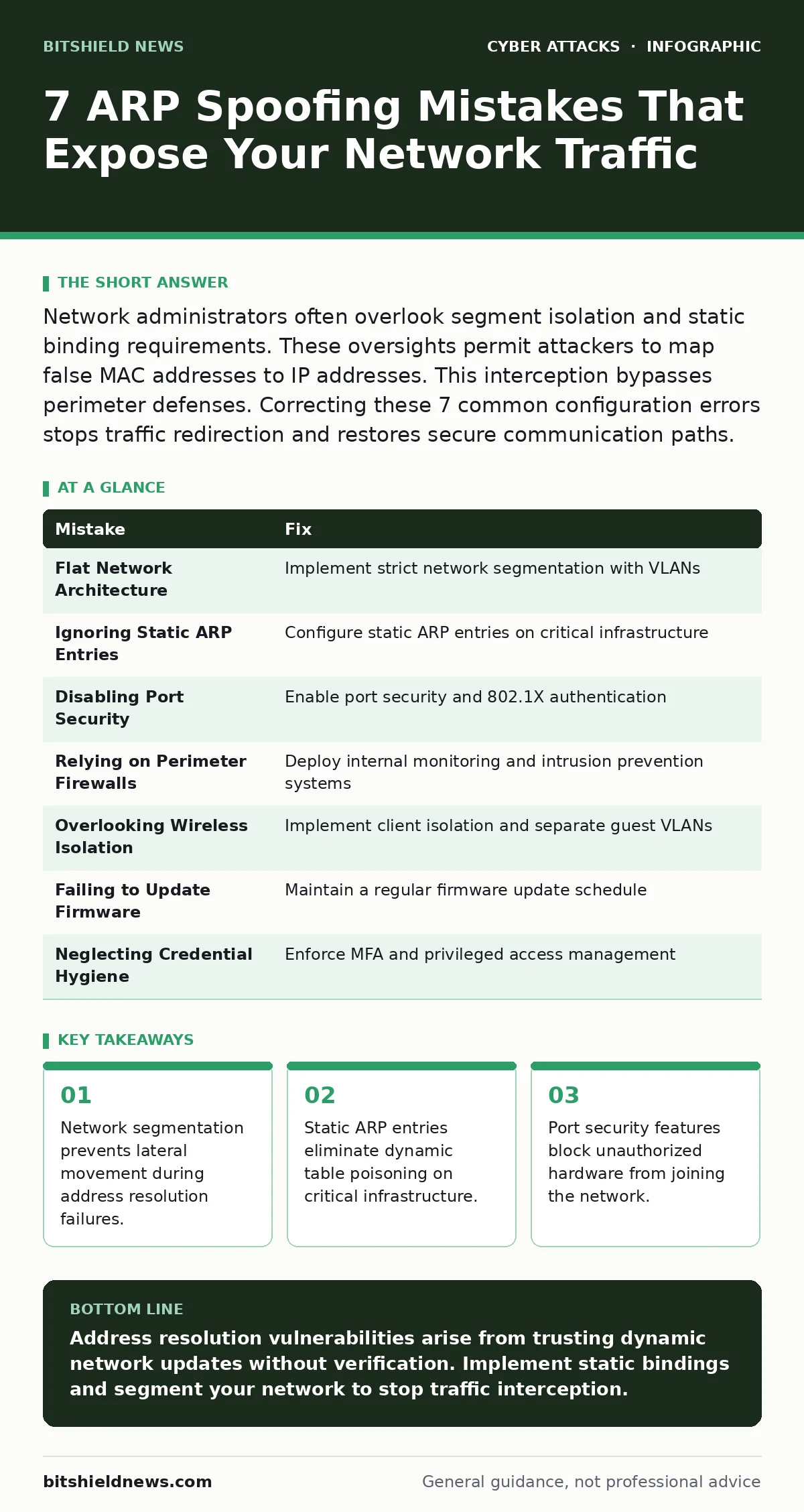
Network administrators often overlook segment isolation and static binding requirements. These oversights permit attackers to map false MAC addresses to IP addresses. This interception bypasses perimeter defenses. Correcting these 7 common configuration errors stops traffic redirection and restores secure communication paths.
Mistake 1: Flat Network Architecture
A flat network architecture connects all devices to a single broadcast domain. This design allows any host to communicate directly with any other host. Attackers exploit this openness by broadcasting fake address resolution protocol messages. These messages convince switches to redirect traffic to the attacker’s machine. The consequence is total visibility into all internal communications. You lose the ability to isolate compromised endpoints from sensitive assets.
Why it hurts:
Broadcast traffic travels to every device on the segment. An attacker listening on this segment receives all address resolution requests. They respond faster than legitimate servers. This redirects traffic through their device. You cannot detect this interception through standard firewall logs. The attack happens at layer 2, below traditional security controls.
The fix:
Implement strict network segmentation. Divide your network into smaller subnets based on function or security level. Use VLANs to isolate groups of devices. Place firewalls between these segments. This limits the scope of any single address resolution attack. Traffic cannot jump between segments without passing through controlled gateways. This reduces the attack surface significantly.
Mistake 2: Ignoring Static ARP Entries
Dynamic address resolution tables update automatically when new devices join. This convenience creates a vulnerability for table poisoning. Attackers send gratuitous address resolution packets to overwrite legitimate entries. The switch then forwards traffic to the wrong MAC address. This happens silently without alerting administrators. You lose control over which device owns which IP address.
Why it hurts:
Dynamic tables trust the first response they receive. An attacker does not need to break encryption. They only need to lie about their identity. The switch accepts the lie as truth. Traffic flows to the attacker instead of the intended server. This enables man-in-the-middle attacks on unencrypted protocols. You cannot verify the legitimacy of the response.
The fix:
Configure static ARP entries on critical infrastructure. Manually map IP addresses to known MAC addresses for servers and gateways. This prevents the table from accepting external updates for these addresses. Use automated scripts to manage these entries if the environment is large. This ensures traffic always reaches the correct destination. It eliminates the possibility of dynamic poisoning for these assets.
Mistake 3: Disabling Port Security
Switch ports often accept connections from any device by default. This flexibility is convenient for temporary users but dangerous for security. An attacker can plug a device into any unused port. They then broadcast spoofed packets to the entire segment. Without port security, the switch treats this device as legitimate. You gain an unauthorized entry point into your network.
Why it hurts:
Physical access grants logical access in this scenario. The attacker does not need to hack the operating system. They only need to connect a cable. The switch learns the attacker’s MAC address. It begins forwarding traffic to this new device. This bypasses all perimeter security measures. You have no control over which hardware connects to your infrastructure.
The fix:
Enable port security on all access switches. Limit the number of MAC addresses allowed per port. Set the violation mode to shutdown or restrict. This disables the port if an unauthorized device connects. Combine this with 802.1X authentication for stronger control. This ensures only approved devices can send traffic. It stops physical layer attacks before they start.
Mistake 4: Relying on Perimeter Firewalls Alone
Perimeter firewalls inspect traffic entering and leaving the network. They are designed to block external threats. They do not monitor internal traffic between devices. Address resolution attacks occur entirely within the local network. Firewalls see the traffic as internal and trusted. They do not inspect the packet headers for spoofing. You create a false sense of security inside your perimeter.
Why it hurts:
Internal threats bypass external defenses. An attacker inside the network can pivot freely. They intercept traffic between internal servers and users. The firewall records this as legitimate internal communication. No alerts are generated for lateral movement. You miss the early signs of a compromise. This blind spot allows attackers to gather credentials and data.
The fix:
Deploy internal monitoring tools. Use intrusion prevention systems to inspect internal traffic. Configure these systems to detect anomalous address resolution patterns. Look for duplicate IP responses or unexpected MAC changes. This adds a layer of defense inside the perimeter. It catches attacks that firewalls ignore. You gain visibility into internal network behavior.
Mistake 5: Overlooking Wireless Network Isolation
Wireless networks often share a single broadcast domain. Guests and employees may connect to the same SSID. This mixing allows cross-segment communication. An attacker on the guest network can target employee devices. They send spoofed packets to intercept sensitive data. The wireless access point does not distinguish between user types. You expose corporate data to unvetted connections.
Why it hurts:
Guest devices are often unpatched or infected. They become launchpads for internal attacks. The attacker does not need to breach the main network. They already have access through the wireless interface. They can intercept traffic from nearby employees. This violates data privacy and security policies. You cannot trust devices that you do not manage.
The fix:
Implement client isolation on wireless networks. This feature prevents wireless clients from communicating directly. They can only reach the internet or specific gateways. Separate guest and corporate traffic onto different VLANs. Apply strict access control lists to these VLANs. This ensures guest devices cannot reach internal resources. It limits the impact of compromised wireless clients.
See also: Detect Ransomware-as-a-Service: Log Signals and Blind Spots
Mistake 6: Failing to Update Switch Firmware
Switch firmware contains the logic for handling network traffic. Older firmware may lack security patches for known vulnerabilities. Attackers exploit these flaws to manipulate address resolution tables. They can crash the switch or take control of it. This disrupts network availability and security. You leave known attack vectors open to exploitation.
Why it hurts:
Vendors release patches to fix security holes. Ignoring these updates leaves the switch vulnerable. Attackers use automated tools to find outdated devices. They exploit these weaknesses to gain access. The switch may behave unpredictably under attack. Traffic may be dropped or redirected incorrectly. You increase the risk of a successful compromise.
The fix:
Maintain a regular firmware update schedule. Test updates in a staging environment first. Apply patches to production switches during maintenance windows. This ensures you have the latest security fixes. It reduces the risk of exploitation. You maintain a secure baseline for your network infrastructure.
Mistake 7: Neglecting Credential Hygiene
Address resolution attacks often precede credential theft. Attackers intercept login requests to capture passwords. Weak or reused credentials make this theft valuable. If users employ the same password across services, the attacker gains wider access. This amplifies the damage of a single interception. You compound the risk of network layer attacks with application layer weaknesses.
Why it hurts:
Intercepted credentials provide direct access to systems. The attacker does not need further exploitation. They simply log in with stolen data. This bypasses network-based security controls. The attack shifts from interception to impersonation. You face account takeover and data exfiltration. The initial network attack becomes a full breach.
The fix:
Enforce strong password policies and multi-factor authentication. This reduces the value of intercepted credentials. Even if an attacker captures a password, they cannot log in without the second factor. Implement privileged access management for administrative accounts. This limits the impact of stolen credentials. You protect sensitive systems from unauthorized access.
| Mistake | Fix |
|---|---|
| Flat Network Architecture | Implement strict network segmentation with VLANs |
| Ignoring Static ARP Entries | Configure static ARP entries on critical infrastructure |
| Disabling Port Security | Enable port security and 802.1X authentication |
| Relying on Perimeter Firewalls | Deploy internal monitoring and intrusion prevention systems |
| Overlooking Wireless Isolation | Implement client isolation and separate guest VLANs |
| Failing to Update Firmware | Maintain a regular firmware update schedule |
| Neglecting Credential Hygiene | Enforce MFA and privileged access management |
Key takeaways
- Network segmentation prevents lateral movement during address resolution failures.
- Static ARP entries eliminate dynamic table poisoning on critical infrastructure.
- Port security features block unauthorized hardware from joining the network.
Address resolution vulnerabilities arise from trusting dynamic network updates without verification. Implement static bindings and segment your network to stop traffic interception.
Frequently asked questions
Can ARP spoofing affect cloud environments?
Cloud providers manage the underlying network, but you must secure your virtual subnets. Misconfigured security groups can still allow internal traffic interception.
How do I detect an active ARP spoofing attack?
Monitor for duplicate IP addresses and unusual MAC address changes. Internal intrusion prevention systems can alert on these anomalies in real time.
Does encryption prevent ARP spoofing?
Encryption protects data content but not the routing path. Attackers can still redirect traffic to themselves before encryption occurs. You must secure the network layer separately.
Is static ARP binding scalable for large networks?
Manual static binding is difficult at scale. Use automated network access control systems to manage dynamic bindings securely. This balances security with operational efficiency.
How this guide was produced: written by the BitShield News editorial team with AI assistance, checked against the public references listed below, and reviewed when the facts change. See our editorial policy or report an error.