
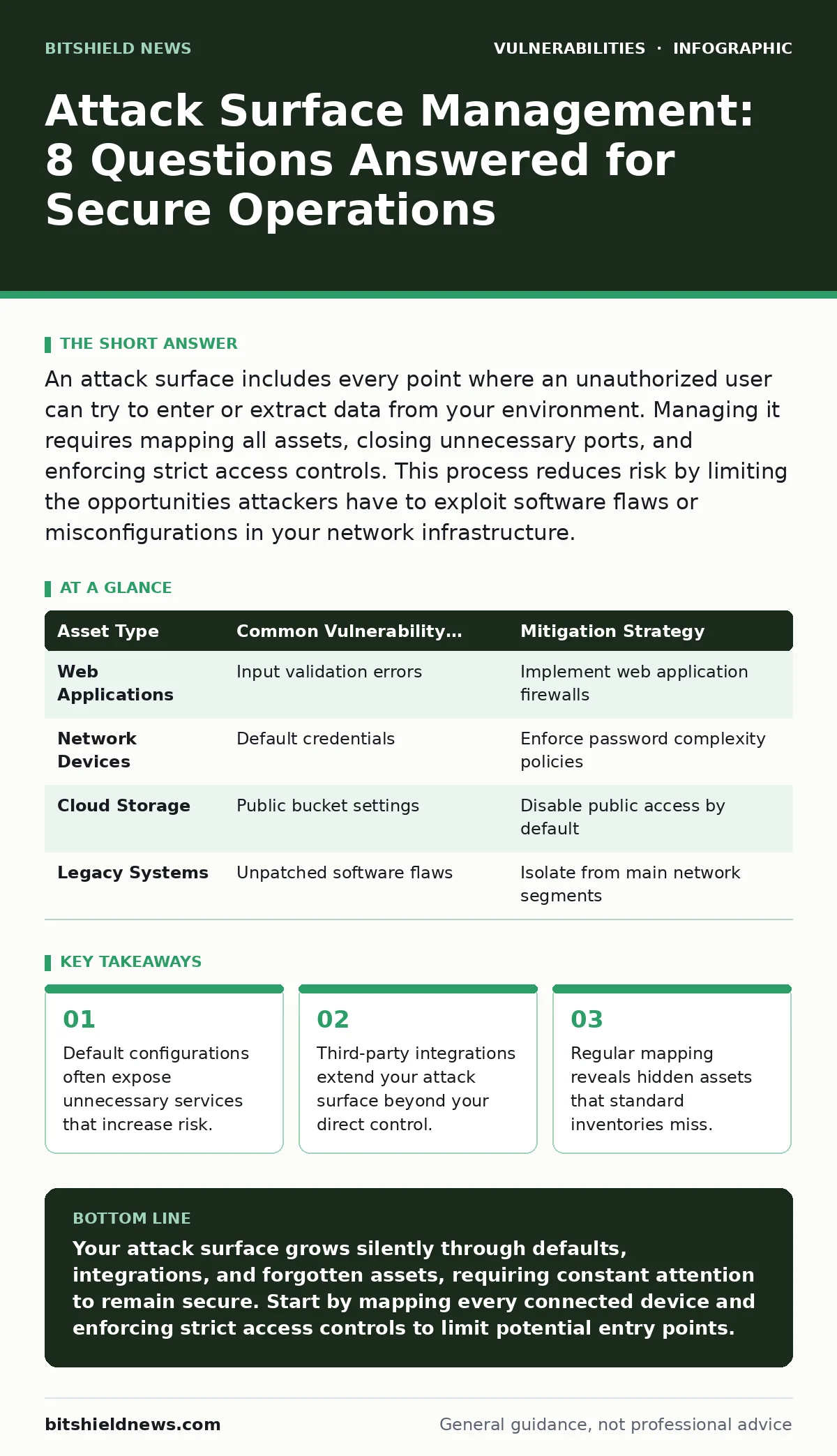
An attack surface includes every point where an unauthorized user can try to enter or extract data from your environment. Managing it requires mapping all assets, closing unnecessary ports, and enforcing strict access controls. This process reduces risk by limiting the opportunities attackers have to exploit software flaws or misconfigurations in your network infrastructure.
What exactly defines the attack surface?
The attack surface is the total sum of all possible entry points where an attacker could attempt to gain unauthorized access to a data holding system. This includes every device, application, network port, and user account connected to your infrastructure. It is not limited to internet-facing web servers.
Internal systems, legacy hardware, and even printed documents containing sensitive information contribute to this surface. Understanding the full scope prevents blind spots in your security posture. You must account for both digital and physical vectors. A single unpatched printer can serve as a pivot point for deeper network intrusion. Mapping these points provides the baseline for effective risk reduction.
How do default configurations increase risk?
Default configurations often leave unnecessary services enabled, creating easy entry points for attackers who know common vendor settings. Many devices ship with pre-set credentials or open ports that administrators forget to close during deployment. These defaults assume a secure environment that rarely exists in practice. Attackers scan for these known signatures automatically.
Leaving them active invites exploitation without any need for complex hacking. Changing default passwords and disabling unused features removes low-hanging fruit from your environment. This simple step significantly raises the barrier for initial compromise. It forces attackers to find more complex vulnerabilities rather than exploiting obvious mistakes.
Why do third-party integrations expand exposure?
Every third-party service you connect to extends your attack surface beyond your direct control and monitoring capabilities. When you integrate a cloud storage provider or a customer support chat tool, you grant that vendor access to your data or network. If the vendor suffers a breach, your organization becomes collateral damage. You inherit their security weaknesses as your own.
This dependency creates a chain of trust that is hard to verify. You must treat external vendors as part of your internal risk profile. Reviewing their security practices and limiting the data they can access mitigates this extended exposure. Ignoring supply chain risks leaves you vulnerable to attacks you cannot directly prevent.
What role does least privilege play in reduction?
Enforcing least privilege access ensures that users and systems only have the permissions necessary to perform their specific tasks. This principle limits the damage an attacker can cause if they compromise a single account. Instead of granting broad administrative rights, you assign narrow, role-based permissions.
If a service account is breached, the attacker cannot move laterally to critical databases. This containment strategy reduces the blast radius of any successful intrusion. It requires regular audits to ensure permissions have not crept up over time. Removing unused access rights is as important as restricting new ones. This discipline makes privilege escalation attacks much harder to execute successfully.
How can hidden assets remain undetected?
Shadow IT and forgotten development environments often remain invisible to standard security tools, creating blind spots in your defense. Employees may spin up test servers or use unauthorized cloud instances for convenience. These assets lack monitoring, patching, and proper access controls. They become easy targets for attackers scanning for low-security targets.
Once compromised, these hidden assets can serve as bridges to your main network. Regular asset discovery scans help identify these rogue systems. You must reconcile technical inventories with business records to find discrepancies. Unmanaged assets are the weakest links in any security chain because they operate outside established governance frameworks.
See also: VEX Documents Explained: How Vulnerability Exploitability Works · Why the CISA Known Exploited Vulnerabilities Catalog Matters for Security
Does patching close the entire surface?
Patching software vulnerabilities is critical but does not eliminate the entire attack surface, as misconfigurations and logic flaws remain. Even fully updated systems can be exploited if firewall rules are too permissive or if authentication mechanisms are weak. Attackers often bypass patches by targeting human error or architectural weaknesses.
Relying solely on Patch Tuesday updates creates a false sense of security. You must also secure the configuration and the code logic. A patched server with a misconfigured database is still vulnerable. Defense in depth requires multiple layers of protection beyond just software updates. Combining patching with strict access controls provides a more resilient security posture.
| Asset Type | Common Vulnerability Source | Mitigation Strategy |
|---|---|---|
| Web Applications | Input validation errors | Implement web application firewalls |
| Network Devices | Default credentials | Enforce password complexity policies |
| Cloud Storage | Public bucket settings | Disable public access by default |
| Legacy Systems | Unpatched software flaws | Isolate from main network segments |
Why is continuous monitoring necessary?
The attack surface changes constantly as new devices are added, software is updated, and network boundaries shift. A static snapshot of your assets becomes outdated within days, leaving new vulnerabilities unaddressed. Continuous monitoring detects these changes in real time, allowing you to react before attackers exploit them.
Automated tools can flag new open ports or unauthorized software installations immediately. This proactive approach prevents the accumulation of technical debt. You cannot protect what you do not see. Regular scans and real-time alerts keep your inventory accurate. This vigilance ensures that your security controls remain aligned with your current infrastructure state.
How do authorization bypasses compromise security?
Authorization bypass vulnerabilities allow attackers to access resources they should not have permission to view or modify, often by manipulating request parameters. These flaws occur when the server fails to properly check user privileges for every action. An attacker might change a user ID in a URL to access another person’s data. This type of vulnerability is dangerous because it does not require breaking encryption or guessing passwords. It exploits logic errors in the application code. Testing for these bypasses requires specialized penetration testing techniques. Implementing strict server-side checks for every request prevents these unauthorized accesses.
What is the cost of ignoring the surface?
Ignoring the attack surface leads to unmanaged risk, where small vulnerabilities accumulate into major security failures. Without regular assessment, you cannot prioritize fixes effectively, wasting resources on low-risk items while critical gaps remain. Attackers exploit this negligence by targeting the weakest links first.
The financial and reputational cost of a breach far exceeds the effort required for regular surface management. Proactive reduction of your attack surface is an investment in operational stability. It prevents the chaos of reactive incident response. You maintain control over your security posture rather than reacting to external threats. This discipline builds resilience against evolving cyber threats.
Key takeaways
- Default configurations often expose unnecessary services that increase risk.
- Third-party integrations extend your attack surface beyond your direct control.
- Regular mapping reveals hidden assets that standard inventories miss.
Your attack surface grows silently through defaults, integrations, and forgotten assets, requiring constant attention to remain secure. Start by mapping every connected device and enforcing strict access controls to limit potential entry points.
Frequently asked questions
How often should I scan my attack surface?
You should scan your attack surface continuously or at least daily for internet-facing assets. Internal assets can be scanned weekly, but any significant change in infrastructure requires an immediate re-scan.
Can firewalls eliminate my attack surface?
Firewalls reduce the attack surface by blocking unauthorized traffic, but they do not eliminate it. Misconfigured firewalls or allowed services with vulnerabilities still present risks that require separate management and monitoring.
What is the difference between attack surface and attack path?
The attack surface is the set of all possible entry points, while the attack path is the specific route an attacker takes to exploit a vulnerability. Managing the surface reduces the number of possible paths.
Do zero-trust architectures remove the attack surface?
Zero-trust architectures minimize the effective attack surface by verifying every request, but they do not remove the underlying assets. They make exploitation harder by limiting lateral movement and enforcing strict access.
How this guide was produced: written by the BitShield News editorial team with AI assistance, checked against the public references listed below, and reviewed when the facts change. See our editorial policy or report an error.