
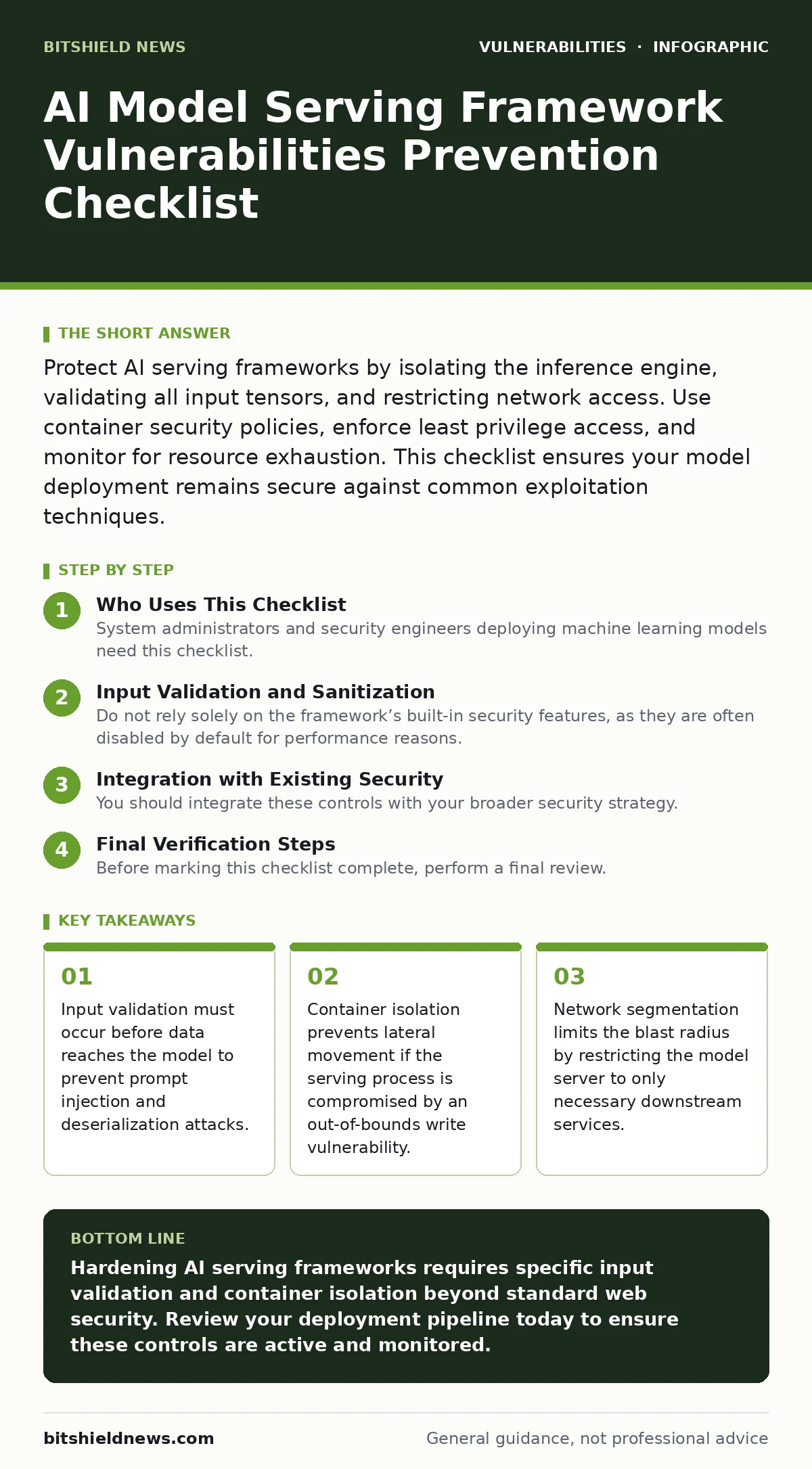
Protect AI serving frameworks by isolating the inference engine, validating all input tensors, and restricting network access. Use container security policies, enforce least privilege access, and monitor for resource exhaustion. This checklist ensures your model deployment remains secure against common exploitation techniques.
Who Uses This Checklist
System administrators and security engineers deploying machine learning models need this checklist. You use it to harden the infrastructure that hosts your inference engines. The goal is to reduce the attack surface of the serving layer. Traditional web application firewalls often fail to inspect binary tensor data or specialized API calls used by AI frameworks. You must apply specific controls to the container, the host, and the application logic.
Input Validation and Sanitization
- Validate tensor dimensions against expected schema: Prevents memory corruption and denial-of-service attacks via oversized inputs.
- Sanitize text inputs for special characters: Stops prompt injection attempts that manipulate model behavior or leak system prompts.
- Reject non-standard data formats early: Avoids deserialization vulnerabilities that allow arbitrary code execution during data parsing.
- Implement rate limiting on inference endpoints: Mitigates resource exhaustion attacks that crash the serving process through high volume.
- Log and alert on anomalous input patterns: Detects adversarial examples designed to bypass security filters or confuse the model.
Container and Runtime Hardening
- Run containers as non-root users: Limits the impact of a container escape to the permissions of that user account.
- Enable read-only root filesystems: Prevents attackers from modifying binary files or configuration within the running container.
- Drop all unnecessary Linux capabilities: Reduces the kernel-level powers available to the process, minimizing exploit potential.
- Use minimal base images: Fewer libraries mean fewer known vulnerabilities to patch and a smaller memory footprint.
- Disable dynamic code loading at runtime: Prevents attackers from injecting malicious shared libraries into the memory space.
Network and Access Controls
- Restrict inbound traffic to known IP ranges: Blocks unauthorized access attempts from the public internet or untrusted networks.
- Enforce mutual TLS for service-to-service calls: Ensures that only authenticated services can request predictions from the model.
- Segment the model server from production databases: Prevents lateral movement if the serving layer is compromised by an attacker.
- Disable unused ports and protocols: Reduces the number of entry points an attacker can probe for vulnerabilities.
- Monitor outbound connections for data exfiltration: Detects attempts to send sensitive training data or model weights to external servers.
Dependency and Supply Chain Security
- Scan all third-party libraries for known CVEs: Identifies vulnerabilities in dependencies that could be exploited through the serving API.
- Verify cryptographic signatures of model artifacts: Ensures the model file has not been tampered with during storage or transfer.
- Pin dependency versions in lock files: Prevents accidental updates that might introduce breaking changes or new security holes.
- Audit custom pre-processing scripts: Code that transforms data before inference is often overlooked but can contain serious flaws.
- Review documentation for framework-specific risks: Many frameworks have unique quirks that standard security tools do not detect.
Monitoring and Incident Response
- Track resource usage metrics in real time: Helps distinguish between legitimate high load and a denial-of-service attack.
- Log all API requests with correlation IDs: Enables forensic analysis to trace malicious inputs back to their source.
- Set alerts for failed authentication attempts: Detects brute-force attacks against the serving endpoint’s access controls.
- Test incident response procedures regularly: Ensures your team knows how to isolate and remediate a compromised serving instance.
- Keep a backup of clean model artifacts: Allows rapid rollback if a model is found to be poisoned or tampered with.
Integration with Existing Security
You should integrate these controls with your broader security strategy. For instance, ensure your deployment practices align with the CISA Known Exploited Vulnerabilities catalog to prioritize patching. If you manage legacy infrastructure, remember that Citrix NetScaler vulnerabilities can sometimes expose backend services, including AI endpoints, if routing is misconfigured.
Additionally, prevent directory listing exposure on any static assets served alongside the model API. Understanding your full attack surface helps you prioritize which controls matter most. Finally, stay aware that OpenSSL vulnerabilities can impact the TLS termination layer, so keep your cryptographic libraries updated.
Final Verification Steps
Before marking this checklist complete, perform a final review. Ensure that least privilege access is enforced at both the operating system and the application level. Verify that all logging mechanisms are active and sending data to a secure, centralized storage location. Confirm that your team has access to the necessary tools to investigate anomalies quickly. This process is not a one-time task. You must repeat it as your infrastructure evolves and new threats emerge. Consistent application of these controls builds a resilient defense around your AI assets.
Key takeaways
- Input validation must occur before data reaches the model to prevent prompt injection and deserialization attacks.
- Container isolation prevents lateral movement if the serving process is compromised by an out-of-bounds write vulnerability.
- Network segmentation limits the blast radius by restricting the model server to only necessary downstream services.
Hardening AI serving frameworks requires specific input validation and container isolation beyond standard web security. Review your deployment pipeline today to ensure these controls are active and monitored.
Frequently asked questions
How do I prevent prompt injection in my AI model?
Validate and sanitize all text inputs before they reach the model, and use system prompts that restrict the model’s ability to override instructions.
Is containerization enough to secure my AI model?
No, containerization provides isolation but does not secure the application code or inputs. You must also harden the runtime and validate data.
What is the biggest risk in AI model serving?
The biggest risk is often unvalidated input, which can lead to denial-of-service, data leakage, or remote code execution via deserialization flaws.
How often should I update my security checklist?
Review and update your checklist with every major framework update, dependency change, or significant infrastructure modification.
How this guide was produced: written by the BitShield News editorial team with AI assistance, checked against the public references listed below, and reviewed when the facts change. See our editorial policy or report an error.