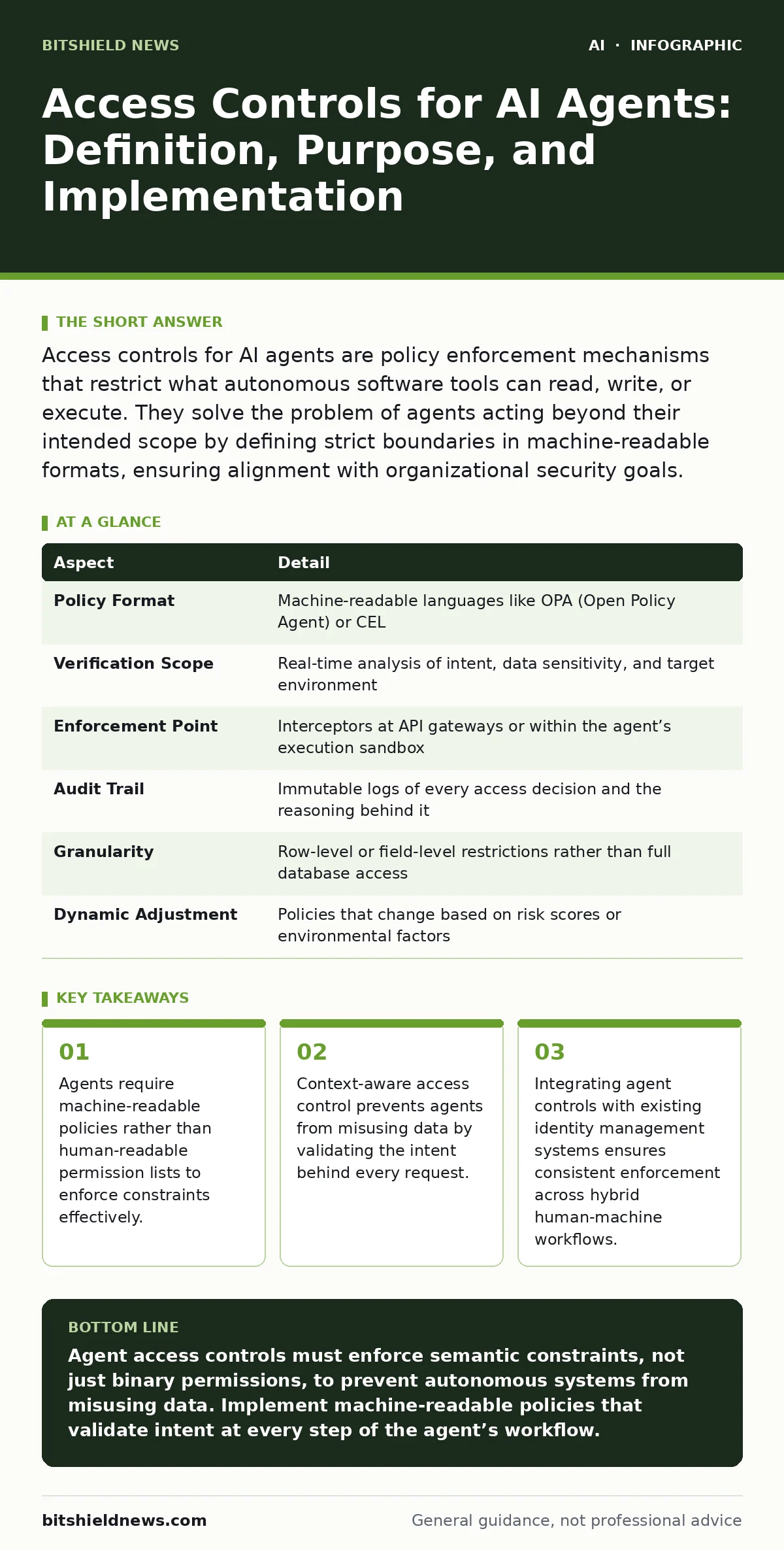
Access controls for AI agents are policy enforcement mechanisms that restrict what autonomous software tools can read, write, or execute. They solve the problem of agents acting beyond their intended scope by defining strict boundaries in machine-readable formats, ensuring alignment with organizational security goals.
Why Human Permissions Fail for Autonomous Agents
Imagine a librarian who can read any book but cannot decide which patron deserves a copy. Traditional access control systems operate on this simple model. They check if a user has a key to a door. If the key fits, the door opens. This binary logic works for humans because humans understand context, social norms, and implicit boundaries. An employee knows not to copy the entire customer database just because they have read access to it. Autonomous software lacks this implicit understanding. An AI agent follows instructions literally.
If an agent has read access to a file, it will read every byte of that file, regardless of whether the data is necessary for the task. This behavior creates a massive attack surface. An agent with broad permissions becomes a high-speed data exfiltration tool if compromised. Access controls for AI agents address this gap by adding semantic constraints to traditional permission models. They do not just ask who is asking. They ask what the agent is trying to achieve and whether that goal aligns with allowed behaviors.
The Core Problem: Scope Creep and Context Loss
Autonomous agents often operate across multiple systems simultaneously. They might pull data from a CRM, analyze it using a large language model, and then post a summary to a project management tool. Each of these systems has its own access control list. The agent needs credentials for all of them. This creates a privilege accumulation problem. The agent holds the combined permissions of all the systems it touches. If an attacker compromises the agent, they inherit all those privileges.
Traditional defenses treat each system in isolation. They do not see the chain of actions. Access controls for AI agents solve this by treating the agent’s workflow as a single unit. They enforce policies that span across system boundaries. This prevents scope creep, where an agent gradually accesses more data than originally intended. It also prevents context loss, where data is moved to an environment with weaker protections. The agent must prove its intent at every step of the chain.
Main Components of Agent Access Control
Effective access control for autonomous systems relies on three distinct components. These components work together to create a secure boundary around the agent’s operations.
- Policy Definition Engine: This component translates human security rules into machine-readable formats. Policies must be precise. Vague rules like "only access relevant data" are useless to an agent. The engine converts these into specific constraints, such as "only access customer records created in the last 30 days."
- Context Verification Layer: This layer analyzes the request in real-time. It checks the current state of the agent, the data being accessed, and the target system. It verifies that the action matches the defined policy. If the policy says "read only," the layer blocks any write attempts.
- Enforcement Mechanism: This component acts as the gatekeeper. It sits between the agent and the resource. It intercepts every request and either allows or denies it based on the verification layer’s output. It logs every decision for audit purposes.
| Aspect | Detail |
|---|---|
| Policy Format | Machine-readable languages like OPA (Open Policy Agent) or CEL |
| Verification Scope | Real-time analysis of intent, data sensitivity, and target environment |
| Enforcement Point | Interceptors at API gateways or within the agent’s execution sandbox |
| Audit Trail | Immutable logs of every access decision and the reasoning behind it |
| Granularity | Row-level or field-level restrictions rather than full database access |
| Dynamic Adjustment | Policies that change based on risk scores or environmental factors |
Integration with Existing Defense Layers
Agent access controls do not replace existing security measures. They complement them. You must integrate them with your identity and access management system. The agent needs a digital identity. This identity should be distinct from human users. It should have a limited lifespan. Rotate the agent’s credentials frequently. Treat the agent’s identity as a high-value asset. If the agent is compromised, the attacker gains immediate access. You must also integrate with your data classification system. The access control engine needs to know what data is sensitive.
It cannot enforce rules if it does not understand the value of the data. This integration allows for dynamic policies. For example, an agent might have full access to public data but restricted access to personally identifiable information. This approach aligns with the principles found in the OWASP Top 10 for LLM applications, which highlights the risks of insecure plugin and agent interactions. By securing the agent’s access, you reduce the risk of data leakage through these channels.
Common Misconceptions About Agent Security
Many organizations assume that restricting the agent’s network access is sufficient. This is a dangerous mistake. An agent can operate entirely within a trusted network. It can still exfiltrate data if it has read permissions. Another common error is treating the agent as a human user. Human users make mistakes. Agents make systematic errors. An agent will repeatedly attempt the same unauthorized action if the policy is unclear. You must design policies that are fail-safe.
If the agent cannot determine the correct action, it should default to denial. Also, do not rely solely on the large language model to enforce security. Models can be tricked. They can hallucinate permissions. The access control must be a separate, deterministic system. It must not depend on the probabilistic output of the model. This separation is critical for maintaining integrity. For more on the risks of untrusted components, see the guide on insecure AI plugins and agents.
The Hidden Cost of Over-Permissive Agents
Giving an agent broad permissions seems efficient. It reduces friction and speeds up tasks. However, this convenience has a hidden cost. It increases the blast radius of any failure. If the agent encounters a bug, it might delete critical data. If it is manipulated by a prompt injection attack, it might bypass safety filters. The cost of remediation is high. You must reconstruct lost data or contain a breach.
This is why emergency stop for AI systems is a necessary companion to access controls. You need a way to halt the agent immediately if it behaves unexpectedly. Access controls prevent unauthorized actions, but they do not stop all errors. You need a combination of prevention and interruption. This layered approach ensures that even if one control fails, the other catches the issue.
Building Resilient Agent Policies
Creating effective policies requires a shift in mindset. You must think in terms of capabilities rather than permissions. Instead of saying "the agent can read files," say "the agent can extract metrics from sales reports." This capability-based approach is more secure. It limits the agent’s actions to specific outcomes. It also makes auditing easier. You can review the outcomes rather than every individual file access. You should also implement least privilege strictly.
Give the agent only the permissions it needs for the current task. Revoke them immediately after the task is complete. This reduces the window of opportunity for attackers. Regularly review and update your policies. As the agent’s role evolves, its permissions should evolve too. Do not leave old permissions in place. This practice aligns with the goals of AI security testing, which helps identify gaps in your control framework. By focusing on capabilities and least privilege, you build a more resilient system.
Final Considerations for Implementation
Implementing access controls for AI agents is not a one-time task. It is an ongoing process. You must monitor agent behavior continuously. Look for anomalies. An agent that suddenly accesses a large volume of data is a red flag. You must also educate your development teams. They need to understand how to design agents that respect these controls. Security must be built into the agent’s architecture from the start.
It cannot be an afterthought. This approach ensures that your AI systems remain secure as they become more autonomous. For insights on detecting unauthorized content generation, refer to the guide on AI content detection. By combining technical controls with cultural awareness, you create a robust defense against emerging threats.
Key takeaways
- Agents require machine-readable policies rather than human-readable permission lists to enforce constraints effectively.
- Context-aware access control prevents agents from misusing data by validating the intent behind every request.
- Integrating agent controls with existing identity management systems ensures consistent enforcement across hybrid human-machine workflows.
Agent access controls must enforce semantic constraints, not just binary permissions, to prevent autonomous systems from misusing data. Implement machine-readable policies that validate intent at every step of the agent’s workflow.
Frequently asked questions
How do I define permissions for an AI agent?
Define permissions based on specific capabilities and outcomes rather than broad data access. Use machine-readable policy languages to specify exactly what the agent can do and what data it can touch.
Can access controls stop prompt injection attacks?
Access controls can mitigate the impact of prompt injection by limiting what the agent can do even if it is tricked. They do not prevent the injection itself, but they restrict the damage the attacker can cause.
Do I need separate access controls for each AI model?
You do not need separate controls for each model, but you do need controls for each agent identity. Multiple agents can share the same model, but each agent should have its own scoped permissions based on its specific role.
How often should I review agent access policies?
Review policies whenever the agent’s role changes or after any security incident. Regular audits, such as quarterly reviews, help ensure that permissions remain aligned with business needs and security requirements.
How this guide was produced: written by the BitShield News editorial team with AI assistance, checked against the public references listed below, and reviewed when the facts change. See our editorial policy or report an error.