
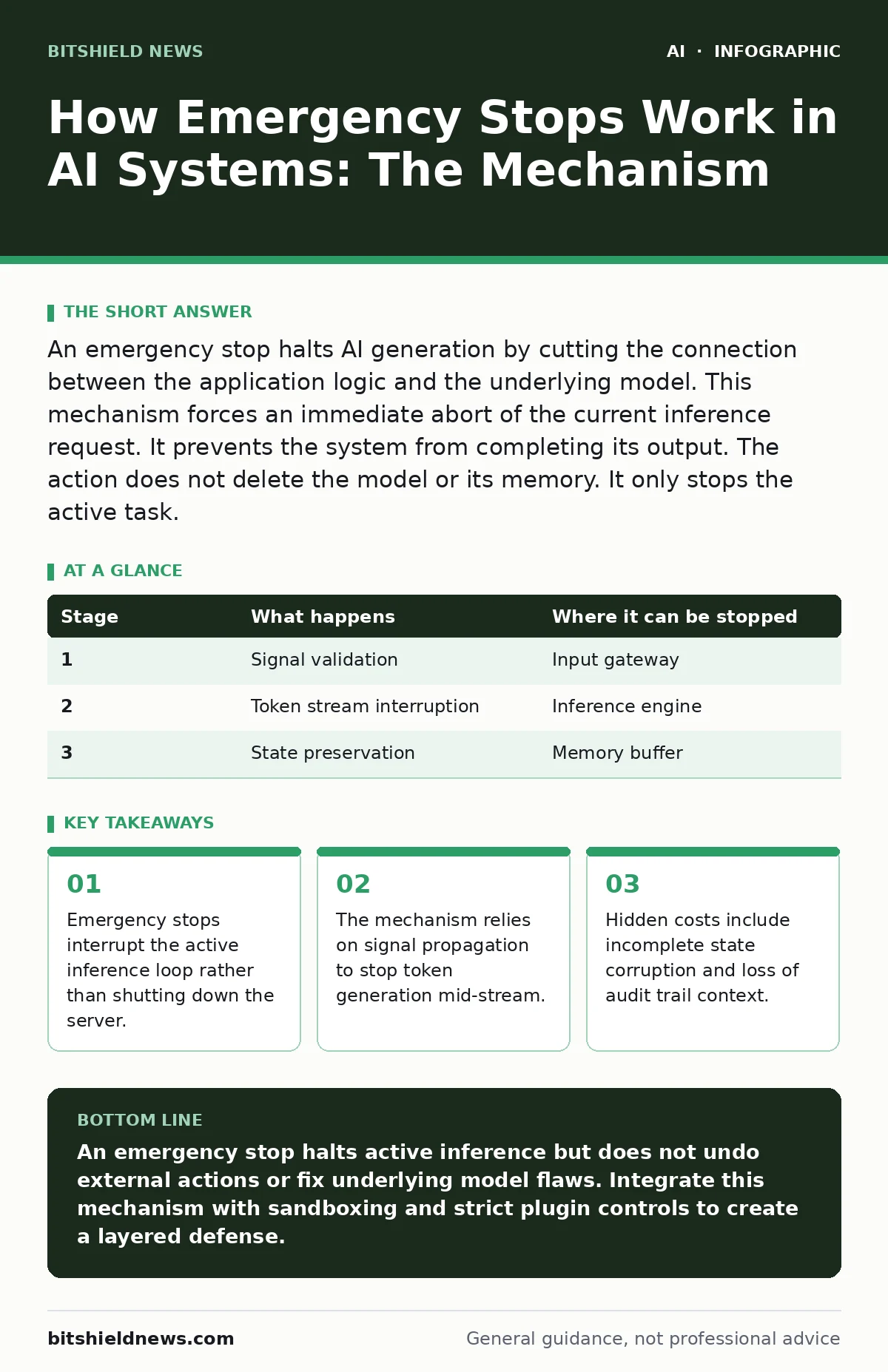
An emergency stop halts AI generation by cutting the connection between the application logic and the underlying model. This mechanism forces an immediate abort of the current inference request. It prevents the system from completing its output. The action does not delete the model or its memory. It only stops the active task.
The Anatomy of an AI Kill Switch
An emergency stop for AI systems functions as a circuit breaker for computational processes. You need to understand that stopping an artificial intelligence is not the same as turning off a light switch. Large language models operate in continuous streams of prediction. When you trigger a stop, you are interrupting a mathematical sequence that is actively calculating the next probable token. The goal is to prevent the model from emitting harmful, hallucinated, or unauthorized output. This requires a mechanism that acts faster than the model’s generation speed. The system must recognize the command and halt the data pipeline instantly.
Stage 1: Signal Detection and Validation
The process begins when a monitoring agent or human operator detects an anomaly. The system receives a stop command. This command must be validated to ensure it is not a false positive. False positives can cause service outages during legitimate high-load operations. The validation step checks the source of the request. It confirms the authority of the sender. This prevents malicious actors from denying service to the AI. The system verifies the integrity of the signal before propagating it. This step ensures that only authorized interrupts trigger the halt.
| Stage | What happens | Where it can be stopped |
|---|---|---|
| 1 | Signal validation | Input gateway |
| 2 | Token stream interruption | Inference engine |
| 3 | State preservation | Memory buffer |
Stage 2: Interrupting the Inference Loop
Once validated, the stop signal travels to the inference engine. This is the core component where the model processes data. The engine is currently generating tokens one by one. The interrupt command forces the engine to drop the current batch. It does not wait for the sentence to finish. It cuts the stream immediately. This action leaves the output incomplete. The model may have predicted the next five tokens internally, but they are discarded. This prevents the completion of any potentially dangerous reasoning chain. The interruption happens at the lowest level of the generation pipeline.
Stage 3: State Isolation and Memory Dump
Stopping the generation is not enough. You must isolate the state of the system. The AI retains context in its short-term memory buffers. This context includes the prompt, the partial response, and the internal attention weights. If this state is not isolated, the system might resume from a corrupted point. The emergency stop dumps the current state to a secure log. It then clears the active memory buffers. This ensures that no residual data influences the next request. This step is critical for maintaining the integrity of the system’s future operations. It prevents cross-contamination between sessions.
Stage 4: Notification and Audit Trail
The final stage involves recording the event. The system generates an audit log entry. This entry details the timestamp, the user, the prompt, and the reason for the stop. It also records the partial output that was suppressed. This data is vital for post-incident analysis. It helps engineers understand why the model behaved unexpectedly. The notification system alerts relevant personnel. This ensures that human oversight is restored quickly. The audit trail provides a clear record of the intervention. It supports compliance and forensic investigation.
The Hidden Costs of Interruption
Emergency stops have unintended consequences. The primary cost is the loss of context. When you interrupt a long reasoning chain, the model loses its place. Restarting the task may require re-submitting the entire prompt. This increases latency and computational cost. Additionally, frequent stops can degrade the model’s performance. The system may become overly cautious. It might refuse legitimate requests to avoid triggering another stop. This phenomenon is known as sycophancy. The model learns to prioritize safety over accuracy. You must balance security with usability.
Limits of the Mechanism
An emergency stop cannot reverse actions already taken. If the AI has already sent an email or executed a command, the stop is too late. The mechanism only affects the generation process. It does not undo external side effects. This is a critical limitation. You must integrate the stop function with other security controls. For instance, use sandboxing to contain the output. Use approval workflows for high-risk actions. The stop button is a last resort, not a preventive measure. It does not fix the underlying vulnerability in the prompt or the model.
Integrating with Broader Security
Effective AI security requires more than a kill switch. You must address the broader ecosystem. Consider the risks of insecure AI plugins and agents. These components can bypass your primary controls. They may execute code outside the main inference loop. An emergency stop in the core model does not stop a plugin from acting. You need layered defenses. Review the OWASP Top 10 for LLM applications to identify other vectors. Address injection attacks and data leakage risks. Ensure that your stop mechanism covers all integration points.
The Role of Human Oversight
Automation cannot replace human judgment. The emergency stop is a tool for human operators. It empowers them to intervene when algorithms fail. However, reliance on automation can lead to alert fatigue. Operators may ignore stop signals if they occur too frequently. You must design the system to highlight genuine threats. Provide clear context for each stop. This helps operators make informed decisions. The goal is to augment human capability, not replace it. Human oversight ensures that the stop is applied correctly. It prevents misuse of the power to halt critical systems.
Key takeaways
- Emergency stops interrupt the active inference loop rather than shutting down the server.
- The mechanism relies on signal propagation to stop token generation mid-stream.
- Hidden costs include incomplete state corruption and loss of audit trail context.
An emergency stop halts active inference but does not undo external actions or fix underlying model flaws. Integrate this mechanism with sandboxing and strict plugin controls to create a layered defense.
Frequently asked questions
Can an emergency stop delete the AI model?
No, an emergency stop only halts the current inference process. It does not delete the model weights or the underlying software. The model remains installed and ready for the next request.
How fast does the stop mechanism activate?
The activation time depends on the architecture. Typically, it happens within milliseconds. The signal must travel from the detection layer to the inference engine. Network latency can add slight delays.
Does the stop preserve the conversation history?
The stop preserves the history up to the point of interruption. It logs the partial output and the context. However, it clears the active memory buffers to prevent state corruption. The full history is stored in the audit log.
Can users bypass the emergency stop?
Users cannot bypass a properly implemented server-side stop. The control is enforced at the infrastructure level. However, users can attempt to evade detection by obfuscating prompts. This requires robust input validation.
How this guide was produced: written by the BitShield News editorial team with AI assistance, checked against the public references listed below, and reviewed when the facts change. See our editorial policy or report an error.