
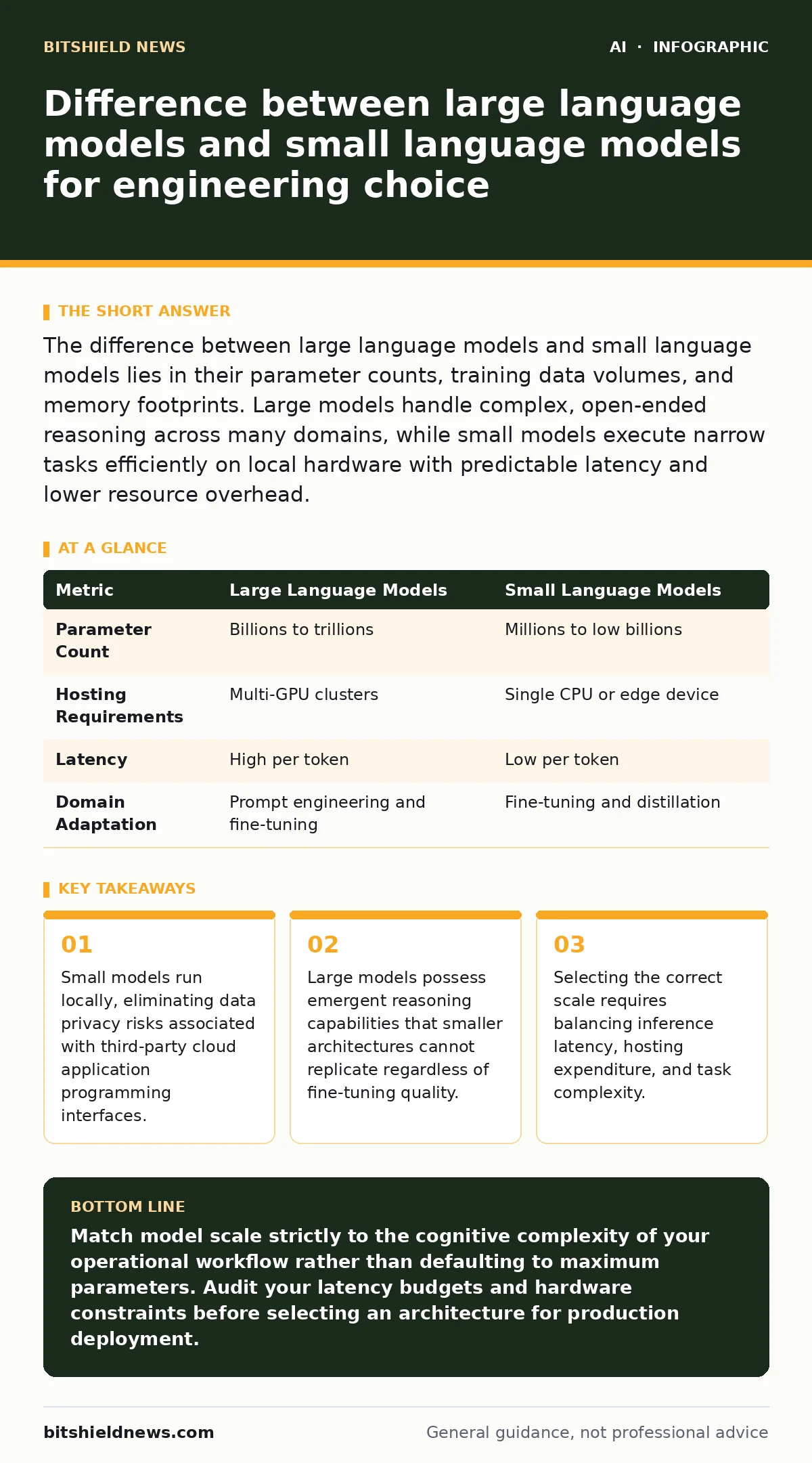
The difference between large language models and small language models lies in their parameter counts, training data volumes, and memory footprints. Large models handle complex, open-ended reasoning across many domains, while small models execute narrow tasks efficiently on local hardware with predictable latency and lower resource overhead.
Are parameter counts the only metric that defines the difference between large language models and small language models?
Parameter counts alone fail to capture the operational difference between large language models and small language models. Architecture design, training token volume, and quantization techniques heavily influence model behavior. A compact model trained on high-quality, domain-specific data often outperforms a massive general-purpose model on specialized technical tasks. You must evaluate memory bandwidth requirements alongside disk storage size when assessing operational capacity.
| Metric | Large Language Models | Small Language Models |
|---|---|---|
| Parameter Count | Billions to trillions | Millions to low billions |
| Hosting Requirements | Multi-GPU clusters | Single CPU or edge device |
| Latency | High per token | Low per token |
| Domain Adaptation | Prompt engineering and fine-tuning | Fine-tuning and distillation |
Can a small model replace a large model for enterprise automation?
Small models replace large models successfully only when tasks remain bounded and well-structured. Bounded tasks include text classification, entity extraction, and syntax translation where output schemas are rigid. Unbounded tasks requiring creative synthesis, multi-step planning, or broad contextual awareness cause small architectures to fail silently by hallucinating incorrect facts. Teams managing shadow AI often deploy underpowered models without realizing their reasoning limitations until production failures occur.
How does inference cost scale between the two tiers?
Inference costs scale non-linearly due to the memory bandwidth required to load billions of weights into processor caches for every generated token. Large architectures demand expensive accelerator hardware with high-bandwidth memory. Compact architectures execute efficiently on standard server processors or local workstation hardware. You trade capital expenditure on specialized silicon for the operational overhead of managing multiple distinct specialized models.
Why do large models exhibit emergent behaviors while small models do not?
Emergent behaviors appear exclusively in massive parameter spaces because complex multi-step logic requires a minimum network capacity to encode relational abstractions. Small architectures lack the capacity to store overlapping semantic representations, leading to predictable forgetting during training. This limitation means fine-tuning a compact network on vast instruction sets cannot manufacture genuine logical deduction. Evaluating AI bias becomes simpler with compact models because their narrower reasoning paths expose specific training data flaws more clearly.
What security trade-offs emerge when deploying models locally versus the cloud?
Local deployment of compact architectures removes network transit vulnerabilities by keeping data within private perimeters. Cloud-hosted massive models require transmitting sensitive prompts across public networks, increasing exposure to interception or provider policy changes. Local hosting introduces the challenge of patching model files against tampering and unauthorized extraction. Reviewing access controls for AI agents helps mitigate the risk of internal systems misusing local model endpoints.
How does quantization alter the performance profile of an architecture?
Quantization compresses model weights from high-precision floating-point numbers to lower-bit representations, shrinking memory footprints significantly. This compression trades away a fraction of output accuracy for massive gains in execution speed and hardware compatibility. Large architectures compressed to low-bit states often retain more reasoning capability than native mid-sized models of the identical final file size.
When should engineering teams choose distillation over training from scratch?
Distillation transfers the behavioral patterns of a massive teacher network into a compact student network through supervised training. This process captures a large fraction of the parent model's reasoning capabilities while retaining the speed of a smaller architecture. Training from scratch requires immense computational budgets and extensive data curation that distillation bypasses effectively. Teams exploring synthetic media generation often rely on distilled architectures to meet real-time performance constraints.
Key takeaways
- Small models run locally, eliminating data privacy risks associated with third-party cloud application programming interfaces.
- Large models possess emergent reasoning capabilities that smaller architectures cannot replicate regardless of fine-tuning quality.
- Selecting the correct scale requires balancing inference latency, hosting expenditure, and task complexity.
Match model scale strictly to the cognitive complexity of your operational workflow rather than defaulting to maximum parameters. Audit your latency budgets and hardware constraints before selecting an architecture for production deployment.
Frequently asked questions
Can fine-tuning turn a small model into a large model?
Fine-tuning adapts the style and domain vocabulary of a model, but it cannot inject new reasoning capabilities or expand the underlying memory capacity of the neural network.
Why do smaller architectures run faster on consumer hardware?
Smaller architectures require fewer arithmetic operations per generated token, allowing processors to load their weights into fast cache memory rather than waiting on slower system memory.
Are compact models inherently safer against prompt injection attacks?
Compact models remain vulnerable to prompt injection because their instruction-following logic can still be overridden by adversarial inputs, though their narrower scope limits the potential blast radius.
How do prompt length constraints differ across model scales?
Context window size depends on architectural design choices rather than parameter count alone, though larger models historically offered wider context windows to support complex reasoning tasks.
How this guide was produced: written by the BitShield News editorial team with AI assistance, checked against the public references listed below, and reviewed when the facts change. See our editorial policy or report an error.