
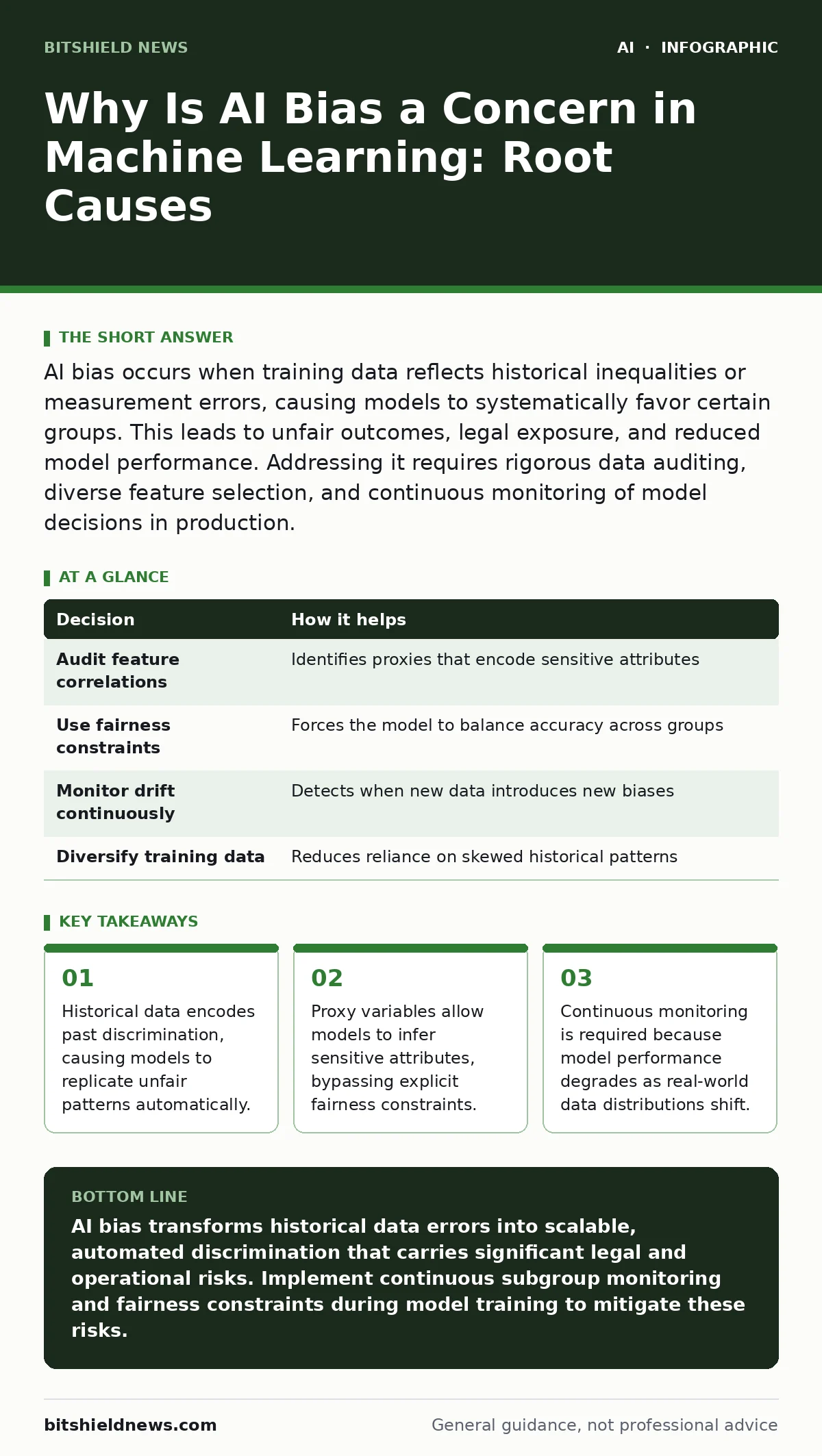
AI bias occurs when training data reflects historical inequalities or measurement errors, causing models to systematically favor certain groups. This leads to unfair outcomes, legal exposure, and reduced model performance. Addressing it requires rigorous data auditing, diverse feature selection, and continuous monitoring of model decisions in production.
Why is ai bias a concern in machine learning
AI bias is a concern in machine learning because it transforms historical inequalities into automated, scalable decisions. When a model learns from flawed data, it does not just make random errors. It creates systematic discrimination that affects hiring, lending, and healthcare outcomes. You face legal liability when these systems deny services based on protected characteristics. The cost is not only reputational. It includes direct financial losses from incorrect predictions and the expense of remediation. Bias undermines the core value of automation by introducing predictable, unjustifiable variance in results.
The Hidden Cost of Proxy Variables
Models often avoid explicit sensitive attributes like race or gender. They still find ways to discriminate through proxy variables. These are features that correlate strongly with protected classes. Zip codes often serve as proxies for race. Purchase history can proxy for socioeconomic status. The model optimizes for accuracy, not fairness. It uses these proxies to make predictions that align with historical biases. You cannot simply remove sensitive columns to fix this. The model reconstructs the signal from other available data points. This makes bias detection difficult because the discrimination is indirect and mathematically subtle.
| Decision | How it helps |
|---|---|
| Audit feature correlations | Identifies proxies that encode sensitive attributes |
| Use fairness constraints | Forces the model to balance accuracy across groups |
| Monitor drift continuously | Detects when new data introduces new biases |
| Diversify training data | Reduces reliance on skewed historical patterns |
Data Quality and Selection Bias
The quality of your training data determines the ceiling of your model’s fairness. Selection bias occurs when the data collection process excludes certain groups. If you train a facial recognition system on images from a single region, it will fail to recognize faces from other regions. This is not a technical failure. It is a data design failure. The model learns the distribution it sees. It assumes that unseen patterns are irrelevant or noise. You must define the population the model serves before collecting data. Excluding underrepresented groups from training creates a blind spot in production. The model becomes less accurate for those it was never trained to see.
Algorithmic Amplification of Errors
Machine learning algorithms amplify small errors in data into large disparities in outcomes. A slight imbalance in training data can lead to significant differences in error rates between groups. False positives may be more common for one group than another. In fraud detection, this means innocent users are blocked more often. In healthcare, it means certain patients receive less accurate risk assessments. The algorithm optimizes for overall accuracy. It ignores the distribution of errors. You must evaluate performance metrics across subgroups, not just in aggregate. Aggregate metrics hide the disparities that cause real-world harm.
The Illusion of Neutral Technology
Technology is not neutral. It reflects the choices of its creators and the data it consumes. You may believe that an algorithm is objective because it is mathematical. This belief is dangerous. The mathematical objective function defines what "good" means. If the objective function does not include fairness, the model will not achieve it. You must define fairness explicitly. Different definitions of fairness often conflict. You cannot simultaneously optimize for equal opportunity and equalized odds. Choosing one metric means accepting trade-offs with another. Understanding these trade-offs is part of responsible development.
See also: Difference between large language models and small language models for engineering choice · Machine Learning vs Deep Learning: Structural Differences for Security
Operational Risks and Model Drift
Bias is not a one-time problem. It evolves as the world changes. Model drift occurs when the relationship between input features and the target variable changes over time. A model trained on pre-pandemic data may fail to understand post-pandemic behaviors. This drift can introduce new biases or exacerbate existing ones. Continuous monitoring is required to detect these shifts. You must track performance metrics in production, not just during training. Alert systems should trigger when subgroup performance degrades. Without this monitoring, bias accumulates silently. The model becomes less reliable and more discriminatory over time.
Practical Steps for Mitigation
You can reduce bias through deliberate design choices. Start by defining the population your model serves. Collect data that represents this population accurately. Audit your features for proxies of sensitive attributes. Use fairness-aware algorithms that constrain the model during training. Evaluate performance across subgroups using multiple metrics. Monitor the model in production for drift and disparity. Document your decisions and their rationale. Transparency helps stakeholders understand the limitations of the system. It also provides a record for regulatory compliance.
Integrating Fairness Into the Lifecycle
Fairness must be integrated into every stage of the machine learning lifecycle. It is not an afterthought. It begins with problem formulation. It continues through data collection, model training, and deployment. You need cross-functional teams to identify potential biases. Data scientists, ethicists, and domain experts must collaborate. Regular audits should be scheduled, not just triggered by incidents. These audits should include both technical metrics and human review. Human review ensures that the model’s decisions align with organizational values and legal requirements.
The Role of Human Oversight
Automated systems require human oversight to ensure accountability. You must define clear escalation paths for disputed decisions. Users should be able to request human review of automated outcomes. This review process helps identify systemic biases that automated metrics miss. It also builds trust with users who feel impacted by the model. Human oversight is not a replacement for technical fixes. It is a safety net. It ensures that the system can correct its own mistakes. It also provides valuable feedback for improving the model.
Key takeaways
- Historical data encodes past discrimination, causing models to replicate unfair patterns automatically.
- Proxy variables allow models to infer sensitive attributes, bypassing explicit fairness constraints.
- Continuous monitoring is required because model performance degrades as real-world data distributions shift.
AI bias transforms historical data errors into scalable, automated discrimination that carries significant legal and operational risks. Implement continuous subgroup monitoring and fairness constraints during model training to mitigate these risks.
Frequently asked questions
How do I detect bias in my model?
Evaluate performance metrics across different subgroups of your data. Look for significant disparities in error rates, false positives, or false negatives between groups.
Can I completely eliminate AI bias?
No, you cannot completely eliminate bias. You can only reduce it to acceptable levels through rigorous auditing, diverse data, and continuous monitoring.
What is the difference between data bias and algorithmic bias?
Data bias comes from skewed or unrepresentative training data. Algorithmic bias comes from the model’s objective function or architecture amplifying errors or ignoring fairness constraints.
How does synthetic media relate to AI bias?
Synthetic media can propagate bias if the generative models are trained on biased datasets, leading to stereotypical or unfair representations in generated content.
How this guide was produced: written by the BitShield News editorial team with AI assistance, checked against the public references listed below, and reviewed when the facts change. See our editorial policy or report an error.