
Artificial intelligence model monitoring requires tracking data distribution shifts and semantic outputs rather than just error rates or server response times. Traditional software metrics fail because machine learning systems can run successfully while generating entirely incorrect or poisoned predictions.
Misreading: Traditional application logs catch machine learning failures
Application logging captures server crashes, memory exceptions, and HTTP status codes, but artificial intelligence systems fail silently while returning standard success responses. Neural networks process inputs through complex mathematical weights, meaning a model can return a completely fabricated answer while executing without a single software error. Monitoring pipelines must inspect the semantic meaning of outputs rather than relying on standard infrastructure telemetry.
Infrastructure monitoring tools track CPU utilization and latency, which tells you nothing about the quality of the predictions generated by your code. A compromised or degraded model often runs faster because it relies on shortcut patterns, consuming fewer resources while producing hazardous outputs. You need dedicated observation layers that evaluate the actual content produced by the inference engine against baseline expectations.
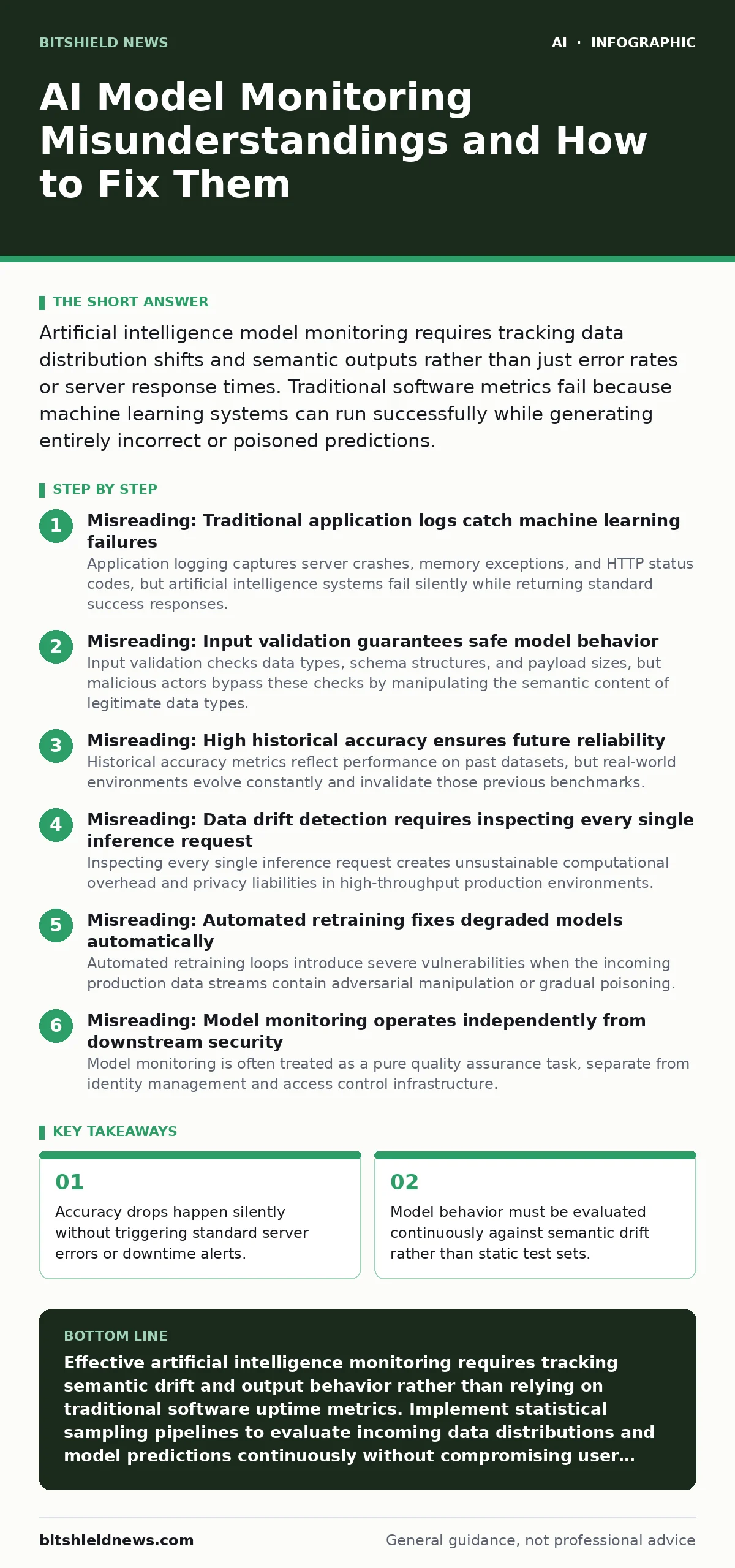
Misreading: Input validation guarantees safe model behavior
Input validation checks data types, schema structures, and payload sizes, but malicious actors bypass these checks by manipulating the semantic content of legitimate data types. Text prompts or image inputs can conform to exact formatting rules while containing hidden instructions designed to provoke unintended model behavior. Schema enforcement only stops malformed packets, leaving the logical reasoning path entirely unmonitored.
Malformed data payloads trigger immediate exceptions, whereas sophisticated manipulation blends seamlessly into normal operational parameters. Monitoring systems must evaluate the statistical properties of incoming payloads to detect subtle shifts that deviate from the training distribution. Without behavioral inspection of inputs, automated pipelines remain blind to targeted prompt injection and data poisoning attempts.
Misreading: High historical accuracy ensures future reliability
Historical accuracy metrics reflect performance on past datasets, but real-world environments evolve constantly and invalidate those previous benchmarks. When user behavior or external conditions change, the statistical assumptions underlying the training phase no longer apply to incoming queries. Relying on static test scores creates false confidence while the operational environment drifts away from the model's competence boundary.
Static validation sets cannot anticipate novel operational scenarios or emerging attack vectors encountered in production environments. Continuous evaluation requires feeding live operational data through automated verification loops that measure output consistency against known ground truths. Testing models requires ongoing validation strategies similar to proactive AI security testing protocols rather than a single pre-deployment checklist.
Misreading: Data drift detection requires inspecting every single inference request
Inspecting every single inference request creates unsustainable computational overhead and privacy liabilities in high-throughput production environments. Analyzing full payloads for drift requires massive storage capacity and processing power that slows down response times for end users. Efficient monitoring systems use statistical sampling methods and sketching algorithms to approximate population distributions without retaining raw user inputs.
Random sampling preserves system performance while providing sufficient data points to detect macro-level shifts in incoming traffic patterns. Privacy regulations further restrict the retention of user inputs, making wholesale logging a compliance violation in many jurisdictions. Streaming mathematics allows systems to update distribution profiles in memory without writing sensitive user data to persistent storage disks.
Misreading: Automated retraining fixes degraded models automatically
Automated retraining loops introduce severe vulnerabilities when the incoming production data streams contain adversarial manipulation or gradual poisoning. If malicious actors inject skewed examples into the operational data stream, an automated feedback loop will internalize those errors and accelerate model degradation. Unsupervised retraining removes human oversight from the governance pipeline and invites silent corruption of core business logic.
Autonomous pipelines lack the contextual judgment required to distinguish between legitimate seasonal shifts in user behavior and coordinated manipulation attempts. Every retraining cycle demands rigorous validation gates to verify that updated weights maintain alignment with safety and performance standards. Human review remains necessary to approve updates before deployment, preventing malicious data inputs from hijacking the learning trajectory.
Misreading: Model monitoring operates independently from downstream security
Model monitoring is often treated as a pure quality assurance task, separate from identity management and access control infrastructure. When an artificial intelligence agent gains excessive autonomy, monitoring tools must track not only what the model predicts, but what actions it takes in external systems. Blind spots occur when output monitoring stops at the prediction boundary and fails to observe how downstream software executes those predictions.
Security monitoring must span the entire lifecycle from initial prompt ingestion to final API execution across connected services. Integrating observation mechanisms with robust access controls for AI agents ensures that anomalous predictions cannot trigger unauthorized database queries or administrative commands. Fragmented visibility leaves gaps where compromised models can abuse privileged integrations without triggering alarms.
Key takeaways
- Accuracy drops happen silently without triggering standard server errors or downtime alerts.
- Model behavior must be evaluated continuously against semantic drift rather than static test sets.
Effective artificial intelligence monitoring requires tracking semantic drift and output behavior rather than relying on traditional software uptime metrics. Implement statistical sampling pipelines to evaluate incoming data distributions and model predictions continuously without compromising user privacy.
Frequently asked questions
Why do standard application performance monitors fail to catch artificial intelligence errors?
Standard monitors track infrastructure health and HTTP status codes, whereas machine learning models can return successful technical responses while generating completely incorrect or harmful predictions.
How does data drift affect production artificial intelligence systems over time?
Data drift occurs when real-world operational inputs gradually diverge from the statistical distribution used during training, leading to silent performance degradation and inaccurate outputs.
What is the risk of using automated retraining loops without human oversight?
Automated retraining can ingest poisoned data or adversarial inputs from the production environment, causing the model to internalize errors and accelerate its own degradation.
How can organizations monitor inference requests without violating user privacy?
Organizations use statistical sampling and mathematical sketching algorithms to approximate population distributions in memory without permanently storing raw user inputs or violating compliance rules.
How this guide was produced: written by the BitShield News editorial team with AI assistance, checked against the public references listed below, and reviewed when the facts change. See our editorial policy or report an error.