
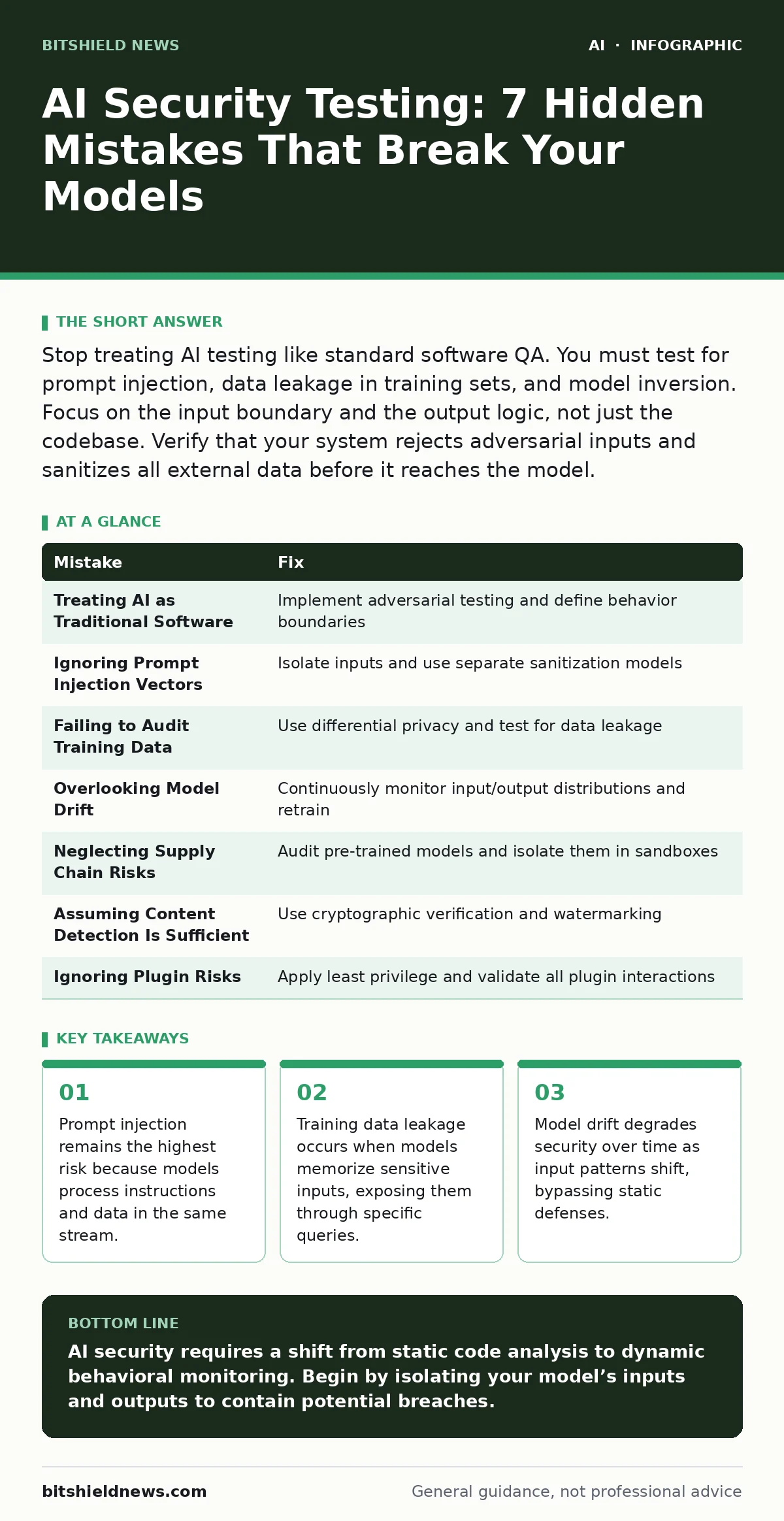
Stop treating AI testing like standard software QA. You must test for prompt injection, data leakage in training sets, and model inversion. Focus on the input boundary and the output logic, not just the codebase. Verify that your system rejects adversarial inputs and sanitizes all external data before it reaches the model.
Mistake 1: Treating AI as Traditional Software
You likely run static analysis and dynamic testing on your application code. This approach fails for machine learning models. Models are probabilistic, not deterministic. They do not follow a fixed path of execution. Instead, they calculate the likelihood of the next token. This means a single input change can produce vastly different outputs. Traditional scanners look for known vulnerabilities in code structure. They cannot see logical flaws in reasoning or data interpretation.
Why it hurts:
An attacker does not need to exploit a buffer overflow. They can manipulate the model’s reasoning process. This leads to unpredictable behavior that standard error logs do not capture. You might pass all unit tests while the model remains vulnerable to subtle input manipulation.
The fix:
Implement adversarial testing. This involves feeding the model unexpected, malformed, or contradictory inputs. Observe how the model handles ambiguity. You must define acceptable behavior boundaries. If the model guesses when it should refuse, that is a failure. Combine this with formal verification for critical logic paths where possible.
Mistake 2: Ignoring Prompt Injection Vectors
Many teams assume that system prompts are read-only instructions. They believe the model separates instructions from user data. Modern large language models do not always maintain this separation. An attacker can embed commands within the user input. These commands override the system instructions. This is known as prompt injection. It allows the attacker to take control of the model’s actions.
Why it hurts:
The model executes the attacker’s commands as if they were your instructions. It may reveal internal data, bypass safety filters, or perform unauthorized actions. This breaks the chain of trust in your application. The damage depends on what permissions the model has. If it can call external APIs, the attack becomes remote code execution.
The fix:
Isolate the model from direct user input. Use a separate model to sanitize inputs before they reach the main model. This is a common pattern in retrieval-augmented generation security architectures. Define strict output schemas. If the model outputs anything outside the expected format, discard it. Never trust the model’s self-assessment of safety.
Mistake 3: Failing to Audit Training Data for Leakage
You often focus on securing the inference endpoint. You forget that the model itself contains memorized data. During training, models can memorize sensitive information from the dataset. This includes personal identifiable information or proprietary secrets. An attacker can query the model to extract this data. This is called model inversion or membership inference.
Why it hurts:
Even if your application code is secure, the model leaks data. The attacker does not need to hack your servers. They simply ask the right questions. This violates privacy regulations and erodes user trust. The data exposure is often invisible to standard monitoring tools.
The fix:
Audit your training data for sensitive information before training. Remove or anonymize PII. Use differential privacy techniques during training. This adds noise to the data to prevent memorization. Test the model for data leakage by probing for specific known inputs. If the model reproduces exact phrases from the training set, it is too overfit.
Mistake 4: Overlooking Model Drift in Security Profiles
You test the model once at deployment. You assume its behavior remains constant. This is incorrect. Model drift occurs when the input data distribution changes over time. The model’s predictions become less accurate. More importantly, its security posture degrades. New attack patterns emerge that the model was not trained to recognize.
Why it hurts:
Defenses that worked yesterday may fail today. The model begins to accept inputs it previously rejected. It may misclassify malicious content as benign. This creates a false sense of security. You are relying on a static defense in a dynamic threat environment.
The fix:
Continuously monitor input and output distributions. Set up alerts for significant shifts in behavior. Re-evaluate security thresholds regularly. Retrain the model with new adversarial examples. Treat security testing as a continuous process, not a one-time event. Integrate this monitoring into your existing machine learning for fraud detection pipelines if applicable.
Mistake 5: Neglecting Supply Chain Risks in Pre-trained Models
You often use third-party pre-trained models to save time. You assume these models are secure because they are popular. This is a dangerous assumption. You do not know how these models were trained. You do not know if they contain backdoors. This is part of the broader shadow AI risk. You are importing unknown code logic into your system.
Why it hurts:
A compromised pre-trained model can bypass all your downstream defenses. The vulnerability exists before your application even starts. You cannot patch a model by updating code. You must replace the model entirely. This creates a massive remediation burden.
The fix:
Verify the source and training process of any pre-trained model. Prefer open-weight models where you can audit the weights. Run baseline security tests on the model before integration. Isolate the model in a sandboxed environment. Limit its network access and permissions. Do not trust vendor claims of security without independent verification.
Mistake 6: Assuming Content Detection Is Sufficient
You may rely on third-party tools to detect AI-generated content. This is a common mistake in the context of AI content detection. These tools are not perfect. They have high false positive and false negative rates. Adversaries can easily evade detection by slightly modifying the output. Relying solely on detection is a losing battle.
Why it hurts:
You miss sophisticated attacks that bypass detectors. You also block legitimate users, degrading the experience. Detection is reactive. It does not prevent the attack. It only identifies it after the fact. This is insufficient for high-risk operations.
The fix:
Focus on verification rather than detection. Use cryptographic signatures to verify the origin of content. Implement watermarking at the generation stage. If you cannot verify the source, treat the content as untrusted. Combine this with behavioral analysis. Look for patterns in how users interact with the AI, not just what the AI outputs.
Mistake 7: Ignoring the Risks of AI Plugins and Agents
You enable plugins to extend the model’s capabilities. These plugins often have access to external systems. This expands the attack surface significantly. An attacker can use the model to trick a plugin into performing malicious actions. This is a key concern in insecure AI plugins and agents deployments. The model acts as a bridge to your critical infrastructure.
Why it hurts:
The model itself may be safe, but the plugin is not. The attacker exploits the plugin’s permissions. This leads to data exfiltration or system compromise. The model’s lack of context awareness makes it easy to trick. It does not understand the consequences of its actions.
The fix:
Apply the principle of least privilege to all plugins. Restrict their access to only necessary resources. Validate all inputs and outputs between the model and the plugin. Implement human-in-the-loop approval for high-risk actions. Monitor plugin activity for anomalies. Treat each plugin as a separate security domain.
| Mistake | Fix |
|---|---|
| Treating AI as Traditional Software | Implement adversarial testing and define behavior boundaries |
| Ignoring Prompt Injection Vectors | Isolate inputs and use separate sanitization models |
| Failing to Audit Training Data | Use differential privacy and test for data leakage |
| Overlooking Model Drift | Continuously monitor input/output distributions and retrain |
| Neglecting Supply Chain Risks | Audit pre-trained models and isolate them in sandboxes |
| Assuming Content Detection Is Sufficient | Use cryptographic verification and watermarking |
| Ignoring Plugin Risks | Apply least privilege and validate all plugin interactions |
Key takeaways
- Prompt injection remains the highest risk because models process instructions and data in the same stream.
- Training data leakage occurs when models memorize sensitive inputs, exposing them through specific queries.
- Model drift degrades security over time as input patterns shift, bypassing static defenses.
AI security requires a shift from static code analysis to dynamic behavioral monitoring. Begin by isolating your model’s inputs and outputs to contain potential breaches.
Frequently asked questions
How do I test for prompt injection in my chatbot?
Use automated tools that generate adversarial prompts. Manually test with complex, multi-step instructions that try to override system rules. Verify that the model refuses to execute unauthorized actions.
Is differential privacy expensive to implement?
It adds computational overhead during training. The cost depends on the required privacy level. It is cheaper than the cost of a data breach. Start with small batches to measure the impact.
Can I secure a third-party API-based model?
You cannot audit the model itself. Focus on securing your integration. Sanitize inputs before sending them. Validate outputs before using them. Limit the model’s permissions in your application.
How often should I retrain my model for security?
Retrain when you detect significant drift or new attack patterns. Regularly update your adversarial training dataset. This ensures the model learns to recognize new threats.
How this guide was produced: written by the BitShield News editorial team with AI assistance, checked against the public references listed below, and reviewed when the facts change. See our editorial policy or report an error.