
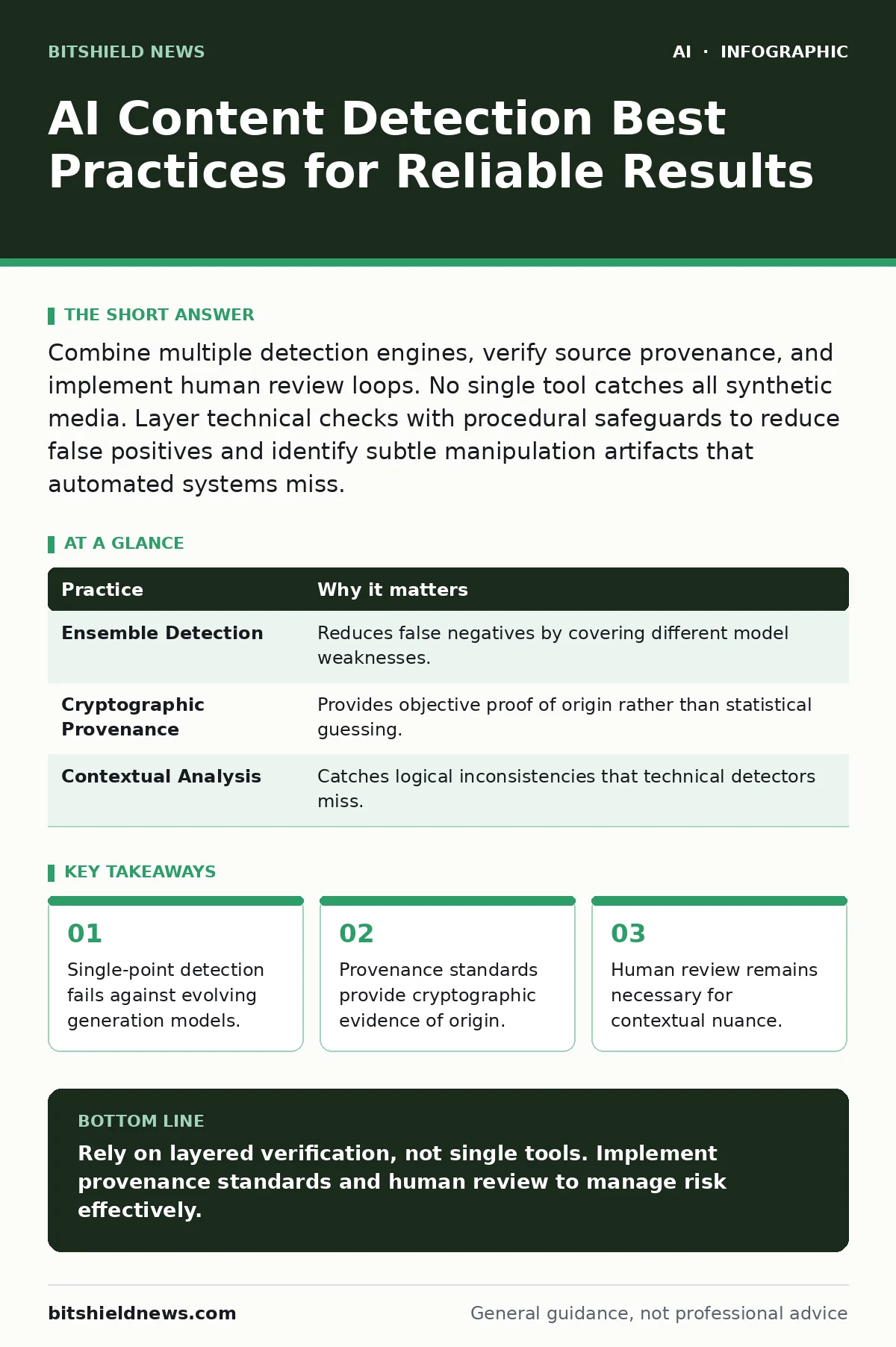
Combine multiple detection engines, verify source provenance, and implement human review loops. No single tool catches all synthetic media. Layer technical checks with procedural safeguards to reduce false positives and identify subtle manipulation artifacts that automated systems miss.
The Detection Paradox
AI content detection is not a binary switch. It is a probabilistic assessment. Generative models improve rapidly, while detection tools rely on statistical patterns that shift as training data changes. This creates a moving target. You cannot trust a single score to determine truth.
The gap between generation and detection widens over time. New models learn to mimic human imperfections, such as typos or irregular pacing. This makes statistical detection less reliable. You must treat detection as a layer of defense, not a final verdict.
1. Use Ensemble Detection Methods
Single detectors have blind spots. One engine might catch image artifacts but miss textual anomalies. Another might identify voice cloning but fail on video. By using multiple engines, you cover different failure modes. This approach reduces the chance that a sophisticated fake passes all checks.
Tip: Integrate at least two independent detection services into your workflow. If both flag content, investigate. If only one flags, treat it as a warning, not proof. This redundancy catches errors that single tools miss.
2. Verify Cryptographic Provenance
Detection analyzes content to guess its origin. Provenance proves its origin. Standards like Content Authenticity Initiative (CAI) embed metadata into files at creation. This metadata travels with the file through edits. It allows you to verify the chain of custody.
Tip: Prioritize content that includes signed provenance metadata. When metadata is missing, treat the content as unverified. This shifts the burden from guessing to verifying. It helps distinguish original work from synthetic output.
| Practice | Why it matters |
|---|---|
| Ensemble Detection | Reduces false negatives by covering different model weaknesses. |
| Cryptographic Provenance | Provides objective proof of origin rather than statistical guessing. |
| Contextual Analysis | Catches logical inconsistencies that technical detectors miss. |
3. Analyze Contextual Consistency
AI models often struggle with long-term logic. They may generate text that sounds correct but contains factual contradictions or internal inconsistencies. Image generators might create impossible lighting or geometry. These errors are subtle but detectable by humans.
Tip: Cross-reference claims with known facts. Check for internal logic errors in text. Look for physical impossibilities in images, such as shadows falling in wrong directions. Context often reveals what technical analysis hides.
4. Implement Human-in-the-Loop Review
Automated tools generate scores, not truths. A high probability score does not mean content is fake. A low score does not mean it is real. Humans provide the judgment needed to interpret these scores. They understand nuance, sarcasm, and cultural context.
Tip: Require human review for any content flagged by detection tools. Do not automate rejection based solely on machine output. This prevents false positives from causing reputational damage. It ensures decisions are made with full context.
5. Monitor for Adversarial Attacks
Attackers know detection exists. They add noise or subtle changes to evade detection. This is called adversarial perturbation. It makes the content look normal to humans but confuses detection algorithms. This renders technical checks useless.
Tip: Use detection tools that are trained to recognize adversarial patterns. Regularly update your detection models. Assume attackers are actively trying to bypass your checks. This keeps your defenses ahead of evasion techniques.
6. Establish Clear Content Policies
Detection is only one part of the solution. You need clear rules for how to handle synthetic content. Define what types of AI content are acceptable. Specify how to label AI-generated material. This reduces ambiguity and builds trust with your audience.
Tip: Publish a clear policy on AI content usage. Require disclosure of AI involvement in content creation. Train staff on how to identify and report suspicious content. Clear policies provide a framework for consistent action.
7. Educate Users on Recognition
Your audience is your first line of defense. Educate them on how to spot AI-generated content. Teach them to look for common artifacts. Explain how to verify provenance. This empowers users to question suspicious content.
Tip: Create simple guides on identifying AI content. Share examples of common artifacts. Encourage users to report suspicious content. An educated audience is harder to deceive. This distributes the burden of verification.
8. Keep Detection Models Updated
AI models evolve constantly. Detection tools must evolve with them. Static detection rules become obsolete quickly. Regular updates are necessary to maintain effectiveness. This requires ongoing investment and attention.
Tip: Schedule regular reviews of your detection tools. Update models frequently. Monitor industry trends for new evasion techniques. Stay ahead of the curve by prioritizing maintenance. This ensures your defenses remain relevant.
9. Document Your Verification Process
Transparency builds trust. Document how you verify content. Explain your detection methods. Share your provenance standards. This allows others to audit your process. It demonstrates your commitment to authenticity.
Tip: Keep records of verification steps. Note which tools were used. Document human review decisions. This creates an audit trail. It helps resolve disputes and maintain accountability.
Integrating with Broader Security
Detection does not exist in isolation. It connects to broader security efforts. For example, deepfake fraud often uses synthetic media to impersonate executives. Understanding voice cloning scams helps you recognize audio-based threats. These risks require coordinated responses.
You should also consider AI security testing to evaluate your own systems. Ensure your shadow AI usage is controlled. Review insecure AI plugins and agents for vulnerabilities. Align your practices with the OWASP Top 10 for LLM applications. This holistic approach strengthens your overall posture.
Machine learning can aid fraud detection, but it must be carefully validated. Use AI in security operations to monitor for anomalies. However, always maintain human oversight. Automation enhances efficiency, but judgment remains human.
Key takeaways
- Single-point detection fails against evolving generation models.
- Provenance standards provide cryptographic evidence of origin.
- Human review remains necessary for contextual nuance.
Rely on layered verification, not single tools. Implement provenance standards and human review to manage risk effectively.
Frequently asked questions
How accurate are AI content detectors?
Accuracy varies widely. Detectors work on probabilities, not certainties. They can produce false positives and false negatives. Never rely on a single tool for definitive answers.
Can AI detect AI-generated images?
Yes, but with limitations. Detectors look for artifacts like inconsistent lighting or texture. However, new models mimic these imperfections. Provenance metadata is more reliable than visual analysis alone.
What is cryptographic provenance?
It is digital evidence embedded in files. It records the origin and history of the content. Standards like CAI allow verification of this chain. It provides stronger proof than statistical detection.
How do I handle false positives?
Use human review to verify flagged content. Do not automate rejection based on scores. Investigate the context and source. Clear policies help manage these situations consistently.
How this guide was produced: written by the BitShield News editorial team with AI assistance, checked against the public references listed below, and reviewed when the facts change. See our editorial policy or report an error.