A synthetic media example is an AI-generated video or audio clip that mimics a real person. These fakes use deep learning to alter faces or voices. You cannot trust visuals alone. Verify through out-of-band channels and check for digital signatures to confirm authenticity.
Imagine receiving a video call from your CEO asking for urgent wire transfers. The face matches. The voice matches. The urgency feels real. Yet the person you see does not exist in that room. This scenario illustrates the core danger of synthetic media. It breaks the link between what you perceive and what is true.
What is synthetic media?
Synthetic media refers to audio, video, or images created or manipulated by artificial intelligence. These files look and sound like genuine recordings but originate from algorithms. The technology generates content that never happened. It can place a known face onto a stranger’s body. It can clone a voice from short audio samples. The result is a convincing simulation of reality.
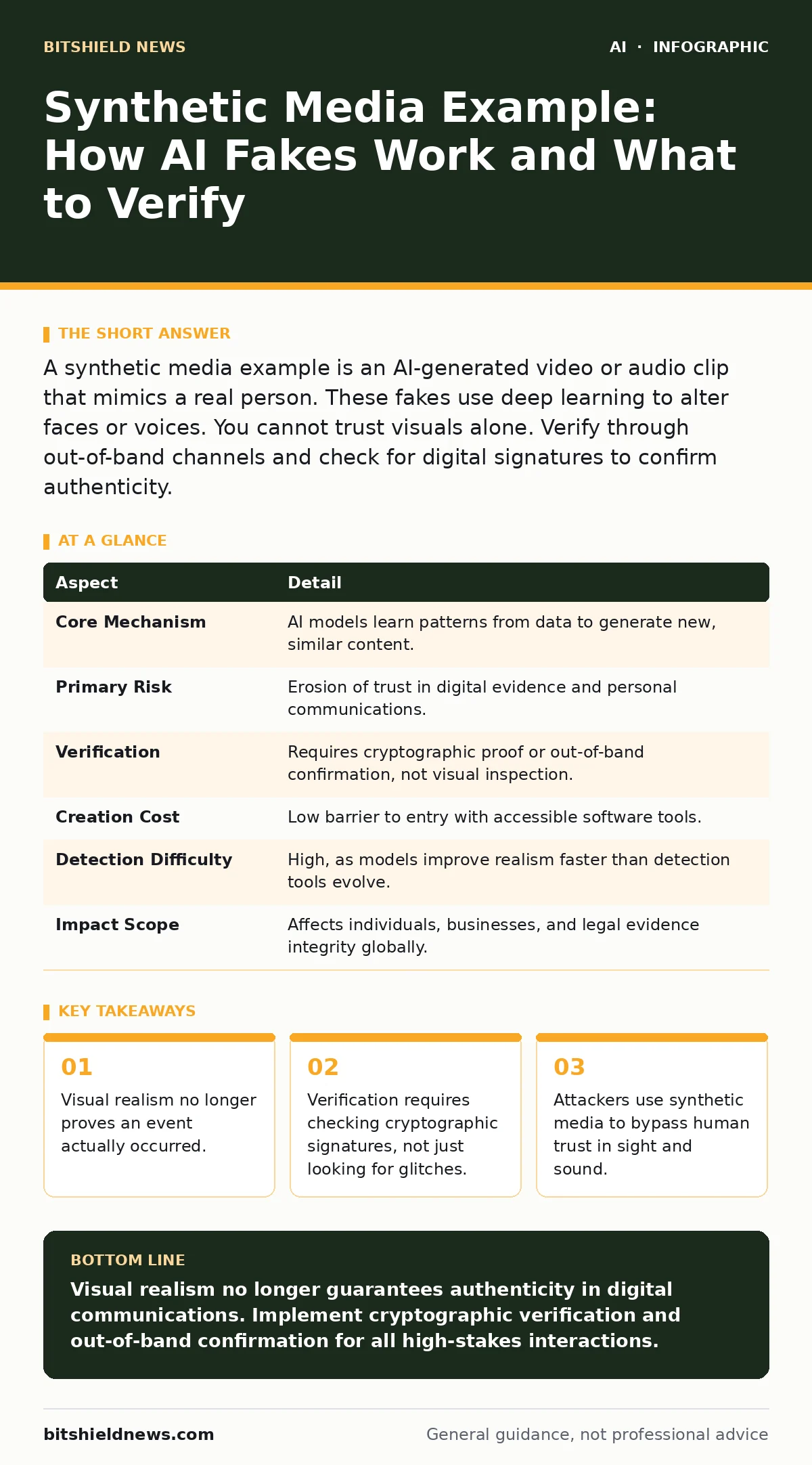
| Aspect | Detail |
|---|---|
| Core Mechanism | AI models learn patterns from data to generate new, similar content. |
| Primary Risk | Erosion of trust in digital evidence and personal communications. |
| Verification | Requires cryptographic proof or out-of-band confirmation, not visual inspection. |
| Creation Cost | Low barrier to entry with accessible software tools. |
| Detection Difficulty | High, as models improve realism faster than detection tools evolve. |
| Impact Scope | Affects individuals, businesses, and legal evidence integrity globally. |
The definition matters because "fake" implies a simple falsehood. Synthetic media is often technically perfect. It is a high-fidelity simulation. You cannot distinguish it from reality using human senses alone. This shifts the security burden from perception to verification.
How synthetic media example works technically
A synthetic media example relies on generative adversarial networks or diffusion models. These systems consist of two parts. One part generates the fake content. The other part tries to spot the flaws. They compete until the generator produces output that fools the discriminator. This process creates highly realistic artifacts.
Text-to-image models convert prompts into pixels. Text-to-speech models convert words into waveforms. Video interpolation predicts missing frames between existing ones. The system learns from massive datasets of real media. It memorizes lighting, texture, and motion patterns. It then reassembles these elements into new combinations.
This mechanism means the output is plausible, not factual. The AI fills in gaps with likely patterns. If it sees a person blinking, it learns the rhythm of blinking. It applies this rhythm to any face it generates. This creates a smooth, natural appearance. But the underlying data is fabricated. The source is code, not a camera or microphone.
Who synthetic media affects most
Synthetic media impacts anyone who relies on digital communication for trust. Individuals face identity theft and reputational harm. Businesses face financial fraud and brand damage. Institutions face legal challenges when digital evidence is disputed.
Financial institutions see pressure on their verification processes. A cloned voice may pass automated phone checks. Legal teams struggle to authenticate digital evidence. Journalists face pressure to publish unverified content. The burden of proof shifts. You must now prove something is real, not just plausible.
The risk is not limited to high-profile targets. Attackers use synthetic media for social engineering at scale. They create fake personas to manipulate people. They generate fake evidence to damage reputations. The cost of creating these fakes has dropped significantly. This makes them accessible to many threat actors.
Common mistakes in detection
People usually get wrong the assumption that visual glitches reveal fakes. Early deepfakes had obvious artifacts. Blurry faces. Unnatural blinking. Warped backgrounds. Modern models fix these errors. They produce clean, sharp images. Looking for glitches is no longer a reliable strategy.
Another mistake is trusting platform labels. Social media sites may label content as AI-generated. But attackers can remove these labels. They can repost content on other platforms. They can use private channels. Labels are not security controls. They are hints that can be ignored or stripped.
A third error is assuming that only video is at risk. Audio cloning is easier and cheaper. A short voice sample can clone a person’s tone and cadence. This makes voice-based authentication vulnerable. You hear a familiar voice, so you trust the message. This trust is exploited by attackers.
Understanding these mistakes is critical. It shifts your focus from detection to verification. You cannot always detect a fake. But you can always verify the source. This requires a change in process. It requires checking for digital signatures. It requires confirming via secondary channels.
Verification strategies for synthetic media
Verification requires moving beyond sensory perception. You need cryptographic proof. Digital signatures attach a unique key to a file. This key proves the file has not been altered. It proves the source of the file. If a video has no signature, treat it as unverified.
Out-of-band verification is another strategy. Receive a suspicious video call? Hang up. Call back using a known, trusted number. Ask a pre-agreed question. This breaks the chain of deception. The attacker controls the initial channel. They do not control your trusted callback number.
For managed environments, implement media provenance standards. These standards embed metadata in the file. The metadata records the origin and history of the media. When you receive a file, check this metadata. If it is missing or inconsistent, reject the file. This creates a chain of custody for digital evidence.
These strategies add friction to your processes. They slow down communication. But they prevent catastrophic losses. The trade-off is speed for security. In a world of synthetic media, speed is a vulnerability. Security is the priority.
See also: AI Model Serving Framework Vulnerabilities Prevention Checklist
Related technologies and risks
Synthetic media does not exist in isolation. It interacts with other AI risks. AI-generated phishing uses text to trick users. Synthetic media adds audio and video to these attacks. This makes the phishing more convincing. The combination of fake text and fake media increases the success rate.
Voice cloning scams are a subset of synthetic media. They focus solely on audio. These scams are particularly effective because voice is a strong biometric. People trust their ears. Combating this requires the same verification steps. You must verify the caller’s identity through other means.
Machine learning for fraud detection helps identify patterns. But it struggles with novel fakes. The AI generating the fake evolves. The detection AI must evolve too. This is an arms race. You cannot rely on automated detection alone. You need human-in-the-loop verification for critical decisions.
Shadow AI refers to unauthorized use of AI tools. Employees may use generative AI to create content. This creates legal and security risks. If an employee creates a fake document using AI, it may be indistinguishable from a real one. This complicates internal audits and compliance.
Deepfake fraud often targets executives. But it also targets ordinary people. Attackers create fake accounts with synthetic profiles. They build trust over time. Then they execute the fraud. The synthetic media makes the persona believable. This requires vigilance in all digital interactions.
Protecting your organization
Start by auditing your verification processes. Do you rely on video calls for approvals? Do you trust email attachments? Identify these weak points. Replace visual trust with cryptographic trust. Implement digital signing for official documents. Require multi-factor authentication for sensitive actions.
Train your staff on the risks. Explain that realistic does not mean real. Teach them to verify out-of-band. Create a culture of skepticism. Encourage questions. Make it safe to challenge authority. If a CEO asks for money, verify it. Do not assume the video is genuine.
Monitor for emerging threats. The technology changes rapidly. New models improve realism. New detection methods emerge. Stay informed. Update your policies regularly. Ensure your security team understands the threat. They need to adapt their defenses.
The goal is resilience. You cannot stop all synthetic media. But you can reduce its impact. By verifying sources, you protect your assets. You protect your reputation. You maintain trust in your digital communications. This is the new normal. Adapt your processes accordingly.
Key takeaways
- Visual realism no longer proves an event actually occurred.
- Verification requires checking cryptographic signatures, not just looking for glitches.
- Attackers use synthetic media to bypass human trust in sight and sound.
Visual realism no longer guarantees authenticity in digital communications. Implement cryptographic verification and out-of-band confirmation for all high-stakes interactions.
Frequently asked questions
How can I tell if a video is fake?
You often cannot tell by looking alone. Modern synthetic media is visually perfect. Rely on digital signatures and out-of-band verification instead of visual inspection.
Is AI content detection reliable?
No. Detection tools lag behind generation tools. New fakes bypass old detectors. Use detection as a hint, not a proof. Always verify the source independently.
What is the best way to verify a phone call?
Hang up and call back using a trusted, known number. Ask a pre-agreed security question. Do not trust the caller ID, which can be spoofed.
Can synthetic media be used in legal cases?
Yes, it can create false evidence. Courts are adapting to require digital provenance. Ensure your organization maintains cryptographic chains of custody for all digital media.
How this guide was produced: written by the BitShield News editorial team with AI assistance, checked against the public references listed below, and reviewed when the facts change. See our editorial policy or report an error.