
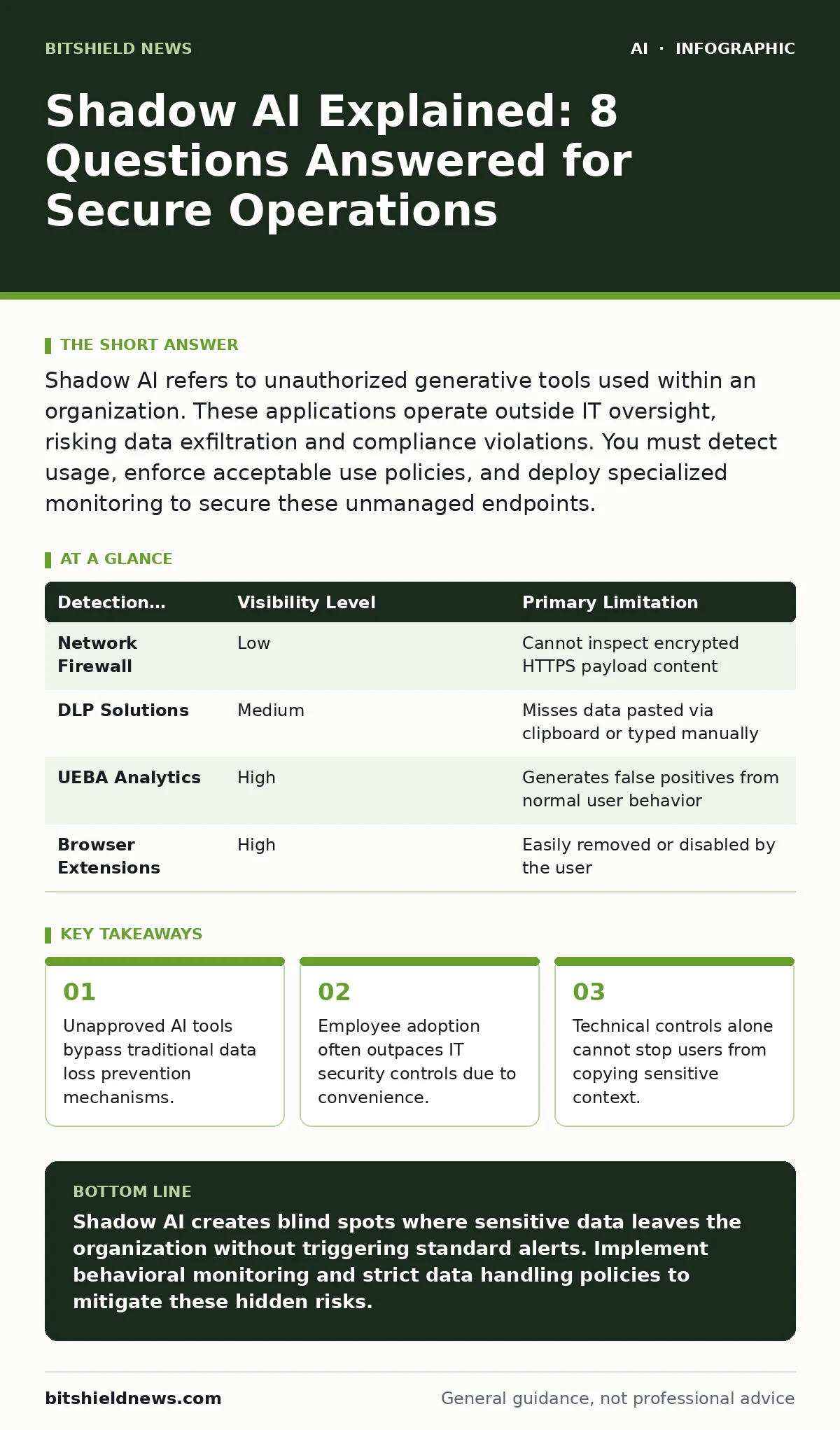
Shadow AI refers to unauthorized generative tools used within an organization. These applications operate outside IT oversight, risking data exfiltration and compliance violations. You must detect usage, enforce acceptable use policies, and deploy specialized monitoring to secure these unmanaged endpoints.
What is shadow AI?
Shadow AI consists of generative artificial intelligence tools that employees use without organizational approval or oversight. These applications often run on personal devices or through unmonitored web browsers. They operate outside the security perimeter, meaning your standard defenses do not inspect the data entering or leaving them.
Why do employees use unapproved AI tools?
Users bypass approved channels because shadow AI tools often offer superior speed, ease of use, or features that sanctioned enterprise solutions lack. Imagine a developer needing to debug code instantly; a public model may provide a faster response than a restricted internal system. This friction between security policy and operational efficiency drives unauthorized adoption.
How does shadow AI bypass security controls?
These tools evade detection by operating over standard HTTPS traffic that firewalls typically allow. They do not install software on managed devices, avoiding endpoint detection and response alerts. Furthermore, data is often pasted manually into web interfaces, bypassing file-level data loss prevention rules that monitor attachments.
What data is at risk with shadow AI?
Any information pasted into a prompt becomes part of the model’s context window, which is the temporary memory the AI uses to generate responses. This includes source code, customer records, and internal strategy documents. Even if the provider claims not to train on user data, the input still traverses external networks and may be logged for abuse monitoring.
Can you detect shadow AI usage technically?
Network detection is difficult because traffic looks like standard web browsing. You must rely on behavioral analytics to identify unusual data transfer patterns or frequent access to known AI domains. Endpoint detection and response tools can flag clipboard activities or browser extensions that facilitate AI interactions, providing a secondary layer of visibility.
| Detection Method | Visibility Level | Primary Limitation |
|---|---|---|
| Network Firewall | Low | Cannot inspect encrypted HTTPS payload content |
| DLP Solutions | Medium | Misses data pasted via clipboard or typed manually |
| UEBA Analytics | High | Generates false positives from normal user behavior |
| Browser Extensions | High | Easily removed or disabled by the user |
See also: Secure File Sharing Best Practices for Enterprise Data Protection · Implement Cloud Encryption: A Step-by-Step Guide for Data Protection
Does acceptable use policy stop shadow AI?
Policies define boundaries but do not technically prevent usage. A written rule cannot stop a user from visiting a public chat interface on their personal phone. Enforcement requires combining policy with technical restrictions, such as blocking access to AI domains from corporate networks, though this may hinder legitimate work.
How do you secure approved AI deployments?
You must implement strict data classification and masking before sending prompts to AI models. This ensures that sensitive identifiers are removed from the context sent to the provider. Additionally, you should treat AI outputs as untrusted input, verifying all generated code or content before integration. For deeper insights on validating AI outputs, consult our guide on AI security testing.
What is the hidden cost of shadow AI?
The primary cost is not just data leakage, but the loss of operational context. When teams use disparate tools, knowledge becomes siloed and unversioned. This fragmentation makes it difficult to audit decisions or reproduce results, creating long-term maintenance debt. The hidden expense is the time spent reconciling inconsistent outputs and managing compliance risks.
How does shadow AI relate to other threats?
Unmonitored AI usage creates entry points for more sophisticated attacks. Attackers may use public models to refine social engineering tactics or generate convincing impersonations. Understanding how these models are manipulated is critical for defense strategies. For more on this, read our guide on AI-generated phishing.
Can voice cloning exacerbate shadow AI risks?
Yes, if employees use unapproved voice synthesis tools, they may inadvertently create material for social engineering. These tools can mimic executive voices to authorize fraudulent transactions. The risk increases when voice data is stored on insecure cloud platforms. Learn more in our guide on voice cloning scams.
How do embeddings impact shadow AI security?
Embeddings are numerical representations of text that AI models use to understand meaning. If sensitive data is converted into embeddings and stored improperly, it can be reverse-engineered or used to infer private information. This technical detail is often overlooked in basic security reviews. See our guide on embeddings for technical details.
What is the role of retrieval-augmented generation?
Retrieval-augmented generation connects AI models to private data sources to improve accuracy. While powerful, it expands the attack surface by exposing internal databases to AI interfaces. Proper access controls are necessary to prevent unauthorized data retrieval. Explore this further in our guide on retrieval-augmented generation security.
How does machine learning help detect this?
Machine learning algorithms can analyze user behavior patterns to flag anomalies indicative of shadow AI usage. These systems learn normal baselines and alert when deviations occur, such as unusual data export volumes. This automated detection complements manual policy enforcement. Read more in our guide on machine learning for fraud detection.
What about AI in security operations?
Security teams also use AI to monitor for these threats, creating a cycle of automation. However, relying on AI to detect AI introduces complexity and potential blind spots. Human oversight remains necessary to validate alerts and adjust strategies. For operational best practices, see our guide on AI in security operations.
How do you manage the human factor?
Education must focus on the specific risks of data context leakage rather than generic warnings. Users need to understand that pasting code or customer data into public models is equivalent to sending it to an external server. Regular training reinforces the connection between daily actions and organizational risk.
Key takeaways
- Unapproved AI tools bypass traditional data loss prevention mechanisms.
- Employee adoption often outpaces IT security controls due to convenience.
- Technical controls alone cannot stop users from copying sensitive context.
Shadow AI creates blind spots where sensitive data leaves the organization without triggering standard alerts. Implement behavioral monitoring and strict data handling policies to mitigate these hidden risks.
Frequently asked questions
Is using free AI tools on personal devices safe?
No, because these tools operate outside corporate security controls, exposing any data you input to external servers and potential interception.
Can AI providers guarantee my data is not used for training?
Providers may claim this, but you cannot independently verify their internal data handling processes, leaving residual risk.
Should I block all AI websites on the corporate network?
Blocking may hinder productivity and drive users to unmonitored personal devices, increasing risk rather than eliminating it.
How do I know if an employee is using shadow AI?
Look for behavioral anomalies, such as frequent clipboard usage or access to known AI domains, using unified endpoint management tools.
How this guide was produced: written by the BitShield News editorial team with AI assistance, checked against the public references listed below, and reviewed when the facts change. See our editorial policy or report an error.