
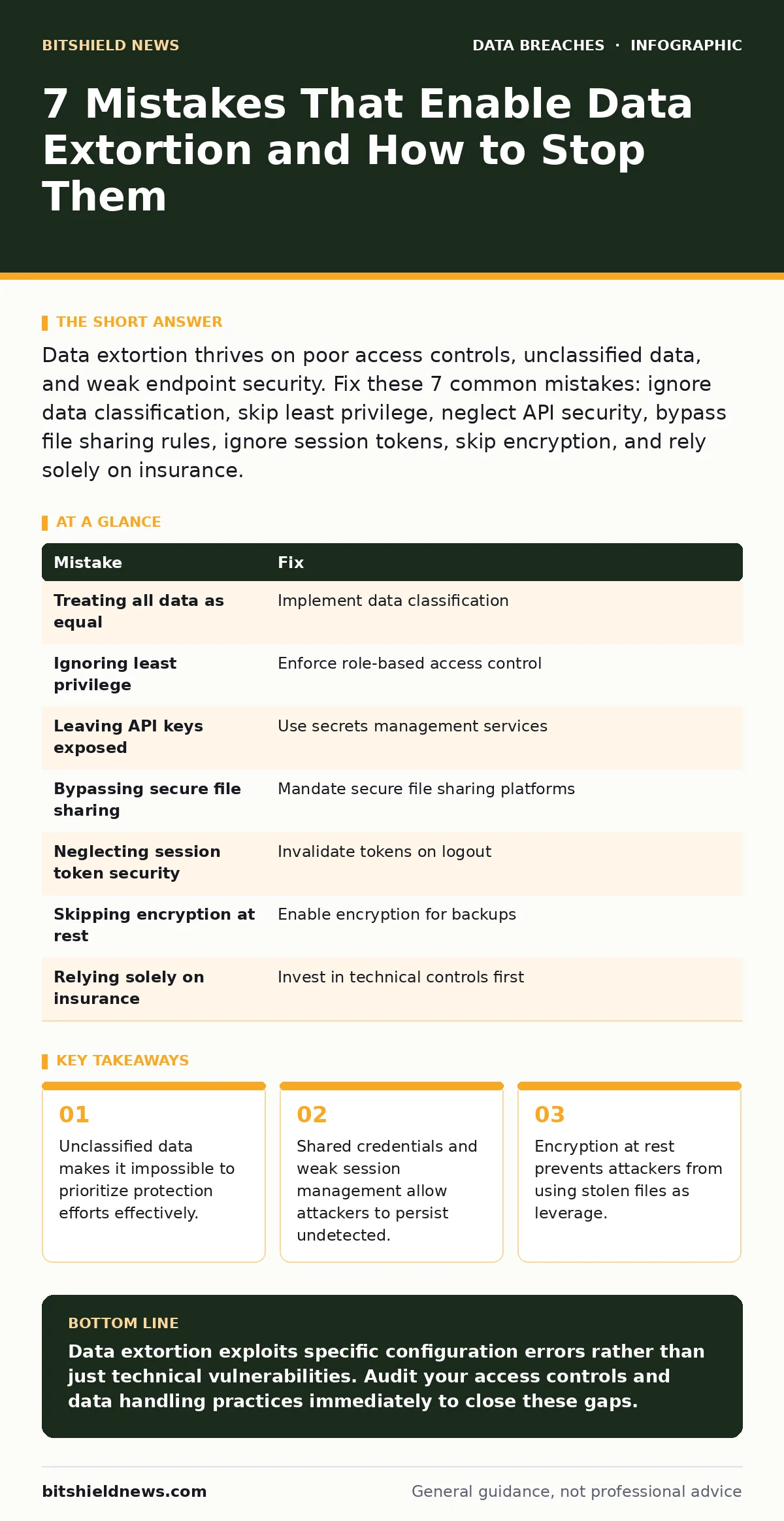
Data extortion thrives on poor access controls, unclassified data, and weak endpoint security. Fix these 7 common mistakes: ignore data classification, skip least privilege, neglect API security, bypass file sharing rules, ignore session tokens, skip encryption, and rely solely on insurance.
Mistake 1: Treating All Data as Equally Valuable
Organizations often store sensitive intellectual property alongside routine administrative records without distinction. This uniformity prevents security teams from applying targeted protections. Attackers scan for high-value targets, but they also take everything they can find to maximize pressure. Without data classification, you cannot determine which assets require the highest security controls. You waste resources protecting low-risk files while leaving critical records vulnerable.
Why it hurts: Extortion relies on the perceived value of stolen information. If attackers find customer records or proprietary designs mixed with public documents, they can claim the entire dataset is compromised. You lose the ability to negotiate or respond precisely because you do not know what was actually taken. The noise of irrelevant data drowns out the signal of critical loss.
The fix: Implement a strict data classification framework. Label data by sensitivity levels such as public, internal, confidential, and restricted. Apply access controls and monitoring based on these labels. Review classification rules annually to account for business changes. This structure helps you identify exactly what is at risk during an incident.
Mistake 2: Ignoring Least Privilege in Access Controls
Many systems grant users broader access than necessary for their daily tasks. This convenience creates a wide attack surface. When an attacker compromises a single account, they inherit all the permissions associated with that role. They can move laterally through the network, accessing databases and servers they should never touch. This lack of restriction turns a minor breach into a major disaster.
Why it hurts: Attackers exploit excessive permissions to escalate their access quickly. They do not need to break into the main database if a marketing employee has read access to customer financial records. The broader the permissions, the more data an attacker can exfiltrate before detection. You lose control over where the threat moves within your environment.
The fix: Enforce role-based access control across all systems. Review user permissions quarterly to ensure they align with current job functions. Remove access for employees who change roles or leave the organization immediately. Use automated tools to detect and alert on unusual access patterns. This limits the damage any single compromised account can cause.
Mistake 3: Leaving API Keys Exposed in Code
Developers often hardcode application programming interface keys into source code repositories. These keys act as master keys for cloud services, databases, and external integrations. When code is pushed to public or poorly secured repositories, attackers harvest these keys automatically. They gain direct access to your infrastructure without needing to exploit vulnerabilities in your network perimeter.
Why it hurts: Exposed API keys provide attackers with authenticated access to your most sensitive systems. They can query databases, modify configurations, or delete backups without triggering standard login alerts. Since the access appears legitimate, security tools may ignore the activity. You face immediate data loss and system manipulation with little chance of early detection.
The fix: Remove all secrets from source code immediately. Use a dedicated secrets management service to store and rotate API keys. Integrate pre-commit hooks that scan for accidental key exposure before code is pushed. Audit existing repositories for leaked credentials and revoke any found keys. This practice ensures that code leaks do not become system breaches.
Mistake 4: Bypassing Secure File Sharing Protocols
Employees often use personal email or unapproved cloud storage to share large files. This shadow IT creates unmonitored data channels outside your security perimeter. Attackers target these informal sharing methods because they lack encryption and access controls. A single sent file can expose thousands of records to anyone who intercepts the transmission or gains access to the recipient’s account.
Why it hurts: Unsecured file transfers leave data vulnerable during transit and at rest on third-party servers. You have no visibility into who accesses these files or where they are stored. Attackers can intercept emails or compromise personal cloud accounts to steal data. This bypasses your corporate security measures entirely, creating a blind spot in your defense strategy.
The fix: Mandate the use of secure file sharing platforms for all external transfers. Configure these tools to require authentication and set automatic expiration dates for shared links. Disable the ability to upload sensitive data to personal cloud accounts via endpoint security policies. Train staff on the risks of using informal channels for business data.
Mistake 5: Neglecting Session Token Security
Websites and applications use session tokens to keep users logged in. These tokens are often stored in browser cookies or local storage. Attackers can steal these tokens through cross-site scripting attacks or malware. Once they possess a valid token, they can impersonate the user without needing a password. This allows them to bypass multi-factor authentication and access protected data seamlessly.
Why it hurts: Stolen session tokens grant immediate access to user accounts. Traditional password resets do not invalidate active sessions, allowing attackers to maintain access. You may detect unusual activity, but the attacker remains logged in until the session expires or is manually terminated. This persistence makes it difficult to contain the breach and recover compromised data quickly.
The fix: Implement short expiration times for session tokens. Invalidate tokens immediately when a user logs out or changes their password. Use secure flags on cookies to prevent theft via scripting. Monitor for multiple concurrent sessions from different locations. This reduces the window of opportunity for attackers to use stolen credentials effectively.
See also: Shadow AI Explained: 8 Questions Answered for Secure Operations · Implement Cloud Encryption: A Step-by-Step Guide for Data Protection
Mistake 6: Skipping Encryption at Rest for Backups
Organizations often encrypt data in transit but leave backups and archived files in plain text. This assumption that backups are isolated is dangerous. Attackers target backup systems because they are often less monitored than primary production environments. If backups are unencrypted, attackers can steal entire data sets and hold them for ransom. You lose your primary recovery mechanism.
Why it hurts: Unencrypted backups are easy for attackers to copy and exfiltrate. They can demand payment to return the data, knowing you have no other copy. Even if you restore from other sources, the stolen data remains in the attacker’s possession. You face continued extortion threats and potential regulatory penalties for failing to protect sensitive information adequately.
The fix: Enable encryption at rest for all storage devices, including backups and archives. Manage encryption keys separately from the data they protect. Test your restoration process regularly to ensure encrypted backups are usable. This ensures that even if attackers steal the files, they cannot read or use the information.
Mistake 7: Relying Solely on Cyber Insurance
Many organizations believe that a cyber insurance policy eliminates the need for technical security controls. This mindset leads to complacency and underinvestment in preventive measures. Insurance covers financial losses but does not stop the attack or protect your reputation. Attackers know that insured companies may pay ransoms quickly, making them attractive targets.
Why it hurts: Insurance policies often exclude coverage for breaches caused by negligence or lack of basic security. If you fail to implement standard controls, your claim may be denied. You face the full cost of the breach, including legal fees and remediation. The delay in coverage approval can exacerbate the impact of the extortion, forcing you to operate under pressure without financial support.
The fix: Treat cyber insurance as a last resort, not a primary defense. Implement robust technical controls to reduce the likelihood and impact of breaches. Review your policy annually to ensure it covers emerging threats like data extortion. Work with your insurer to identify gaps in your security posture and address them proactively.
| Mistake | Fix |
|---|---|
| Treating all data as equal | Implement data classification |
| Ignoring least privilege | Enforce role-based access control |
| Leaving API keys exposed | Use secrets management services |
| Bypassing secure file sharing | Mandate secure file sharing platforms |
| Neglecting session token security | Invalidate tokens on logout |
| Skipping encryption at rest | Enable encryption for backups |
| Relying solely on insurance | Invest in technical controls first |
Key takeaways
- Unclassified data makes it impossible to prioritize protection efforts effectively.
- Shared credentials and weak session management allow attackers to persist undetected.
- Encryption at rest prevents attackers from using stolen files as leverage.
Data extortion exploits specific configuration errors rather than just technical vulnerabilities. Audit your access controls and data handling practices immediately to close these gaps.
Frequently asked questions
How do attackers find exposed API keys?
Attackers use automated scanners to search public code repositories and cloud storage for common key patterns.
Does encryption at rest prevent data theft?
Encryption prevents attackers from reading stolen data, but it does not stop them from copying the files.
Can cyber insurance cover data extortion payments?
Policies vary, but many exclude payments for breaches caused by known security gaps or negligence.
How often should I review user permissions?
Review permissions quarterly or whenever an employee’s role changes to ensure least privilege.
How this guide was produced: written by the BitShield News editorial team with AI assistance, checked against the public references listed below, and reviewed when the facts change. See our editorial policy or report an error.