
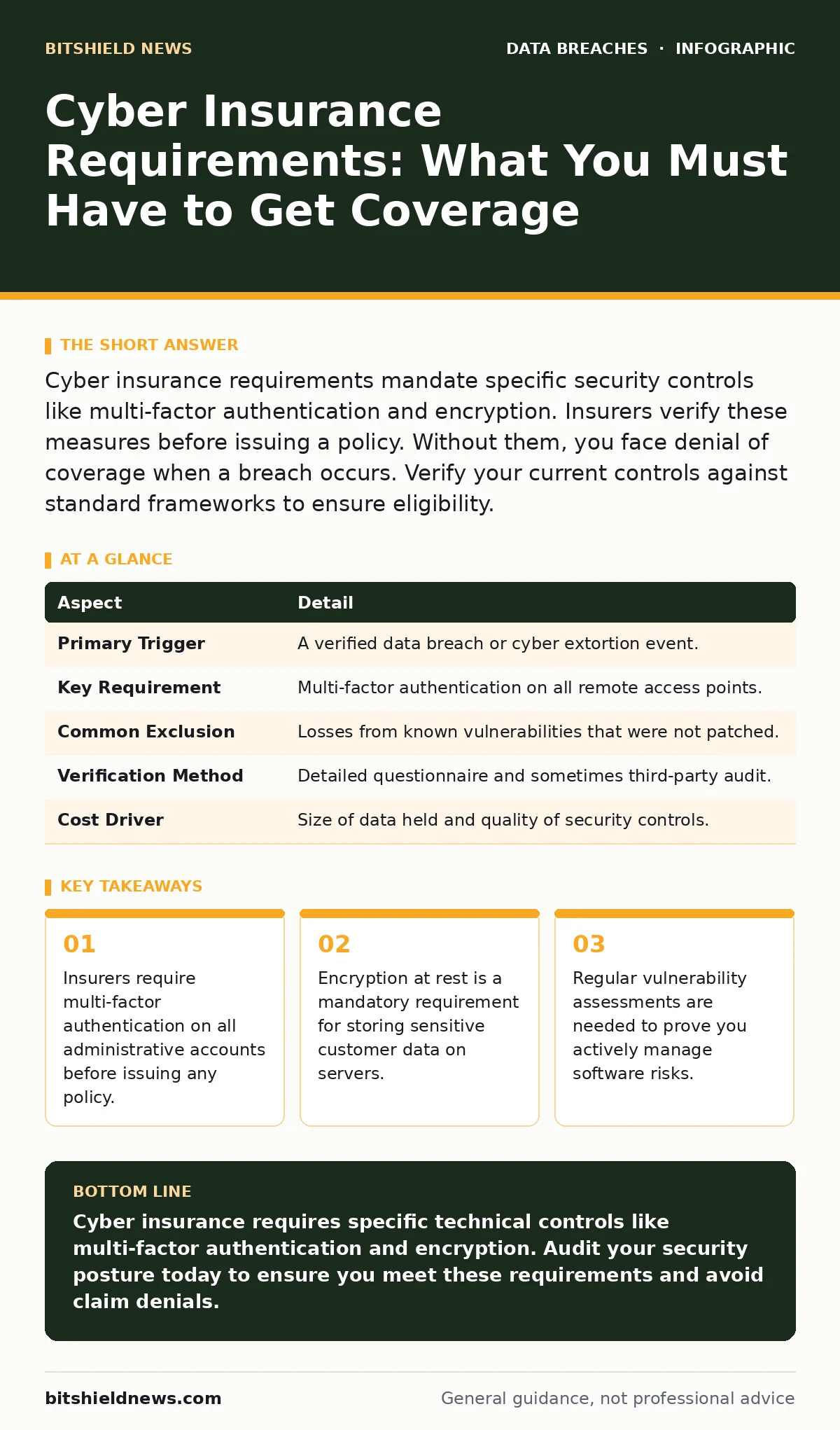
Cyber insurance requirements mandate specific security controls like multi-factor authentication and encryption. Insurers verify these measures before issuing a policy. Without them, you face denial of coverage when a breach occurs. Verify your current controls against standard frameworks to ensure eligibility.
Understanding the Core Mechanism
Cyber insurance is a financial contract that transfers the cost of data breaches from your organization to an insurer. It covers legal fees, notification costs, and ransom payments, but only if you meet strict security requirements. This is not a simple purchase. It is a conditional agreement based on your technical posture.
Think of it like home insurance. An insurer will not cover a house with a broken lock or no fire alarm. They require basic safeguards to reduce their risk. Cyber insurance works the same way. The insurer assesses your digital locks and alarms. If they are weak, they will not write the policy. If they are strong, the premium drops.
| Aspect | Detail |
|---|---|
| Primary Trigger | A verified data breach or cyber extortion event. |
| Key Requirement | Multi-factor authentication on all remote access points. |
| Common Exclusion | Losses from known vulnerabilities that were not patched. |
| Verification Method | Detailed questionnaire and sometimes third-party audit. |
| Cost Driver | Size of data held and quality of security controls. |
Cyber Insurance Requirements Explained
When you search for cyber insurance requirements, you are looking for the minimum security controls an insurer demands. These are not suggestions. They are hard gates. If you fail one, the application is rejected. The most universal requirement is multi-factor authentication. This means every user, especially administrators, must prove their identity with two methods.
Another standard requirement is encryption at rest. This ensures that data stored on disks is unreadable without a key. Insurers want to know that if a laptop is stolen, the data remains safe. They also look for role-based access control. This principle ensures users only have access to the data they need for their job. Excessive access increases the blast radius of a breach.
Insurers also require regular software updates. They check if you patch operating systems and applications promptly. Unpatched software is an open door. They view it as negligence. You must demonstrate a process for identifying and applying security patches. This reduces the window of exposure to known exploits.
Who Faces These Demands
Every organization that holds sensitive data faces these demands. Small businesses often think they are too small to be targeted. This is a dangerous misconception. Attackers automate their scans. They do not care about your size. They care about your connectivity. If you process payments or store customer records, you are a target.
Large enterprises face stricter scrutiny. Insurers look for advanced logging and monitoring. They want to see that you can detect an intrusion quickly. Mid-sized organizations often struggle with the documentation required. They may have good security but lack the records to prove it. The burden of proof lies with you. You must show, not just tell, that your controls are active.
Managed service providers often act as the eyes and ears for smaller clients. They must ensure their own controls meet the insurer's standards. If a provider fails a requirement, their clients may lose coverage. This creates a chain of dependency. Security is no longer siloed. It affects your entire business ecosystem.
What People Usually Get Wrong
Many organizations believe that buying insurance solves their security problems. This is a fundamental error. Insurance is a financial backstop, not a security solution. It does not prevent breaches. It only pays for the cleanup. Relying on insurance as a substitute for security leads to complacency. When a breach occurs, the insurer will investigate. If they find you ignored basic requirements, they will deny the claim.
Another common mistake is assuming that compliance equals insurability. Meeting regulatory standards like GDPR or HIPAA is not enough. Insurers have their own requirements. They may demand controls that regulations do not specify. For example, regulations might not require multi-factor authentication for internal systems. Insurers do. You must satisfy both sets of rules.
Organizations often forget about third-party risks. Your insurance may require you to vet your vendors. If a vendor is breached, your data is exposed. If you did not check their security posture, your claim may be denied. You are responsible for the entire chain of custody for your data. This includes the cloud providers and software vendors you use.
The Hidden Cost of Non-Compliance
Failing to meet cyber insurance requirements has immediate financial consequences. You cannot buy coverage. You are left fully exposed. The cost of a single breach can exceed annual revenue. Legal fees, forensic investigations, and customer notifications add up quickly. Without insurance, you pay every cent.
There is also a reputational cost. Customers expect you to have cyber insurance. It signals that you take security seriously. If you cannot provide a certificate of insurance, you may lose contracts. Many businesses now require proof of cyber insurance before signing agreements. This is becoming a standard business practice. It is no longer optional.
Imagine a company that ignores multi-factor authentication requirements. An attacker steals admin credentials. They move laterally through the network and encrypt all files. The company pays the ransom. They try to claim the loss. The insurer denies the claim because multi-factor authentication was disabled. The company bears the full cost. This scenario is hypothetical but common.
See also: Shadow AI Explained: 8 Questions Answered for Secure Operations · Implement Cloud Encryption: A Step-by-Step Guide for Data Protection
Steps to Meet the Bar
You must audit your current security posture against standard frameworks. Start with multi-factor authentication. Ensure it is enabled on all accounts with internet access. Check for exceptions. Remove any that are not strictly necessary. Document the policy. Insurers will ask for proof.
Next, review your encryption practices. Ensure all sensitive data is encrypted at rest. This includes databases, backups, and portable devices. Verify that keys are managed securely. If keys are stored with the data, the encryption is weak. Use a dedicated key management system.
Implement role-based access control. Review user permissions regularly. Remove access for employees who have changed roles or left the company. Excessive permissions are a major red flag for insurers. They indicate poor governance. Tighten access to the principle of least privilege.
Integrating Security and Insurance
Security and insurance are linked. Better security lowers premiums. It also increases the likelihood of claim approval. Treat cyber insurance as a validation of your security program. If you struggle to get coverage, your security is likely weak. Use the underwriting process as a free audit.
Review related topics to strengthen your posture. Understanding exposed API keys can help you secure cloud environments. Ensuring full disk encryption protects mobile devices. Preventing database exposure stops large-scale data theft. Proper data classification helps you focus on high-risk assets. Managing data extortion requires clear incident response plans. Implementing role-based access control limits internal threats. Conducting privacy impact assessments identifies regulatory gaps. Using encryption at rest secures stored data.
Key takeaways
- Insurers require multi-factor authentication on all administrative accounts before issuing any policy.
- Encryption at rest is a mandatory requirement for storing sensitive customer data on servers.
- Regular vulnerability assessments are needed to prove you actively manage software risks.
Cyber insurance requires specific technical controls like multi-factor authentication and encryption. Audit your security posture today to ensure you meet these requirements and avoid claim denials.
Frequently asked questions
Does cyber insurance cover ransomware payments?
It may cover ransomware payments, but many insurers now exclude this. Check your policy language carefully. Some require you to consult the insurer before paying.
How often do insurers review security requirements?
Insurers typically review requirements annually when you renew the policy. They may also require updates if a major security incident occurs in your industry.
Can I get insurance if I have had a breach before?
It is difficult but possible. Insurers will scrutinize your past breach heavily. You must show that you have fixed the root cause and implemented stronger controls.
Do small businesses need cyber insurance?
Yes. Small businesses are frequent targets. The cost of a breach can be devastating. Insurance provides financial protection and signals trust to clients.
How this guide was produced: written by the BitShield News editorial team with AI assistance, checked against the public references listed below, and reviewed when the facts change. See our editorial policy or report an error.