
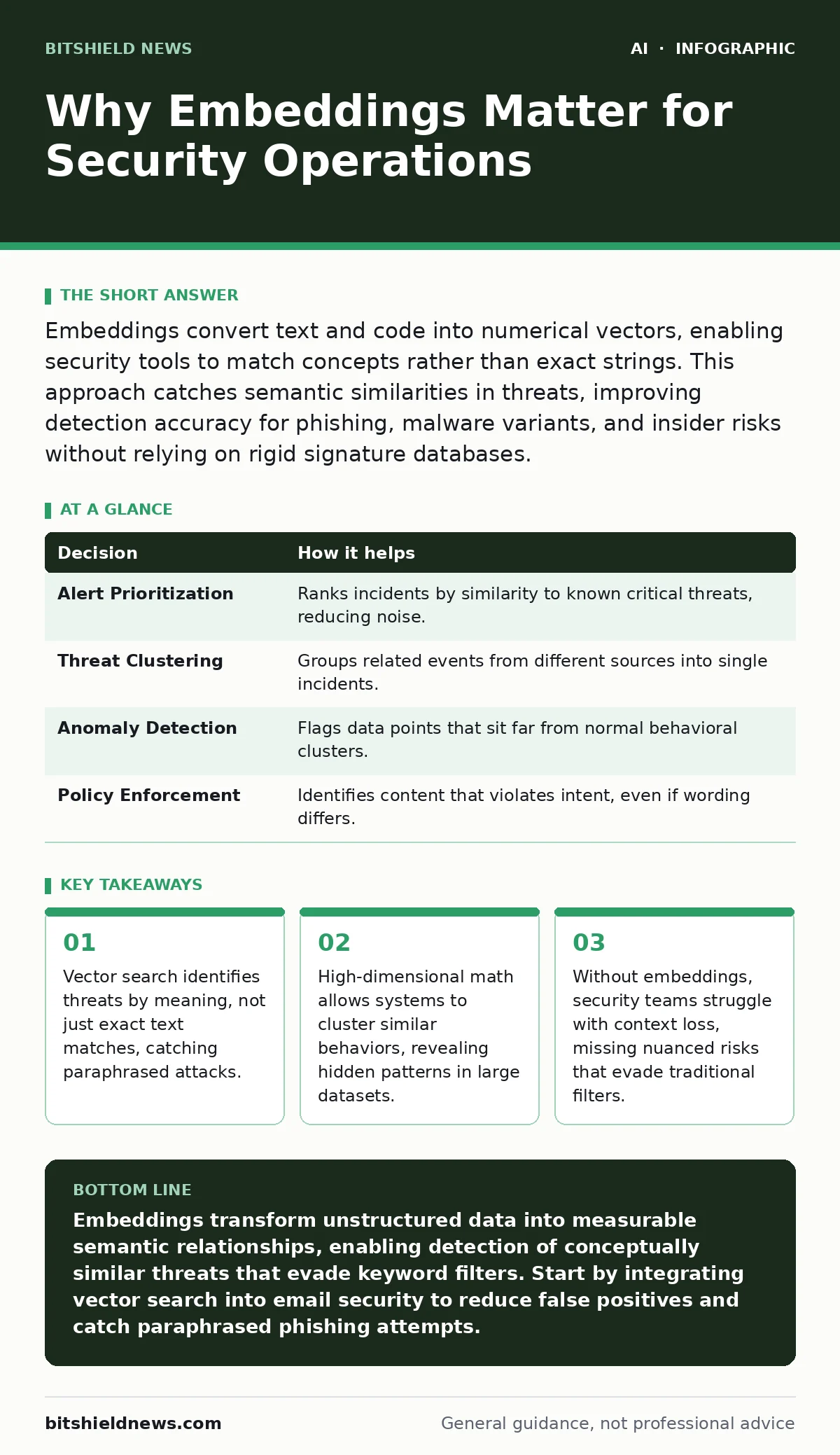
Embeddings convert text and code into numerical vectors, enabling security tools to match concepts rather than exact strings. This approach catches semantic similarities in threats, improving detection accuracy for phishing, malware variants, and insider risks without relying on rigid signature databases.
The Geometry of Meaning
Security data is rarely clean. Logs, emails, and code snippets contain vast amounts of noise. Traditional keyword matching fails when an attacker changes a single word in a script or paraphrases a phishing lure. Embeddings solve this by converting unstructured data into vector representations. These are long lists of numbers that capture the semantic meaning of the input.
When two pieces of data have similar meanings, their vectors sit close together in a multi-dimensional space. When they differ, the vectors are far apart. This geometric relationship allows security systems to measure similarity with mathematical precision. You no longer search for exact phrases. You search for concepts.
This shift changes how you detect threats. Instead of asking "does this string match the blacklist?", you ask "how similar is this behavior to known malicious activity?". This approach catches variations that rigid rules miss. It turns qualitative analysis into quantitative measurement.
Decisions Driven by Distance
The value of embeddings lies in the decisions they inform. Security teams use vector proximity to prioritize alerts, cluster incidents, and identify outliers. Without this capability, analysts drown in false positives. With it, they focus on high-risk anomalies.
| Decision | How it helps |
|---|---|
| Alert Prioritization | Ranks incidents by similarity to known critical threats, reducing noise. |
| Threat Clustering | Groups related events from different sources into single incidents. |
| Anomaly Detection | Flags data points that sit far from normal behavioral clusters. |
| Policy Enforcement | Identifies content that violates intent, even if wording differs. |
These decisions rely on the accuracy of the embedding model. A poorly chosen model creates vectors that do not reflect true semantic similarity. This leads to incorrect clustering and missed detections. You must validate that your embeddings align with your security context.
The Cost of Ignoring Context
Imagine a team that relies solely on keyword filtering. They block emails containing the word "invoice" from unknown senders. An attacker sends a message with "billing statement" instead. The filter passes. The victim clicks the link. This is the cost of ignoring context.
Keyword filters operate on surface-level features. They cannot understand intent. Embeddings understand intent. They recognize that "billing statement" and "invoice" are semantically equivalent in a financial context. A system using embeddings would flag both.
This difference becomes critical in sophisticated attacks. Attackers use paraphrasing tools to evade detection. They rewrite malicious code to look different while keeping the same logic. Traditional tools see different code. Embedding-based tools see the same logic. The gap in detection capability is significant.
How Teams Use Embeddings in Practice
Security operations centers integrate embeddings into various workflows. They start by embedding historical data. This creates a baseline of normal behavior. New data is then embedded and compared against this baseline.
Teams use vector databases to store these representations. These databases are optimized for similarity search. They can find the nearest neighbors to a query vector in milliseconds. This speed is essential for real-time detection.
Common use cases include:
- Detecting AI-generated phishing by comparing new emails to known phishing templates.
- Identifying shadow AI usage by finding code snippets similar to public AI model outputs.
- Monitoring for insecure AI plugins and agents by checking for patterns associated with known vulnerabilities.
The key is consistency. You must embed new data using the same model used for the baseline. Mixing models creates incompatible vectors. The comparisons become meaningless.
Hidden Costs and Trade-offs
Embeddings are not a silver bullet. They introduce new complexities. The primary cost is computational. Generating vectors for large datasets requires significant processing power. Storing these vectors also consumes more space than raw text.
Another trade-off is interpretability. A vector is a list of numbers. It does not explain why two items are similar. You know they are close in space, but you may not know why. This lack of transparency can complicate incident response. Analysts need to understand the "why" behind an alert.
This drift requires ongoing maintenance. You cannot set it and forget it. You need a process for evaluating model performance. Regular audits ensure your embeddings remain aligned with current threats.
See also: How Security Telemetry Works: From Raw Data to Actionable Insight · Detect Remote Access Trojans: Logs, Tools and Blind Spots
Edge Cases and Limitations
There are scenarios where embeddings fail. One edge case is out-of-distribution data. If an input is completely unlike anything in the training data, the embedding may be meaningless. The vector might sit in an empty region of the space. Similarity search returns no useful results.
Another limitation is sensitivity to context length. Most embedding models have a maximum token limit. Long documents must be chunked. This can split semantic meaning across chunks. The resulting vectors may not capture the full context. You must design chunking strategies that preserve meaning.
General-purpose models often miss niche threats. They lack the specialized knowledge to distinguish between benign and malicious uses of technical terms. Domain-specific models provide better accuracy for security applications.
Integrating with Existing Tools
You do not need to rebuild your security stack. Embeddings can be integrated into existing workflows. Many AI in security operations platforms support vector search. You can add an embedding layer to your SIEM or SOAR.
Start with a high-value use case. Email security is a good candidate. Phishing detection benefits significantly from semantic analysis. Implement embeddings for email body text. Compare new emails against a library of known phishing attempts.
Monitor the results. Track reduction in false positives. Measure improvement in detection rates. Use these metrics to justify expansion. Gradually apply embeddings to other data sources, such as logs and code repositories.
Integration requires careful planning. Ensure your infrastructure can handle the computational load. Optimize your vector database for performance. Test thoroughly before deploying to production.
The Path Forward
Embeddings represent a shift in how security teams process information. They move beyond rigid rules to flexible, context-aware analysis. This shift improves detection accuracy and reduces analyst fatigue.
However, they require careful implementation. You must manage computational costs, model drift, and interpretability challenges. Choose the right models for your domain. Validate your results continuously.
The technology is evolving. New models offer better accuracy and efficiency. Stay informed about advancements. But focus on the fundamentals. Understand how vectors represent meaning. Build your strategy around this core concept.
By embracing embeddings, you gain a deeper understanding of your security data. You see connections that were previously hidden. You detect threats that were previously invisible. This capability is becoming standard in modern security operations.
Key takeaways
- Vector search identifies threats by meaning, not just exact text matches, catching paraphrased attacks.
- High-dimensional math allows systems to cluster similar behaviors, revealing hidden patterns in large datasets.
- Without embeddings, security teams struggle with context loss, missing nuanced risks that evade traditional filters.
Embeddings transform unstructured data into measurable semantic relationships, enabling detection of conceptually similar threats that evade keyword filters. Start by integrating vector search into email security to reduce false positives and catch paraphrased phishing attempts.
Frequently asked questions
Do embeddings replace traditional keyword filters?
No, they complement them. Keyword filters are fast and precise for exact matches. Embeddings catch semantic similarities. Use both for layered defense.
How do I choose the right embedding model?
Select models trained on data similar to your use case. For security, choose models fine-tuned on technical text. Evaluate performance on your specific dataset.
Are vector databases expensive to run?
They require more storage and compute than traditional databases. However, costs are decreasing. Optimize your indexing strategy to balance performance and cost.
Can embeddings detect zero-day attacks?
They can detect behavior similar to known attacks. Zero-days with entirely new logic may not match existing vectors. Combine embeddings with other detection methods.
How this guide was produced: written by the BitShield News editorial team with AI assistance, checked against the public references listed below, and reviewed when the facts change. See our editorial policy or report an error.