
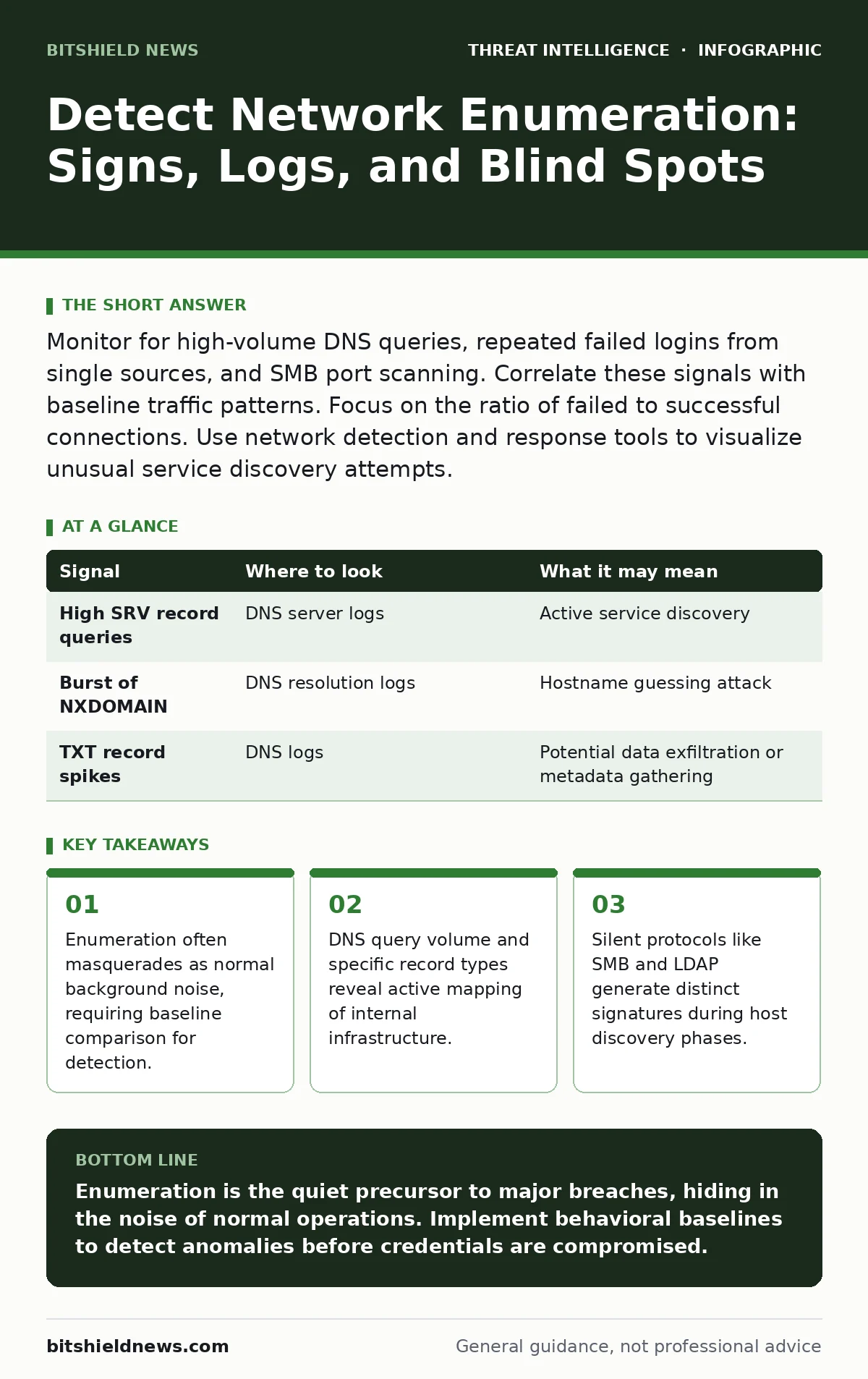
Monitor for high-volume DNS queries, repeated failed logins from single sources, and SMB port scanning. Correlate these signals with baseline traffic patterns. Focus on the ratio of failed to successful connections. Use network detection and response tools to visualize unusual service discovery attempts.
The Anatomy of Reconnaissance
Attackers rarely strike immediately. They first map your environment to find valuable targets. This phase is called network enumeration. It involves discovering hosts, services, operating systems, and user accounts. The goal is to reduce uncertainty before launching an exploit.
You must distinguish between legitimate administrative tasks and malicious probing. Both generate similar traffic. The difference lies in volume, timing, and context. An administrator scans a subnet to troubleshoot a server. An adversary scans the same subnet to find unpatched vulnerabilities.
Imagine a quiet Tuesday morning. Suddenly, a single workstation initiates thousands of connection attempts across the subnet. This is not a user browsing the web. This is a systematic probe. Detecting this requires looking beyond simple firewall logs. You need to understand the behavior pattern, not just the individual packets.
DNS Query Anomalies
Domain Name System queries are the most common side channel for enumeration. Attackers use DNS to resolve hostnames and discover services. They often query for specific records that reveal infrastructure details. Look for spikes in queries for SRV records, which locate services like Kerberos or LDAP.
Normal users rarely query for these records directly. Applications do it automatically in the background. However, a sudden burst of SRV queries from a single client is suspicious. It suggests an automated tool is mapping your domain controllers.
Also watch for queries to non-existent domains. Attackers may guess hostnames based on common naming conventions. If your servers follow a pattern like "SRV-APP-01", they will try "SRV-APP-02" and so on. High rates of NXDOMAIN responses indicate active guessing. This ties into broader security telemetry strategies where DNS logs provide early warnings.
| Signal | Where to look | What it may mean |
|---|---|---|
| High SRV record queries | DNS server logs | Active service discovery |
| Burst of NXDOMAIN | DNS resolution logs | Hostname guessing attack |
| TXT record spikes | DNS logs | Potential data exfiltration or metadata gathering |
SMB and Port Scanning
Server Message Block is a protocol used for file sharing. It is also a primary target for enumeration. Attackers scan for open SMB ports to find shared drives and hidden administrative shares. They look for signs of active hosts and potential lateral movement paths.
Standard port scans send SYN packets to many ports. Firewalls often log these as blocked attempts. However, stealthy scanners use fragmented packets or slow scanning techniques. These methods bypass simple rate-limiting rules. You must look for the pattern of connections, not just the volume.
A single host connecting to hundreds of other hosts on port 445 is a red flag. Legitimate file transfers do not behave this way. This behavior often precedes lateral movement attempts. The attacker is building a map of where they can move next. Correlating this with network detection and response alerts can stop the process before credentials are stolen.
Authentication Failures
User enumeration is a critical step. Attackers need valid usernames to launch brute-force attacks or pass-the-hash attacks. They achieve this by triggering different error messages for valid and invalid users. Some systems return a generic "login failed" for both cases. Others specify "user not found" for invalid accounts.
Look for a high ratio of failed logins from a single source. If the failures stop abruptly after a certain username, the attacker likely found a valid account. This is a strong indicator of successful enumeration.
These logs are often noisy. Administrators mistype passwords. Service accounts expire. You must filter for anomalies. A sudden increase in failures from an external IP is different from internal noise. This connects to incident triage processes where you prioritize alerts based on context. Ignoring these signals allows attackers to build a list of valid targets.
LDAP and Directory Queries
Lightweight Directory Access Protocol is used to query directory services. Attackers use it to harvest user attributes, group memberships, and computer objects. They look for privileged accounts and service accounts. These are high-value targets for privilege escalation.
Normal LDAP traffic is sporadic. Enumeration traffic is rapid and systematic. Attackers request large sets of data in short bursts. They may request all users in a specific Organizational Unit. This generates significant load on the domain controller.
Monitor for search filters that return large result sets. A query for "userAccountControl" attributes reveals account types. A query for "servicePrincipalName" reveals Kerberos targets. This is often a precursor to AS-REP roasting attacks. Detecting these queries early disrupts the attack chain.
See also: Detect Ransomware-as-a-Service: Log Signals and Blind Spots
Silent Protocols and Blind Spots
Not all enumeration generates loud alerts. Some protocols are designed to be quiet. ICMP, or ping, is often blocked by firewalls. Attackers use alternative methods to discover hosts. They may use TCP SYN scans or UDP probes.
One major blind spot is internal traffic. Many organizations monitor perimeter traffic but ignore internal flows. An attacker who compromises one host can enumerate the rest of the network without triggering external alerts. You must monitor east-west traffic.
Another blind spot is encrypted traffic. If you cannot inspect TLS payloads, you miss the content of the enumeration. However, metadata remains visible. The frequency and destination of encrypted connections still reveal patterns. Relying solely on deep packet inspection leaves gaps.
Tools for Detection
You need the right tools to see these patterns. Standard firewalls are not enough. They block traffic but do not analyze behavior. You need systems that correlate events across multiple sources.
Network detection and response platforms excel here. They capture traffic metadata and apply behavioral analytics. They can identify a host that is scanning too many ports. Endpoint detection and response agents help too. They see the processes initiating the scans.
Integrate these tools with your SIEM. Create alerts for specific combinations of events. For example, alert when a host resolves a domain controller and then attempts an LDAP bind. This reduces noise and highlights true threats. Understanding security telemetry basics helps you tune these alerts effectively.
Reducing Attack Surface
Detection is reactive. Prevention is proactive. Reduce the information available to enumerators. Disable unnecessary services. Close unused ports. Restrict access to directory services.
Implement strict access controls. Only allow necessary queries to LDAP. Limit who can view user attributes. This reduces the value of successful enumeration.
Regularly review your network baseline. What is normal for your environment? Document it. When traffic deviates from this baseline, investigate. This ongoing process keeps your defenses sharp. It ensures that new enumeration techniques are caught quickly.
Key takeaways
- Enumeration often masquerades as normal background noise, requiring baseline comparison for detection.
- DNS query volume and specific record types reveal active mapping of internal infrastructure.
- Silent protocols like SMB and LDAP generate distinct signatures during host discovery phases.
Enumeration is the quiet precursor to major breaches, hiding in the noise of normal operations. Implement behavioral baselines to detect anomalies before credentials are compromised.
Frequently asked questions
How do I distinguish between a vulnerability scanner and an attacker?
Legitimate scanners are usually scheduled, well-known, and limited in scope. Attacker tools run at odd hours, target specific high-value ports, and correlate with other suspicious activities like DNS guessing.
Can DNS logs alone detect enumeration?
DNS logs provide strong indicators, especially for hostname guessing and service discovery. However, they should be correlated with authentication and network flow data to confirm malicious intent and reduce false positives.
What is the most common blind spot in enumeration detection?
The most common blind spot is internal east-west traffic. Once an attacker is inside the perimeter, they can enumerate other hosts without triggering external firewall alerts, making internal monitoring critical.
Does encryption prevent enumeration detection?
Encryption hides the payload content but not the metadata. You can still detect enumeration by analyzing the frequency, volume, and destination of encrypted connections, as well as the DNS queries that precede them.
How this guide was produced: written by the BitShield News editorial team with AI assistance, checked against the public references listed below, and reviewed when the facts change. See our editorial policy or report an error.