
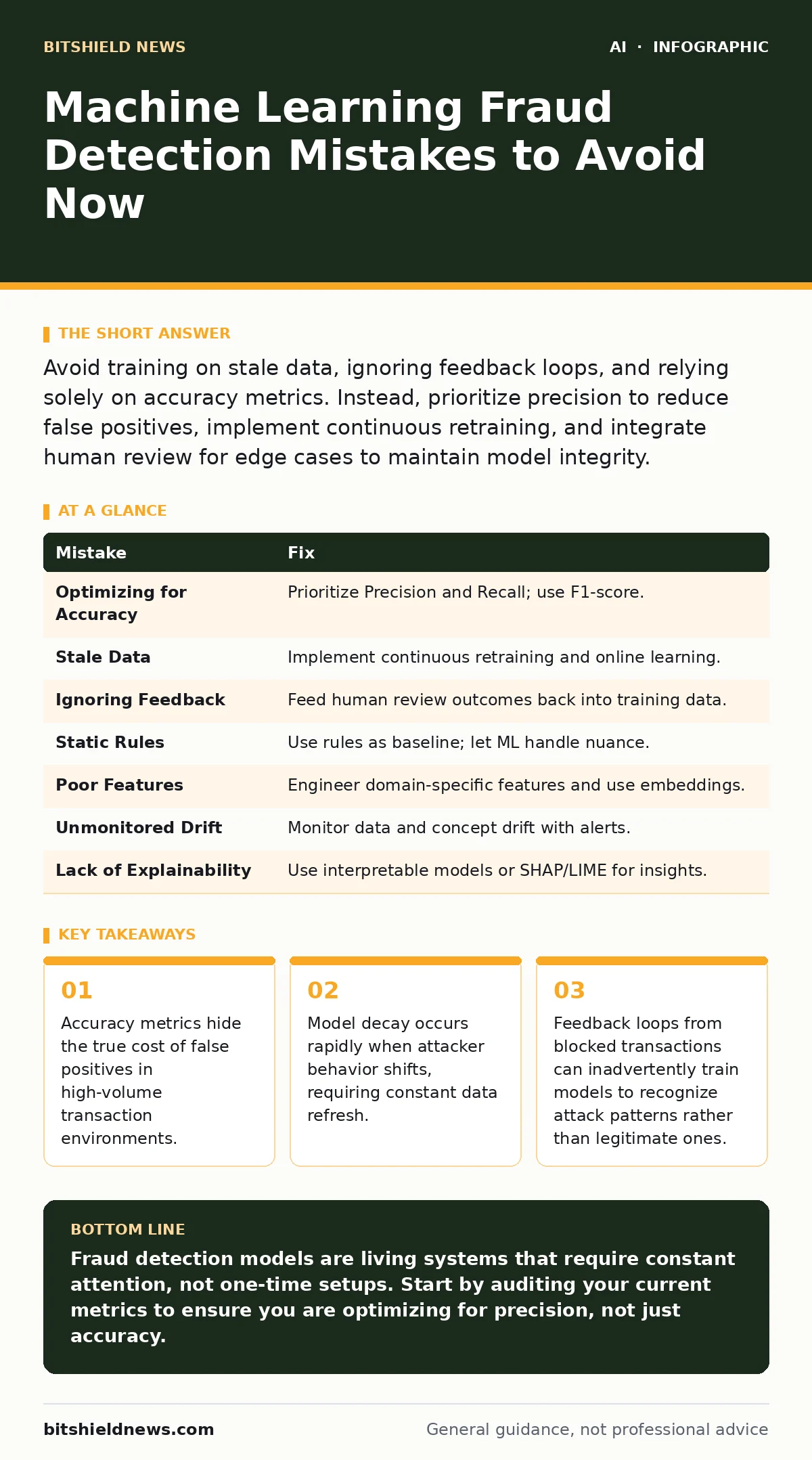
Avoid training on stale data, ignoring feedback loops, and relying solely on accuracy metrics. Instead, prioritize precision to reduce false positives, implement continuous retraining, and integrate human review for edge cases to maintain model integrity.
Mistake 1: Optimizing for Accuracy Over Precision
Fraud detection is an asymmetric battle. The volume of legitimate transactions dwarfs the volume of fraudulent ones, creating a heavily imbalanced dataset. When you train a model to maximize overall accuracy, it learns that the easiest path to a high score is to classify every transaction as legitimate. This creates a false sense of security. The model appears to perform well on paper, yet it fails to catch the rare, high-value attacks that matter most.
Why it hurts: You face two distinct failures. First, the model misses actual fraud because it is biased toward the majority class. Second, if you tweak the threshold to catch more fraud, you trigger a cascade of false positives. These false positives block legitimate customers, eroding trust and increasing operational overhead as support teams manually review innocent transactions.
The fix: Shift your evaluation metric from accuracy to precision and recall. Precision measures how many of the flagged transactions are actually fraud. Recall measures how many of the actual fraud cases you caught. For fraud detection, precision is often more valuable because the cost of blocking a good customer is immediate and tangible. Use the F1-score, which balances both, but weight it toward precision. This forces the model to be conservative in its accusations, ensuring that when it flags a transaction, it is highly confident.
Mistake 2: Training on Stale or Non-Representative Data
Attackers adapt their methods faster than you can collect data. A model trained on last quarter’s fraud patterns is blind to this quarter’s tactics. Fraudsters constantly rotate their techniques, using new payment methods, different device fingerprints, or altered behavioral sequences. If your training data does not reflect the current threat environment, your model is effectively guessing. This is known as concept drift, where the statistical properties of the target variable change over time.
Why it hurts: The model becomes obsolete. It continues to flag historical patterns that no longer occur, while missing new patterns entirely. This leads to a gradual degradation in performance that is often unnoticed until a significant breach occurs. The model appears stable because the overall volume of fraud may not change, but the nature of the fraud has shifted beyond its recognition capabilities.
The fix: Implement a continuous retraining pipeline. Do not rely on annual or quarterly updates. Instead, set triggers for retraining based on data volume or time intervals. Ensure your training data includes a representative sample of recent transactions, including both legitimate and fraudulent ones. Use techniques like online learning, where the model updates incrementally with new data points, to keep it responsive to emerging trends. This requires robust data hygiene to ensure that the new data is correctly labeled.
Mistake 3: Ignoring the Feedback Loop from Human Review
Many organizations treat the machine learning model and the human review team as separate entities. When the model flags a transaction for review, a human analyst investigates it. The outcome of that investigation—whether the transaction was truly fraud or a false positive—is rarely fed back into the model. This breaks the learning cycle. The model never learns from its mistakes, and human insights remain siloed.
Why it hurts: The model stagnates. It continues to make the same errors because it receives no corrective signal. Furthermore, if human reviewers develop their own heuristics or rules that contradict the model’s logic, you create conflicting signals in your security operations. This disconnect leads to inefficiency and frustration, as the tool does not improve with experience.
The fix: Close the loop by feeding the results of human reviews back into the training data. Every time an analyst confirms or rejects a fraud allegation, that decision should be logged and used to retrain the model. This creates a symbiotic relationship where human expertise enhances machine learning, and machine learning scales human effort. Ensure that the feedback is timely and accurate, as poor-quality feedback can degrade model performance.
Mistake 4: Over-Reliance on Static Rules
Attackers quickly learn these thresholds and adjust their behavior to stay just below them. For example, they may split large transactions into smaller ones or use proxy servers to mask their location.
Why it hurts: Static rules create predictable blind spots. They generate high volumes of false positives for legitimate users who happen to cross an arbitrary threshold. They also fail to detect sophisticated attacks that mimic legitimate behavior. Over time, the rules become a maintenance burden, requiring constant tweaking to stay relevant, which diverts resources from more strategic initiatives.
The fix: Use static rules only as a baseline or for known, high-confidence threats. Let the machine learning model handle the nuanced, probabilistic decisions. The model can analyze hundreds of features simultaneously, including behavioral patterns, device telemetry, and network context, to identify anomalies that static rules miss. Gradually retire static rules as the model demonstrates reliability in those areas. This reduces complexity and improves detection rates.
Mistake 5: Neglecting Feature Engineering and Context
Raw data is rarely sufficient for effective fraud detection. A transaction amount alone tells you little. However, when combined with the user’s historical spending patterns, the time of day, the device used, and the geolocation, it becomes a powerful signal. Feature engineering is the process of creating these meaningful inputs from raw data. Many teams skip this step, feeding raw logs directly into the model.
Why it hurts: The model struggles to find patterns in noisy, unstructured data. It may miss subtle correlations that indicate fraud, such as a sudden change in typing speed or a mismatch between the billing and shipping address. Without proper features, the model requires more data to learn, increasing the risk of overfitting to noise rather than signal.
The fix: Invest time in creating domain-specific features. Collaborate with fraud analysts to understand what indicators they use manually, then encode these into the model. Examples include the velocity of transactions, the diversity of devices used by an account, and the deviation from normal behavior. Use embeddings to convert categorical data, like merchant categories, into dense vectors that capture semantic relationships. This allows the model to recognize that a purchase at a hardware store is different from a purchase at a grocery store, even if the amounts are similar.
See also: Difference between large language models and small language models for engineering choice · Why Is AI Bias a Concern in Machine Learning: Root Causes
Mistake 6: Failing to Monitor Model Drift
Even with continuous retraining, models can drift. This happens when the underlying data distribution changes in ways that are not immediately apparent. For instance, a new product launch might change user behavior, causing the model to flag normal activity as suspicious. Without monitoring, this drift goes unnoticed until it causes significant business impact.
Why it hurts: The model’s performance degrades silently. You may not realize the model is failing until you see a spike in chargebacks or customer complaints. By then, the damage is done. Monitoring drift is not just about accuracy; it is about understanding how the model’s predictions are distributed over time.
The fix: Implement comprehensive monitoring for both data drift and concept drift. Track the distribution of input features and model predictions. Set alerts for significant deviations from the baseline. Use tools like those discussed in our guide on AI security testing to regularly evaluate model performance in a controlled environment. This proactive approach allows you to detect and address drift before it impacts your users.
Mistake 7: Lack of Explainability in Decisions
Machine learning models, particularly deep learning networks, are often black boxes. They make decisions based on complex, non-linear relationships that are difficult for humans to interpret. When a transaction is blocked, customers and support staff want to know why. If you cannot explain the decision, you lose trust and face regulatory scrutiny.
Why it hurts: Lack of transparency leads to disputes and compliance risks. Customers may challenge blocked transactions, forcing your team to spend time investigating each case. Regulators may require explanations for automated decisions, particularly in financial services. Without explainability, you cannot effectively debug the model or identify biases in its decision-making process.
The fix: Use interpretable models where possible, such as decision trees or linear models with regularization. For more complex models, employ explainability techniques like SHAP (SHapley Additive exPlanations) or LIME (Local Interpretable Model-agnostic Explanations). These tools provide insights into which features contributed most to a specific prediction. This allows you to explain decisions to stakeholders and identify potential biases or errors in the model’s logic.
| Mistake | Fix |
|---|---|
| Optimizing for Accuracy | Prioritize Precision and Recall; use F1-score. |
| Stale Data | Implement continuous retraining and online learning. |
| Ignoring Feedback | Feed human review outcomes back into training data. |
| Static Rules | Use rules as baseline; let ML handle nuance. |
| Poor Features | Engineer domain-specific features and use embeddings. |
| Unmonitored Drift | Monitor data and concept drift with alerts. |
| Lack of Explainability | Use interpretable models or SHAP/LIME for insights. |
Key takeaways
- Accuracy metrics hide the true cost of false positives in high-volume transaction environments.
- Model decay occurs rapidly when attacker behavior shifts, requiring constant data refresh.
- Feedback loops from blocked transactions can inadvertently train models to recognize attack patterns rather than legitimate ones.
Fraud detection models are living systems that require constant attention, not one-time setups. Start by auditing your current metrics to ensure you are optimizing for precision, not just accuracy.
Frequently asked questions
How often should I retrain my fraud detection model?
Retrain frequently, ideally in a continuous pipeline, to adapt to evolving attacker tactics and prevent concept drift.
How do I handle false positives without blocking customers?
Implement a tiered response system. Flag high-confidence fraud for automatic blocking, but route lower-confidence alerts to human review or step-up authentication.
How this guide was produced: written by the BitShield News editorial team with AI assistance, checked against the public references listed below, and reviewed when the facts change. See our editorial policy or report an error.