
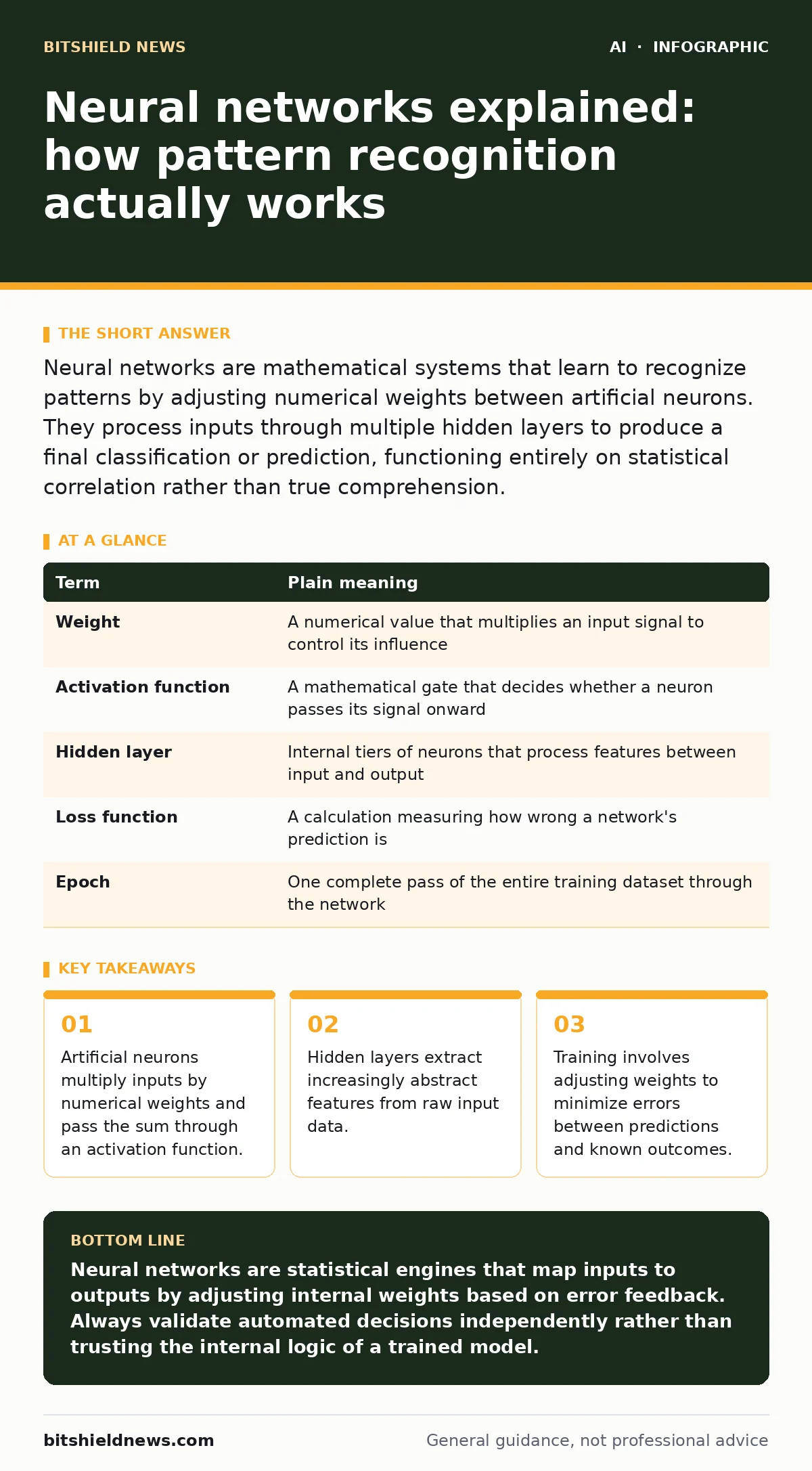
Neural networks are mathematical systems that learn to recognize patterns by adjusting numerical weights between artificial neurons. They process inputs through multiple hidden layers to produce a final classification or prediction, functioning entirely on statistical correlation rather than true comprehension.
How a bakery sorting line reveals neural mechanics
Neural networks operate much like a massive industrial bakery sorting line designed to categorize incoming dough shapes into specific pastry types. Raw ingredients enter the system at the start, and dozens of workers inspect different physical traits simultaneously. Each worker passes their partial assessment down the line, combining observations until the final station decides whether the item becomes a croissant or a loaf.
Sorting dough shapes requires transforming vague physical traits into rigid numerical values that mathematical equations can manipulate. Raw pixels or sensor readings enter the first tier of the network, known as the input layer. This initial tier acts like a bank of basic filters, capturing raw edges, colors, or tones without understanding the broader context of the entire object.
Passing judgments through hidden layers
Hidden layers sit between the input stage and the final output, performing the heavy lifting of feature extraction. Workers in the early hidden layers might notice simple curves or parallel lines, passing those notes to subsequent tiers that recognize eyes, wheels, or textures. Each worker multiplies incoming observations by a specific numerical value called a weight, determining how much influence any particular observation holds over the final decision.
Combining weighted inputs requires an activation function to decide whether a worker passes their findings downstream. This mathematical gatekeeper prevents weak signals from clogging the network while amplifying strong correlations that match known patterns. Passing data through this activation threshold turns linear math into complex curves capable of separating cat photos from security logs, or identifying subtle anomalies that mirror shadow AI risks.
Adjusting behavior during training
Training a network resembles a manager correcting bakery apprentices by adjusting how much they trust each worker's opinion after every failed batch. The system calculates a loss function, measuring the exact mathematical distance between its current guess and the correct label. A high loss value triggers a correction wave that ripples backward through every layer, tweaking weights slightly to improve future accuracy.
Tweaking millions of interconnected weights relies on an optimization algorithm that walks down a mathematical slope toward the lowest possible error rate. Stopping this adjustment phase too early leaves the network unable to generalize beyond its training materials, while running it too long causes overfitting, where the system memorizes specific examples rather than learning underlying rules. Real-world performance depends heavily on having diverse training sets, a challenge frequently analyzed alongside AI model monitoring frameworks.
Core vocabulary of artificial intelligence
| Term | Plain meaning |
|---|---|
| Weight | A numerical value that multiplies an input signal to control its influence |
| Activation function | A mathematical gate that decides whether a neuron passes its signal onward |
| Hidden layer | Internal tiers of neurons that process features between input and output |
| Loss function | A calculation measuring how wrong a network's prediction is |
| Epoch | One complete pass of the entire training dataset through the network |
Common points of confusion
Believing that neural networks possess human intuition remains a widespread trap for beginners examining modern software capabilities. Networks do not understand concepts; they merely locate statistical correlations across vast numerical spaces, which explains why they fail catastrophically when presented with inputs slightly outside their training distribution.
Confusing correlation with causation leads operators to trust automated outputs blindly without verifying the underlying mechanical logic. A network might classify a network packet as malicious because of an irrelevant background detail in the training set rather than an actual exploit payload, creating vulnerabilities analogous to those mapped in the OWASP Top 10 for LLM applications.
See also: Difference between large language models and small language models for engineering choice · Why Is AI Bias a Concern in Machine Learning: Root Causes
3 steps to trace a prediction
- Feed a standardized input vector into the input layer of a trained network.
- Multiply each node value by its corresponding weight as the data flows through hidden tiers.
- Read the final probability distribution generated at the output layer to see which category won.
Key takeaways
- Artificial neurons multiply inputs by numerical weights and pass the sum through an activation function.
- Hidden layers extract increasingly abstract features from raw input data.
- Training involves adjusting weights to minimize errors between predictions and known outcomes.
Neural networks are statistical engines that map inputs to outputs by adjusting internal weights based on error feedback. Always validate automated decisions independently rather than trusting the internal logic of a trained model.
Frequently asked questions
Can a neural network explain how it reached a specific conclusion?
Standard networks cannot explain their reasoning because their decisions emerge from millions of interacting numerical weights rather than explicit logical rules.
Why do neural networks require such massive amounts of training data?
Networks must observe countless variations of inputs to learn which features matter and which random details to ignore.
What happens if you feed corrupted data into a trained neural network?
Corrupted inputs often produce wildly confident but entirely incorrect outputs because the network lacks common sense to reject anomalies.
Are all machine learning systems built using neural networks?
Many machine learning algorithms use simpler statistical methods like decision trees or linear regression without any neural network architecture.
How this guide was produced: written by the BitShield News editorial team with AI assistance, checked against the public references listed below, and reviewed when the facts change. See our editorial policy or report an error.