
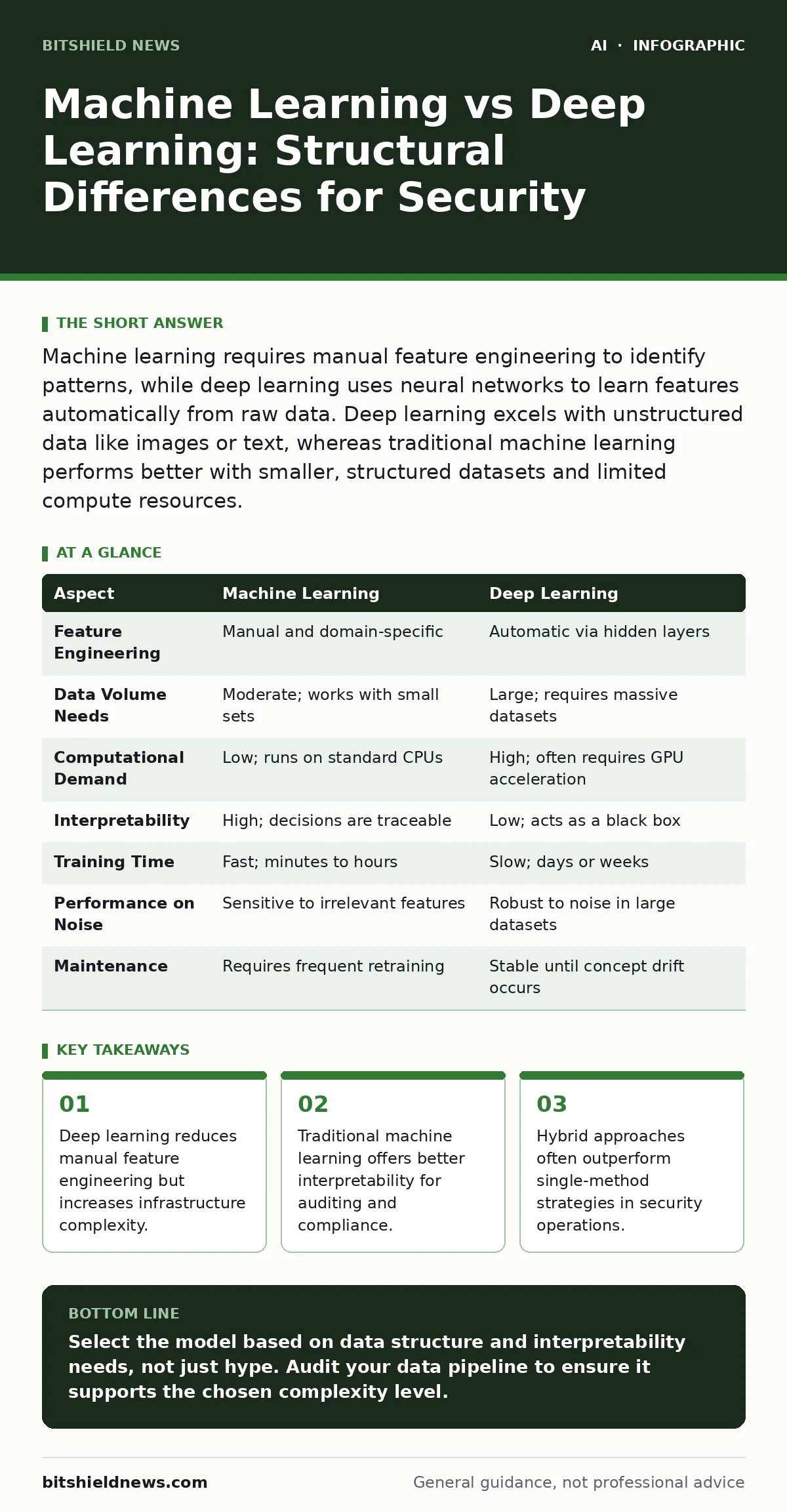
Machine learning requires manual feature engineering to identify patterns, while deep learning uses neural networks to learn features automatically from raw data. Deep learning excels with unstructured data like images or text, whereas traditional machine learning performs better with smaller, structured datasets and limited compute resources.
The Core Distinction in Pattern Recognition
The fundamental difference lies in how the system identifies relevant signals. Traditional machine learning algorithms require you to explicitly define which data points matter. You must engineer features, such as transaction frequency or login location, before the model can learn. Deep learning bypasses this manual step by using artificial neural networks to discover hierarchical patterns directly from raw input. This automation changes the engineering workflow from feature selection to data volume management.
Defining Machine Learning Mechanics
Machine learning relies on statistical models that adjust parameters based on labeled training data. Algorithms like decision trees or support vector machines analyze the features you provide to find boundaries between classes. You must understand the domain well enough to select inputs that correlate with the outcome. If you omit a critical signal, the model cannot infer it. This method provides high transparency, allowing you to trace why a specific decision was made. It remains the standard for structured data where relationships are linear or easily quantifiable.
Defining Deep Learning Architecture
Deep learning utilizes multiple layers of artificial neurons to process information. Each layer transforms the input into a more abstract representation. The first layer might detect edges in an image, while deeper layers identify shapes or objects. This hierarchy allows the system to handle unstructured data, such as audio, text, or pixel arrays, without manual preprocessing. The trade-off is opacity. The internal weights of a deep neural network are difficult to interpret, making it harder to explain why the system flagged a specific event. This complexity demands significant computational power and large datasets to avoid overfitting.
Comparative Analysis of Operational Traits
| Aspect | Machine Learning | Deep Learning |
|---|---|---|
| Feature Engineering | Manual and domain-specific | Automatic via hidden layers |
| Data Volume Needs | Moderate; works with small sets | Large; requires massive datasets |
| Computational Demand | Low; runs on standard CPUs | High; often requires GPU acceleration |
| Interpretability | High; decisions are traceable | Low; acts as a black box |
| Training Time | Fast; minutes to hours | Slow; days or weeks |
| Performance on Noise | Sensitive to irrelevant features | Robust to noise in large datasets |
| Maintenance | Requires frequent retraining | Stable until concept drift occurs |
Choosing Traditional Machine Learning
Select machine learning when your data is structured and tabular. This approach suits scenarios where you need to explain decisions to auditors or regulators. The transparency of algorithms like logistic regression allows you to validate logic against business rules. It also fits environments with limited computational resources. You do not need specialized hardware to train or deploy these models. This method is ideal for tasks like credit scoring or simple anomaly detection in network logs. Refer to machine learning for fraud detection for specific implementations of these lightweight models.
See also: Difference between large language models and small language models for engineering choice · Why Is AI Bias a Concern in Machine Learning: Root Causes
Choosing Deep Learning
Choose deep learning when dealing with unstructured data types. Images, audio files, and natural language text require the hierarchical abstraction that neural networks provide. This method is necessary for complex pattern recognition, such as identifying malicious code signatures in binary files. It also excels in scenarios where human experts cannot easily define the features. The system learns nuances that escape manual definition. However, you must ensure you have the data volume and compute capacity to support training. See voice cloning scams for examples where deep learning capabilities create new attack vectors.
Overlapping Zones and Hybrid Strategies
The boundary between these fields is porous. Many modern security tools use both approaches. A system might use machine learning to filter obvious benign traffic and deep learning to analyze suspicious packets. This hybrid model balances speed with depth. AI in security operations often relies on this tiered approach to manage alert fatigue. Additionally, techniques like embeddings allow traditional algorithms to process the dense vectors generated by deep networks. This combination leverages the interpretability of simple models with the representational power of complex ones.
Managing Hidden Costs and Risks
Deep learning introduces hidden operational costs. The energy consumption for training large models is significant. Storage requirements for raw data and model checkpoints grow exponentially. You must also address the security of the models themselves. Adversarial attacks can manipulate inputs to fool neural networks.
The OWASP Top 10 for LLM applications outlines vulnerabilities specific to these complex systems. Traditional machine learning models are easier to secure and audit. They offer a predictable failure mode, whereas deep learning failures can be subtle and catastrophic. Consider retrieval-augmented generation security when building systems that combine retrieval with generative models.
Future-Proofing Your Security Stack
As data volumes increase, deep learning becomes more viable. However, the need for explainability remains constant in regulated industries. You must balance predictive power with accountability. Monitor for concept drift, where the statistical properties of target variables change over time. Both machine learning and deep learning models degrade if the underlying data distribution shifts.
Regular retraining and validation are necessary for both. Stay aware of emerging threats like deepfake fraud which exploit the very capabilities these models provide. Understanding AI content detection methods helps you defend against synthetic media generated by these same architectures.
Key takeaways
- Deep learning reduces manual feature engineering but increases infrastructure complexity.
- Traditional machine learning offers better interpretability for auditing and compliance.
- Hybrid approaches often outperform single-method strategies in security operations.
Select the model based on data structure and interpretability needs, not just hype. Audit your data pipeline to ensure it supports the chosen complexity level.
Frequently asked questions
Can I use machine learning for image recognition?
Yes, but you must manually extract features like color histograms or edges. Deep learning automates this, usually yielding higher accuracy for complex images.
Is deep learning always more accurate?
No. With small or noisy datasets, traditional machine learning often outperforms deep learning because neural networks require large amounts of data to generalize effectively.
How do I explain a deep learning decision?
You cannot directly inspect the weights. Use explainability tools like SHAP or LIME to approximate the contribution of each input feature to the final prediction.
What hardware do I need for deep learning?
Training typically requires GPUs or TPUs. Inference can sometimes run on CPUs, but performance will be slower. Traditional machine learning runs efficiently on standard processors.
How this guide was produced: written by the BitShield News editorial team with AI assistance, checked against the public references listed below, and reviewed when the facts change. See our editorial policy or report an error.