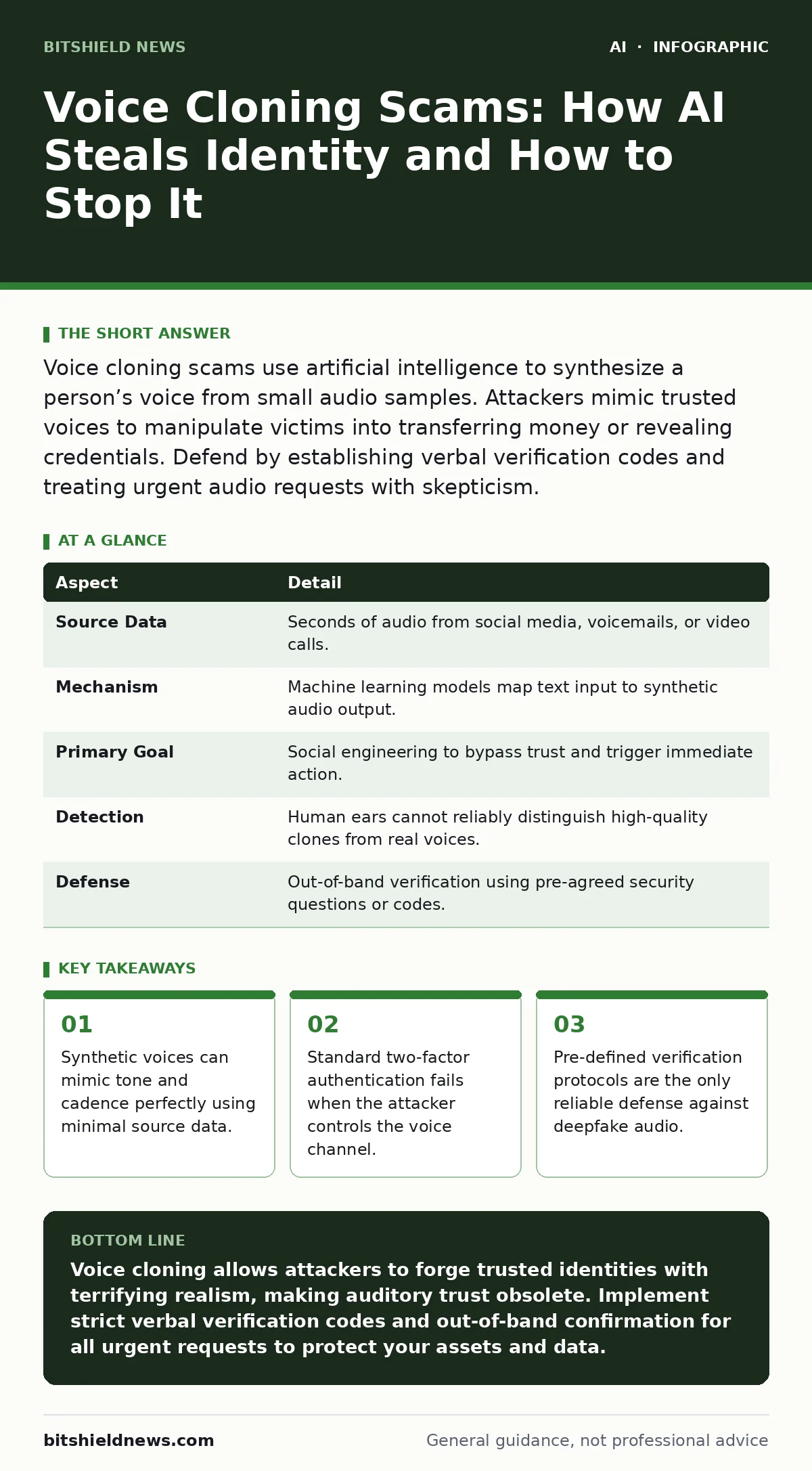
Voice cloning scams use artificial intelligence to synthesize a person’s voice from small audio samples. Attackers mimic trusted voices to manipulate victims into transferring money or revealing credentials. Defend by establishing verbal verification codes and treating urgent audio requests with skepticism.
The Echo That Lies
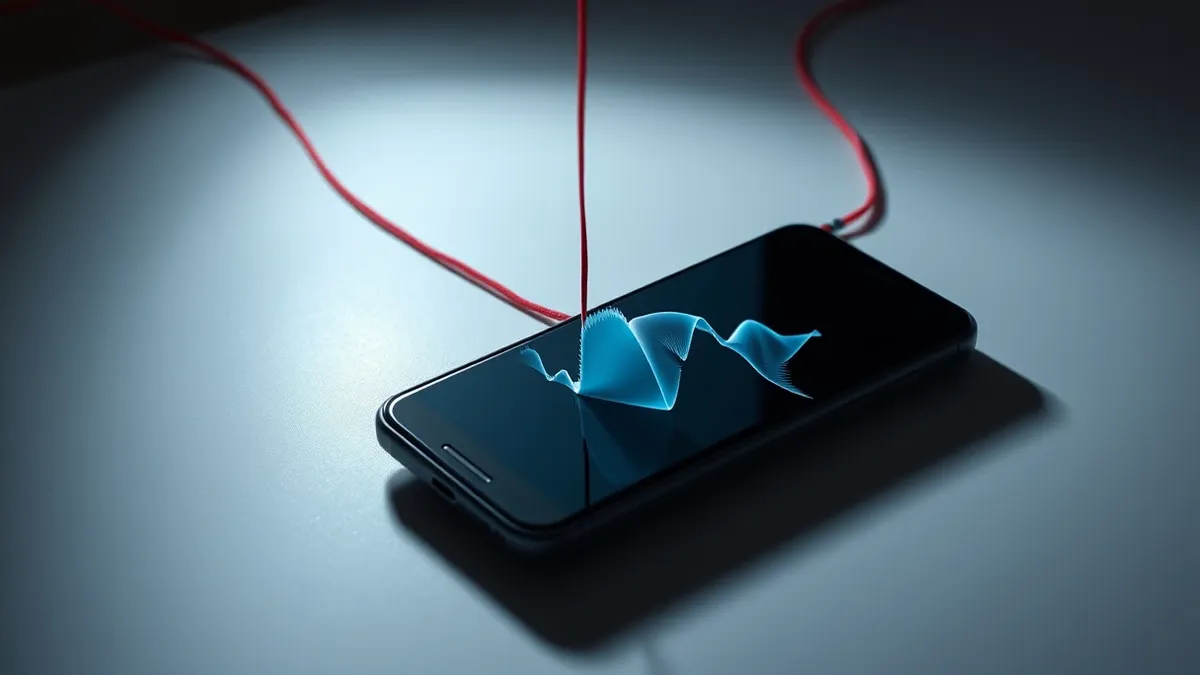
Imagine hearing your mother’s voice on the phone, trembling with fear, asking for money to pay a legal fine. The urgency feels real. The accent matches. The background noise sounds like a busy street. It is not your mother. An attacker used a voice cloning model to generate that audio in real time. This is not science fiction. It is a current threat vector that exploits the human tendency to trust familiar auditory cues over logical verification.
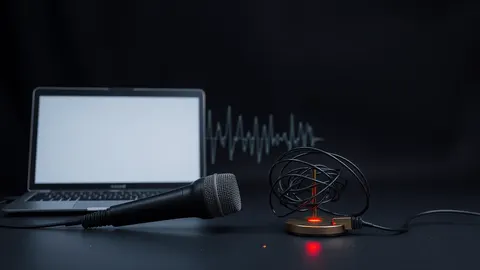
Voice cloning, or voice synthesis, is the process of training an artificial intelligence model on a target’s speech patterns. The model learns the unique acoustic features of the voice, including pitch, speed, and pronunciation. Once trained, it can generate new speech in that voice, saying words the person never actually spoke. The danger lies in the speed and accessibility of this technology. What once required hours of studio recording now requires seconds of background audio.
| Aspect | Detail |
|---|---|
| Source Data | Seconds of audio from social media, voicemails, or video calls. |
| Mechanism | Machine learning models map text input to synthetic audio output. |
| Primary Goal | Social engineering to bypass trust and trigger immediate action. |
| Detection | Human ears cannot reliably distinguish high-quality clones from real voices. |
| Defense | Out-of-band verification using pre-agreed security questions or codes. |
How the Forgery Is Built
The process begins with data collection. Attackers do not need a long, clear monologue. They often harvest short clips from public sources. A three-second snippet of a CEO speaking at a conference is enough to capture the spectral characteristics of their voice. These clips are fed into a neural network that maps the audio waveform to a mathematical representation. This representation, often called an embedding, captures the unique "fingerprint" of the voice.
Once the model has this fingerprint, it can perform text-to-speech generation. You type a sentence, and the model outputs audio that sounds like the target person saying it. The technology has improved to the point where it can mimic emotional inflection. If the script says "I am scared," the generated voice will tremble. This emotional realism is what makes the scam effective. It bypasses the listener’s critical thinking by triggering an immediate emotional response.
Who Is in the Crosshairs
You might think only high-profile executives are at risk. That is a common misconception. While CEOs and public figures are targets, the average employee is equally vulnerable. Attackers often target mid-level managers who have access to financial systems or sensitive data. They also target individuals for personal gain, mimicking family members to request gift cards or wire transfers.
The vulnerability is not just about access; it is about authority. People are conditioned to obey voices they recognize. In a corporate setting, a voice cloning attack can bypass standard protocols. If an attacker calls an IT helpdesk and sounds exactly like the CFO, they may be granted immediate access to reset passwords or approve transactions. The social engineering aspect is amplified by the technical realism of the audio.
Common Forms of the Attack
The most prevalent form is the urgent financial request. The caller claims to be in trouble and needs immediate funds. They instruct you to use a specific payment method that is hard to trace. Another common form is the credential harvest. The attacker poses as IT support, claiming your account is compromised. They ask you to read out verification codes or passwords to "secure" the account.
A more sophisticated variant involves real-time voice conversion. Instead of pre-generating audio, the attacker uses a live translation or conversion tool. As you speak, the tool converts your voice to the target’s voice in milliseconds. This allows for a two-way conversation, making it even harder to detect. The attacker can ask clarifying questions, maintaining the illusion of a real interaction. This dynamic interaction reduces the chance of suspicion, as the conversation flows naturally.
What People Usually Get Wrong
Many believe that hearing a voice guarantees identity. This is false. Audio can be spoofed with high fidelity. Another mistake is relying on standard two-factor authentication (2FA) sent via voice call. If the attacker can clone your voice, they can also intercept or redirect voice calls. They may trick you into reading the code aloud, effectively bypassing the security measure.
It is also wrong to assume that AI detection tools are a silver bullet. While tools exist, they are an arms race. As generation models improve, detection models must constantly adapt. There is a lag time where new generation techniques outpace detection capabilities. Relying solely on automated detection is risky. Human verification protocols remain the most reliable defense.
Reducing the Risk
The most effective defense is a pre-established verification protocol. This is a secret word or code that only you and the trusted person know. If you receive an urgent request, you ask for the code. If the caller cannot provide it, you hang up. This simple step breaks the social engineering chain. It does not matter how perfect the voice clone is if the attacker does not know the secret code.
Another measure is to use out-of-band verification. If someone calls with an urgent request, hang up. Call them back using a known, trusted phone number. Do not use the number displayed on your caller ID, as this can be spoofed. By initiating the call yourself, you verify the identity through a separate channel. This adds friction to the attack, which attackers dislike.
Integrating Defense into Operations
For organizations, this means updating security policies. Standard operating procedures must include steps for verifying voice requests. This should be part of your broader AI security testing strategy. Regularly test your staff’s ability to identify and respond to social engineering attempts. Include voice cloning scenarios in these drills.
You should also review your communication channels. Encourage the use of encrypted messaging apps for sensitive instructions. These platforms often have additional verification features and leave a digital trail. If a request comes in via a voice call, require a follow-up message in the secure channel to confirm the details. This creates a verification loop that is difficult for an attacker to replicate in real time.
Consider the implications for AI-generated phishing. Voice cloning is the auditory equivalent of email spoofing. Just as you train staff to spot fake emails, you must train them to spot fake voices. The principles are similar: verify the source, check the context, and look for inconsistencies.
The Future of Auditory Trust
As voice cloning becomes more accessible, the cost of producing high-quality forgeries drops. This means more attackers will have the capability to launch these scams. The barrier to entry is low, and the potential payoff is high. You must assume that any voice you hear can be synthetic.
This shift requires a change in mindset. Trust must be verified, not assumed. The convenience of voice communication must be balanced with the risk of identity theft. By implementing strict verification protocols and educating users, you can mitigate the risk. The technology will continue to evolve, but human skepticism and procedural rigor remain effective defenses.
Key takeaways
- Synthetic voices can mimic tone and cadence perfectly using minimal source data.
- Standard two-factor authentication fails when the attacker controls the voice channel.
- Pre-defined verification protocols are the only reliable defense against deepfake audio.
Voice cloning allows attackers to forge trusted identities with terrifying realism, making auditory trust obsolete. Implement strict verbal verification codes and out-of-band confirmation for all urgent requests to protect your assets and data.
Frequently asked questions
Can I hear the difference between a real voice and a cloned one?
No, not reliably. High-quality voice clones mimic tone, accent, and emotion perfectly. Human ears cannot distinguish them from real speech in most cases.
Does two-factor authentication protect against voice cloning?
No. If an attacker can clone your voice, they can trick you into revealing verification codes. Voice-based 2FA is vulnerable to this type of social engineering.
How much audio do attackers need to clone a voice?
Very little. Seconds of clear audio are often sufficient for modern AI models to capture the unique characteristics of a voice and generate convincing speech.
Should I stop using voice calls for business?
No, but you must add verification steps. Voice calls remain useful, but any request for money or sensitive data must be confirmed through a separate, secure channel.
How this guide was produced: written by the BitShield News editorial team with AI assistance, checked against the public references listed below, and reviewed when the facts change. See our editorial policy or report an error.