Voice cloning scams succeed when organizations rely on unverified phone calls for high-risk approvals. Fixing these vulnerabilities requires establishing strict out-of-band verification protocols and treating audio alone as untrustworthy.
Mistake 1: Trusting familiar voices over unverified channels
Why it hurts: Audio synthesis software can replicate tone, cadence, and regional accents using only short audio samples. Treating a familiar voice on a standard phone call as proof of identity bypasses logical caution. Attackers manipulate this psychological shortcut to authorize urgent financial transfers or password resets.
The fix: Establish mandatory out-of-band verification protocols for sensitive requests. Require employees to call back using a pre-determined internal directory number or use a secure messaging application to confirm instructions received via audio.
Mistake 2: Publishing pristine audio samples on public platforms
Why it hurts: High-fidelity recordings from podcasts, conference presentations, and video interviews provide machine learning pipelines with clean training data. Algorithms require minimal clean audio to build convincing synthetic media profiles. Publicly accessible media acts as an unintended harvesting ground for malicious actors.
The fix: Scrub unnecessary audio recordings from public view and advocate for synthetic media watermarking standards across corporate communications. Limit the availability of isolated vocal tracks on public channels.
Mistake 3: Skipping secondary authentication for urgent requests
Why it hurts: Artificial urgency short-circuits standard security procedures by inducing panic. When an attacker impersonates a senior executive demanding immediate action, employees often bypass normal authorization checks to be helpful. This behavior turns procedural discipline into a liability during critical moments.
The fix: Enforce dual-authorization rules that require 2 independent approvals for high-risk actions regardless of who requested them. Treat perceived emergencies as a signal to slow down and follow verification steps precisely.
Mistake 4: Treating video calls as foolproof proof of identity
Why it hurts: Real-time video manipulation technology now allows bad actors to sync synthetic voices with generated facial movements during live video streams. Assuming that seeing someone on a screen guarantees their authenticity ignores the capabilities of modern generative frameworks. This blind spot is frequently compounded by unmonitored shadow AI deployments within internal communication channels.
The fix: Introduce cryptographic challenge-response tests during unexpected video interactions. Ask the participant to perform a specific physical movement or display an object that cannot be predicted in advance.
Mistake 5: Failing to train staff on acoustic anomalies
Why it hurts: Synthetic speech often contains subtle artifacts such as unnatural pacing, robotic breathing patterns, or missing background noise transitions. Employees who do not know what these technical flaws sound like will attribute them to poor cellular reception. Ignorance of these acoustic markers allows fraudulent calls to pass undetected.
The fix: Conduct specialized training simulations that expose teams to audio samples containing common artifacts generated by voice synthesis tools. Teach staff to recognize the distinct digital signatures left by automated voice generators.
See also: Smishing vs Vishing: How Voice and Text Attacks Differ
Mistake 6: Relying on static challenge phrases
Why it hurts: Using a static password or a fixed secret phrase to verify identity over the phone fails if the phrase is intercepted or recorded. Attackers can capture the verification phrase during a previous conversation and replay it back during the scam. Static secrets provide a false sense of security once compromised.
The fix: Implement dynamic, time-based verification codes generated by internal authenticator applications rather than relying on static verbal passwords. Ensure every verification event uses a completely unique token.
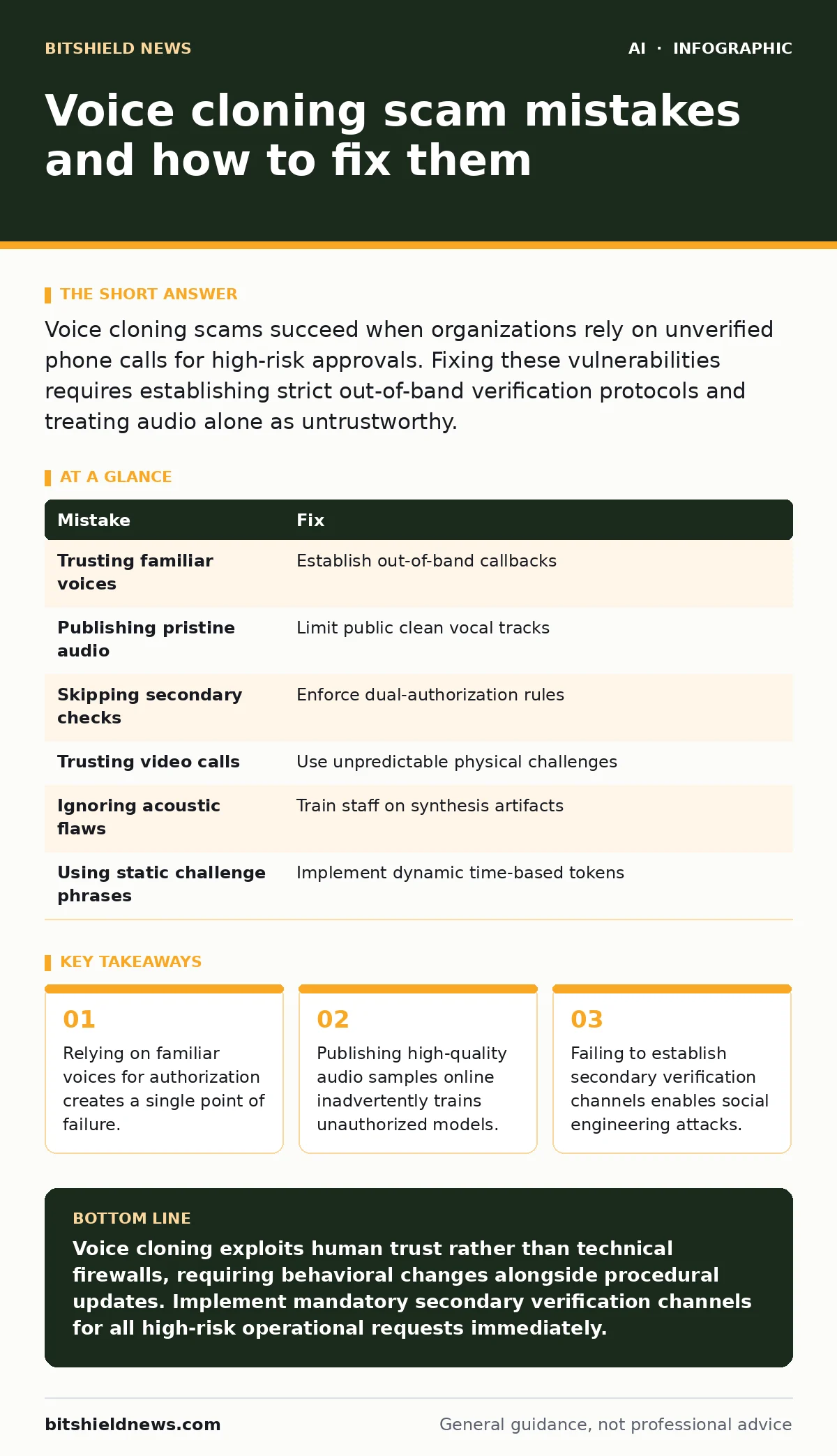
| Mistake | Fix |
|---|---|
| Trusting familiar voices | Establish out-of-band callbacks |
| Publishing pristine audio | Limit public clean vocal tracks |
| Skipping secondary checks | Enforce dual-authorization rules |
| Trusting video calls | Use unpredictable physical challenges |
| Ignoring acoustic flaws | Train staff on synthesis artifacts |
| Using static challenge phrases | Implement dynamic time-based tokens |
Key takeaways
- Relying on familiar voices for authorization creates a single point of failure.
- Publishing high-quality audio samples online inadvertently trains unauthorized models.
- Failing to establish secondary verification channels enables social engineering attacks.
Voice cloning exploits human trust rather than technical firewalls, requiring behavioral changes alongside procedural updates. Implement mandatory secondary verification channels for all high-risk operational requests immediately.
Frequently asked questions
Can modern security software detect voice cloning in real time?
Real-time detection remains unreliable because synthesis algorithms constantly evolve to bypass acoustic filters. Relying on procedural verification is far more effective than automated detection tools.
How long does an attacker need to clone a voice?
Modern machine learning models can generate a recognizable voice clone from only a few seconds of clean recorded speech. Public conference talks and podcast episodes easily provide enough source material.
Are enterprise phone systems vulnerable to synthetic audio?
Standard telephone networks transmit compressed audio, which can actually mask the minor digital artifacts produced by voice generators. This compression makes synthetic speech sound more natural to the human ear.
What should an employee do if they suspect a voice cloning scam?
Disconnect the call immediately and report the incident through an official internal security channel. Never continue the conversation or attempt to investigate the caller independently.
How this guide was produced: written by the BitShield News editorial team with AI assistance, checked against the public references listed below, and reviewed when the facts change. See our editorial policy or report an error.