Smishing uses SMS texts to trick you into clicking malicious links or revealing data. Vishing uses phone calls, often with voice cloning, to manipulate you into transferring funds or sharing passwords. Both aim to steal access, but they exploit different human and technical vulnerabilities.
The Core Distinction Between Text and Voice
The fundamental difference lies in the medium and the speed of interaction. Smishing is a form of social engineering delivered via Short Message Service (SMS) or similar text-based platforms. It relies on the assumption that you will read and act on a message without verifying the source. Vishing, short for voice phishing, uses telephone calls to engage you in a direct conversation. This allows the attacker to adapt their script in real time based on your responses. While smishing is asynchronous and depends on your initiative to click or reply, vishing is synchronous and depends on your compliance during a live interaction.
What Is Smishing?
Smishing messages often mimic communications from trusted entities like banks, shipping companies, or government agencies. They create a sense of urgency, claiming a package is delayed or an account is locked. The goal is to get you to click a link that leads to a fake login page or to reply with sensitive information. Because SMS lacks built-in verification of the sender’s identity, it is easy for attackers to spoof the display name or number. You might see a message from "Your Bank" that actually originates from a random number. The mechanism exploits the casual nature of texting. You are less likely to scrutinize a text message than an email or a formal letter.
What Is Vishing?
Vishing attacks involve a direct phone call. The attacker may use Voice over IP (VoIP) technology to mask their location and identity. They often claim to be from IT support, law enforcement, or a financial institution. The power of vishing comes from the human element. A voice can convey authority, empathy, or panic. Attackers use these emotional cues to lower your defenses. They may ask you to verify your identity by repeating your account number or password. In advanced cases, they use AI voice cloning to mimic the voice of a colleague or executive. This makes the request appear legitimate, especially if it aligns with internal processes you recognize.
Comparing the Attack Vectors
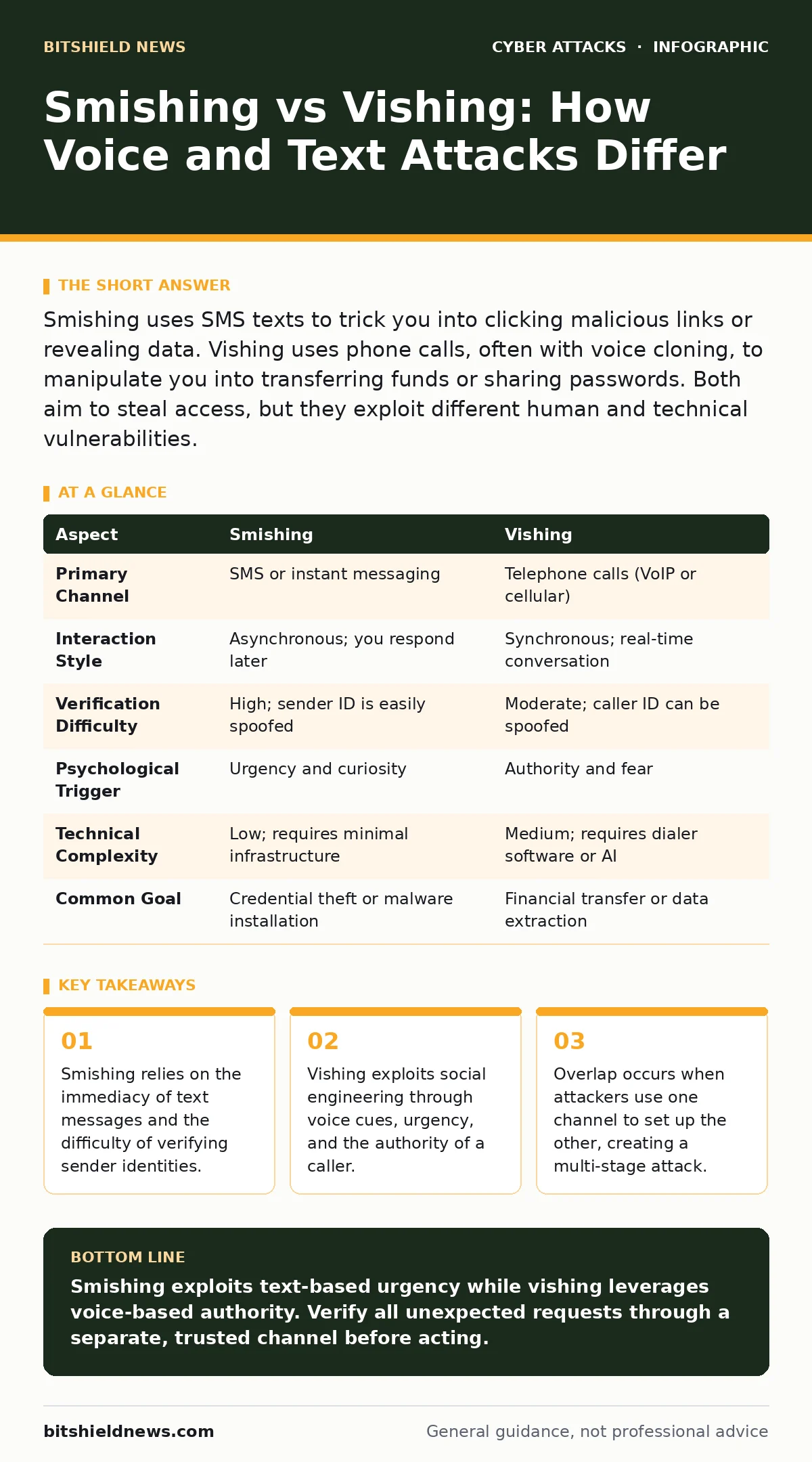
| Aspect | Smishing | Vishing |
|---|---|---|
| Primary Channel | SMS or instant messaging | Telephone calls (VoIP or cellular) |
| Interaction Style | Asynchronous; you respond later | Synchronous; real-time conversation |
| Verification Difficulty | High; sender ID is easily spoofed | Moderate; caller ID can be spoofed |
| Psychological Trigger | Urgency and curiosity | Authority and fear |
| Technical Complexity | Low; requires minimal infrastructure | Medium; requires dialer software or AI |
| Common Goal | Credential theft or malware installation | Financial transfer or data extraction |
Where the Attacks Overlap
These methods rarely exist in isolation. Attackers often combine them to increase success rates. A common scenario involves a smishing message alerting you to a security issue, followed immediately by a vishing call from someone claiming to help resolve it. This coordination creates a cohesive narrative that feels more legitimate.
The text provides a pretext, and the call provides the pressure. This multi-channel approach is known as a spear phishing campaign when targeted at specific individuals. It bypasses the skepticism you might apply to a single channel. If you ignore the text, the call reinforces the urgency. If you ignore the call, the text remains a persistent threat.
See also: Debunking AI Phishing Myths: What Attackers Really Want
Choosing Your Defense Strategy
You must tailor your defenses to the specific weaknesses of each channel.
- Choose smishing defenses when you need to protect against mass, automated attacks. Focus on filtering and education. Ensure your users understand that legitimate organizations will never ask for passwords via text. Implement security awareness training that includes examples of recent smishing campaigns. Teach users to hover over links or use a separate browser to type in official URLs.
- Choose vishing defenses when you need to protect against high-value, targeted attacks. Focus on verification protocols. Establish a process for verifying unexpected requests for sensitive data or money. This might involve hanging up and calling back using a known, official number. Implement conditional access policies that require multi-factor authentication for sensitive actions. This ensures that even if an attacker gets a password, they cannot access the account without a second factor.
The Hidden Cost of Convenience
The ease of communication is the attacker's greatest ally. Texting and calling are fast and convenient, which makes them ideal for attacks. Users are conditioned to respond quickly to texts and to answer calls from unknown numbers if they seem important. This conditioning is the hidden cost of modern connectivity. Defending against these attacks requires slowing down. You must introduce friction into the verification process. This friction can feel inconvenient, but it is necessary. Without it, speed becomes a liability.
Integrating Broader Security Measures
These attacks are part of a larger ecosystem of threats. They often precede more technical attacks like credential stuffing, where stolen passwords are used to gain access. To mitigate this risk, enforce strong authentication methods. Regular tabletop exercises can help your team practice responding to these scenarios. Simulate a vishing attack during a drill to see how staff react under pressure. This prepares them for the real event. Additionally, be aware of other vectors like Bluetooth attacks or DNS amplification attacks that may be used in conjunction with social engineering to overwhelm defenses.
Key takeaways
- Smishing relies on the immediacy of text messages and the difficulty of verifying sender identities.
- Vishing exploits social engineering through voice cues, urgency, and the authority of a caller.
- Overlap occurs when attackers use one channel to set up the other, creating a multi-stage attack.
Smishing exploits text-based urgency while vishing leverages voice-based authority. Verify all unexpected requests through a separate, trusted channel before acting.
Frequently asked questions
Can I block smishing and vishing completely?
No, because attackers constantly change numbers and tactics. Blocking is a temporary measure. Focus on verification and education instead.
What should I do if I click a smishing link?
Change your passwords immediately. Check for unauthorized transactions. Report the incident to your IT security team.
How do I know if a call is vishing?
Be suspicious of urgent requests for money or sensitive data. Legitimate organizations will not pressure you to act immediately.
Does two-factor authentication stop vishing?
It helps, but attackers can try to intercept the code. Use app-based authenticators instead of SMS codes for better security.
How this guide was produced: written by the BitShield News editorial team with AI assistance, checked against the public references listed below, and reviewed when the facts change. See our editorial policy or report an error.