
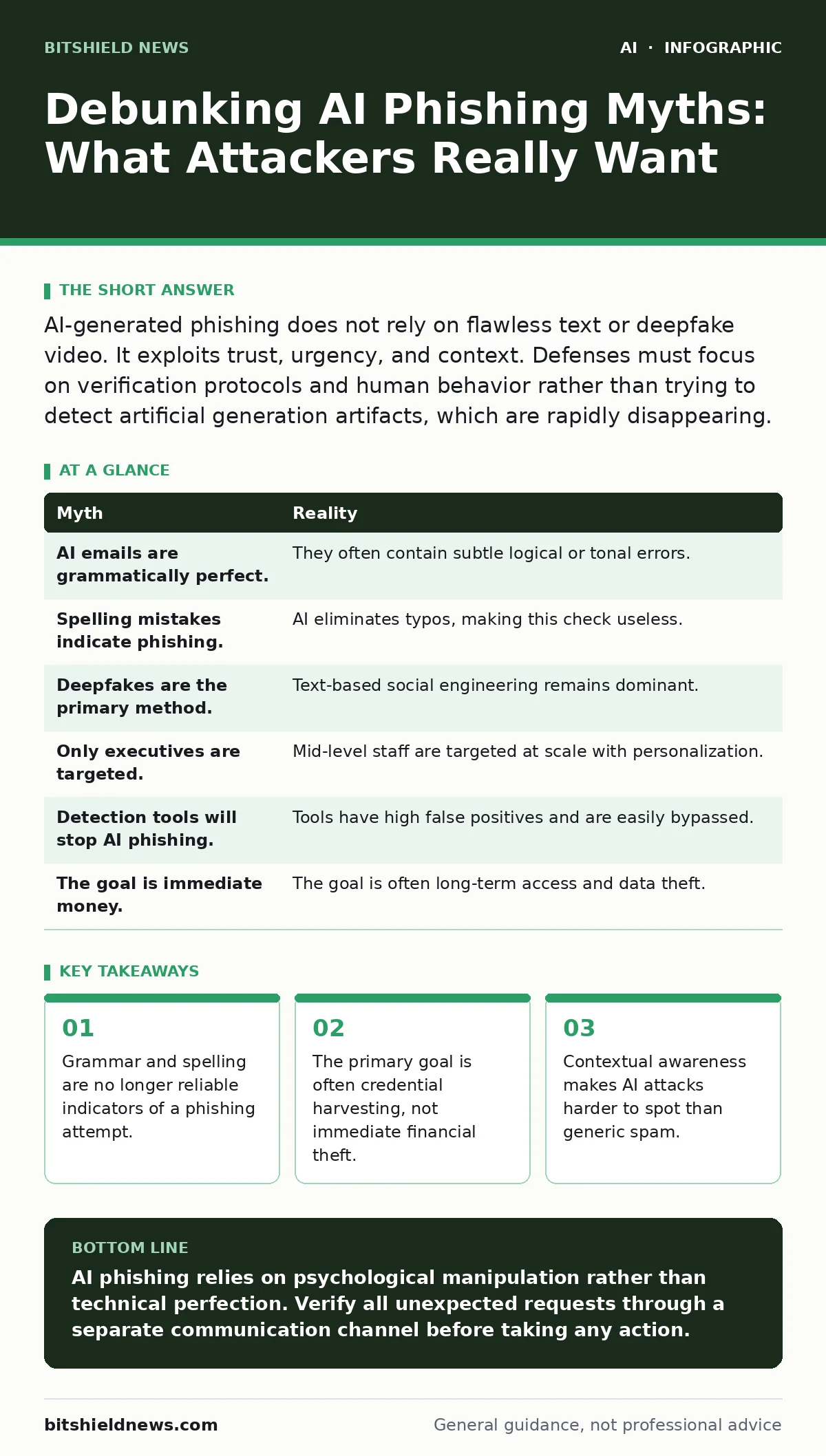
AI-generated phishing does not rely on flawless text or deepfake video. It exploits trust, urgency, and context. Defenses must focus on verification protocols and human behavior rather than trying to detect artificial generation artifacts, which are rapidly disappearing.
Myth: AI-Generated Phishing Emails Are Flawless
Reality: Artificial intelligence models frequently produce subtle errors in logic, tone, or formatting that human writers would avoid. Large language models predict the next most likely word, not the most contextually perfect one. This process can result in awkward phrasing, inconsistent capitalization, or references to non-existent company policies.
You might expect AI to create perfect English. It often creates plausible but slightly "off" text. The model does not understand the nuance of your specific workplace culture or the exact branding guidelines of your vendor. It mimics patterns it has seen in training data, which can lead to generic or slightly mismatched content.
Myth: You Will Spot AI Phishing Through Poor Spelling
Reality: Modern phishing campaigns use AI specifically to eliminate the spelling and grammar mistakes that used to be red flags. The barrier to entry for creating convincing text has dropped to near zero. Consequently, relying on typos as a primary detection method is now a failed strategy.
The absence of errors no longer signals safety. It only signals that the sender had resources to polish the message. Attackers can generate dozens of variations of a phishing email, each with different grammatical structures, to evade simple text filters. Your eye, trained for years to spot misspelled words, may now overlook a perfectly constructed lie.
This shift forces a change in defense strategy. You must look beyond the text itself. Consider the context, the sender’s identity, and the requested action. Does the request align with normal business processes? Is the urgency justified? These questions matter more than the comma placement.
Myth: AI Phishing Always Uses Deepfake Video or Audio
Reality: Most AI-assisted phishing remains text-based because it is cheaper, faster, and harder to detect. Video and audio deepfakes require significant computational power and leave digital artifacts that can be analyzed. Text-based social engineering requires only a prompt and a sending mechanism.
Imagine an attacker trying to clone the voice of a CEO. This requires a clear, long sample of the CEO’s speech and specialized tools. It is high-effort and high-risk for the attacker. In contrast, generating a convincing email that mimics the CEO’s writing style takes seconds and leaves no acoustic footprint.
The majority of successful breaches start with a simple email or instant message. These channels are trusted and ubiquitous. Adding a video call or voice note adds a layer of verification that many users do not perform. Attackers exploit this convenience. They rely on the assumption that you will not question a text message from a known contact.
Myth: AI Phishing Targets Only High-Value Executives
Reality: AI enables attackers to personalize attacks at scale, targeting mid-level employees and support staff just as effectively. These individuals often have access to critical data or systems but may receive less security training than executives. They are viewed as easier entry points.
Traditional spear-phishing was expensive and limited to high-value targets. AI changes the economics. An attacker can generate unique, personalized messages for thousands of employees simultaneously. Each message references specific projects, colleagues, or recent activities, making it appear legitimate.
This broadens the attack surface significantly. A junior developer or an HR assistant may receive a message that seems to come from IT, asking for a password reset. The message includes their username, their department, and a plausible reason for the request. The personalization makes it hard to distinguish from routine internal communication.
Myth: AI Content Detection Tools Will Stop These Attacks
Reality: AI detection tools are unreliable and produce high false-positive rates. They struggle to distinguish between human-written and AI-generated text, especially when the human uses editing tools. Relying on these tools gives a false sense of security.
The technology behind detection is a cat-and-mouse game. As detection models improve, generation models adapt. Attackers can mix human-written segments with AI-generated text to evade classifiers. They can also use "prompt injection" techniques to bypass safety filters in the generation tools themselves.
For a deeper look at how these systems fail, consider reading our guide on AI content detection. It explains the technical limitations of current classifiers and why they cannot be trusted to block malicious messages automatically.
See also: What Is Scareware: How Fake Alerts Trap Users and How to Block Them
Myth: The Goal Is Always Immediate Financial Theft
Reality: Many AI phishing campaigns aim for long-term access, not quick cash. Attackers seek credentials to install malware, steal data, or pivot to other systems. The initial compromise is often quiet, allowing the attacker to remain hidden for months.
Imagine an attacker who gains access to a helpdesk ticketing system. They do not steal money immediately. Instead, they monitor tickets for password resets or software installations. They use this intelligence to craft more convincing attacks against higher-value targets.
This patience makes the attack harder to detect. There are no large wire transfers to trigger financial alerts. There are no obvious ransomware demands. The attacker operates in the background, slowly expanding their access. Your defenses must assume that a successful login is not the end of the attack, but the beginning.
Myth: AI Phishing Is Easy to Block with Traditional Filters
Reality: Traditional email filters rely on known bad signatures, blacklisted domains, and keyword matching. AI-generated phishing bypasses these by using new domains, unique text, and legitimate-sounding keywords. The content is novel, so the filters have no historical data to reference.
Attackers use domain generation algorithms to create thousands of new email addresses. Each address is used only once or twice. This prevents blacklisting from being effective. The text of the email is also unique for each recipient, defeating keyword-based filters.
You need a layered defense that goes beyond simple filtering. This includes user training, multi-factor authentication, and behavioral analytics. You must verify unexpected requests, regardless of how legitimate they appear. The human element remains the most critical component of your security posture.
For strategies on building these defenses, see our guide on AI security testing. It outlines how to test your systems against these evolving threats.
| Myth | Reality |
|---|---|
| AI emails are grammatically perfect. | They often contain subtle logical or tonal errors. |
| Spelling mistakes indicate phishing. | AI eliminates typos, making this check useless. |
| Deepfakes are the primary method. | Text-based social engineering remains dominant. |
| Only executives are targeted. | Mid-level staff are targeted at scale with personalization. |
| Detection tools will stop AI phishing. | Tools have high false positives and are easily bypassed. |
| The goal is immediate money. | The goal is often long-term access and data theft. |
Key takeaways
- Grammar and spelling are no longer reliable indicators of a phishing attempt.
- The primary goal is often credential harvesting, not immediate financial theft.
- Contextual awareness makes AI attacks harder to spot than generic spam.
AI phishing relies on psychological manipulation rather than technical perfection. Verify all unexpected requests through a separate communication channel before taking any action.
Frequently asked questions
How can I tell if an email was written by AI?
You generally cannot. AI text is designed to look human. Focus on the context and the sender’s identity instead of trying to detect the generation method.
Should I use an AI detector plugin in my browser?
No. These tools are unreliable and can block legitimate communications. They create a false sense of security and do not address the root cause of the threat.
Is multi-factor authentication enough to stop AI phishing?
It helps, but it is not a complete solution. Attackers can use AI to craft convincing requests for MFA codes. You must also verify the legitimacy of the request itself.
How often should I update my training materials?
Continuously. The tactics used by attackers evolve rapidly. Regular, short training sessions are more effective than annual, lengthy seminars.
How this guide was produced: written by the BitShield News editorial team with AI assistance, checked against the public references listed below, and reviewed when the facts change. See our editorial policy or report an error.