
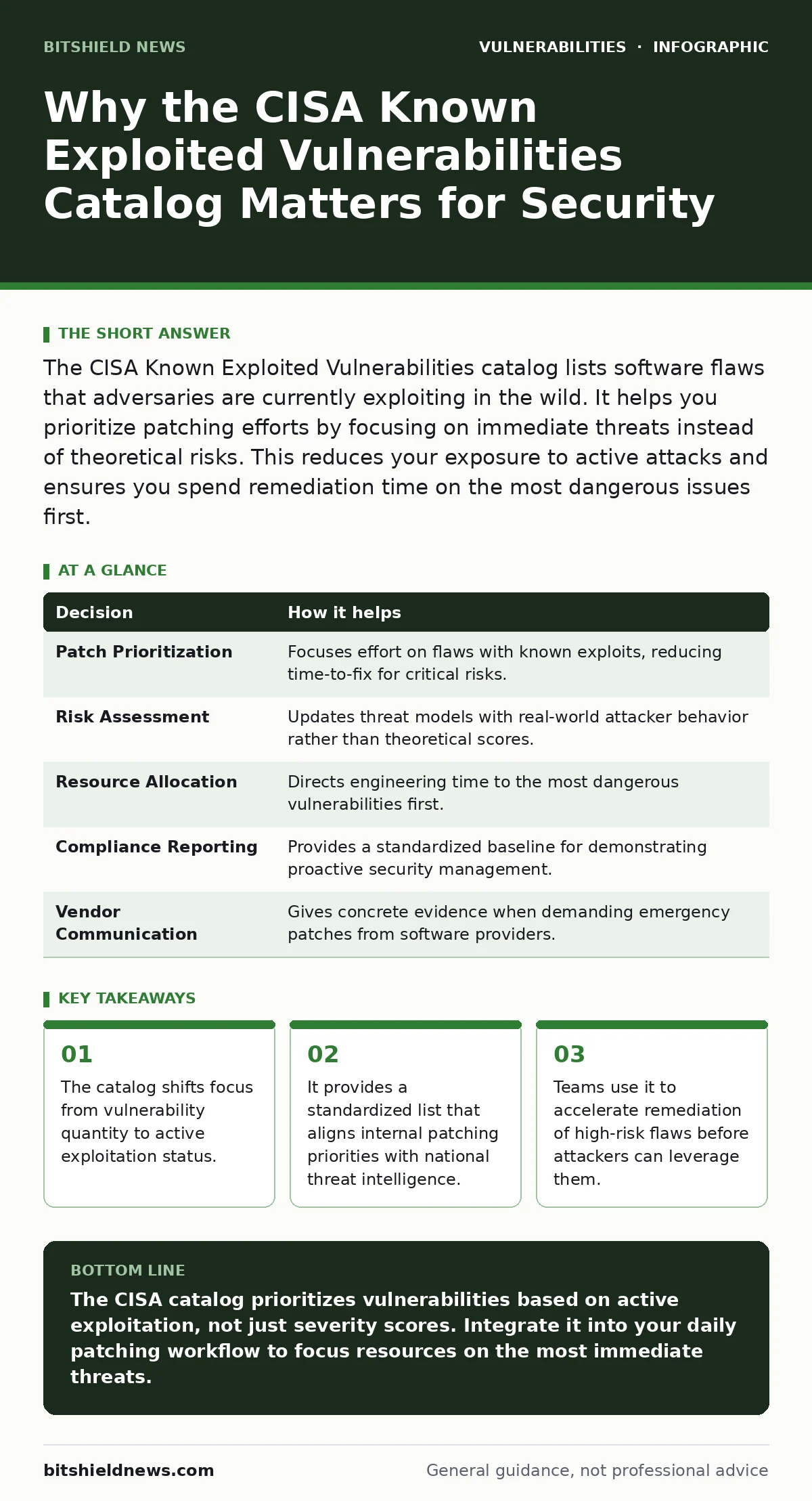
The CISA Known Exploited Vulnerabilities catalog lists software flaws that adversaries are currently exploiting in the wild. It helps you prioritize patching efforts by focusing on immediate threats instead of theoretical risks. This reduces your exposure to active attacks and ensures you spend remediation time on the most dangerous issues first.
The Signal in the Noise
Security teams face a constant deluge of vulnerability data. Every week, new flaws appear in software, libraries, and operating systems. Most of these issues are theoretical. They exist in code, but no one is actively using them to break into systems. Treating every vulnerability with equal urgency leads to burnout and ineffective security postures. You end up patching low-risk issues while critical doors remain open.
The CISA Known Exploited Vulnerabilities catalog changes this dynamic. It is a curated list of flaws that the Cybersecurity and Infrastructure Security Agency has confirmed are being actively exploited by adversaries. This distinction matters. It separates the background noise of potential risks from the immediate signal of active threats. When a flaw is on this list, it means someone is already writing code to take advantage of it.
Imagine you are managing a fleet of servers. You have hundreds of unpatched systems. Without a clear priority list, you might fix a minor configuration error while ignoring a critical remote code execution flaw. The catalog tells you exactly which flaws require immediate attention. It removes the guesswork from your patching strategy. You stop reacting to every new advisory and start focusing on the vulnerabilities that actually endanger your infrastructure.
Decisions Informed by Active Threat Data
The catalog informs specific operational decisions. It tells you which systems need immediate isolation or patching. It helps you allocate limited engineering resources to the highest-risk areas. Instead of asking "what is vulnerable?", you ask "what is being attacked?". This shift in perspective changes how you plan your maintenance windows.
| Decision | How it helps |
|---|---|
| Patch Prioritization | Focuses effort on flaws with known exploits, reducing time-to-fix for critical risks. |
| Risk Assessment | Updates threat models with real-world attacker behavior rather than theoretical scores. |
| Resource Allocation | Directs engineering time to the most dangerous vulnerabilities first. |
| Compliance Reporting | Provides a standardized baseline for demonstrating proactive security management. |
| Vendor Communication | Gives concrete evidence when demanding emergency patches from software providers. |
This table shows how the catalog transforms raw data into action. Each decision point relies on knowing which vulnerabilities are live targets. You no longer treat a flaw with a high Common Vulnerability Scoring System score the same as one with a low score if the latter is actively exploited. The catalog provides the context that static scores lack.
What Goes Wrong Without It
Without a clear view of active exploitation, teams often fall into the trap of "patch paralysis." They try to fix everything at once. This spreads their resources too thin. Critical systems remain exposed because the team is busy fixing minor issues on non-critical assets. Attackers do not care about your patching schedule. They care about what works.
Suppose your organization ignores the catalog. You continue to prioritize patches based on release order or internal policy. Meanwhile, attackers are targeting a specific flaw in a widely used web application. Because you did not recognize it as an active threat, you leave it unpatched. The attackers gain access. They move laterally through your network. By the time you detect the breach, the damage is done.
This scenario highlights the hidden cost of ignoring active threat data. You are not just missing a patch. You are missing the context that makes that patch urgent. The catalog prevents this by highlighting the flaws that matter most right now. It acts as a reality check against internal biases and outdated processes.
How Teams Use the Catalog
Teams integrate the catalog into their existing workflows. They check it daily or weekly. They cross-reference it with their asset inventory. If a system in their environment matches a vulnerability on the list, they trigger an emergency patching process. This is not about perfection. It is about speed. The goal is to close the window of opportunity for attackers.
This example shows the difference between proactive and reactive security. Team A uses the catalog to stay ahead of attackers. Team B relies on routine processes that do not account for real-time threats. The catalog gives Team A the intelligence they need to act quickly. It turns a passive list into an active defense tool.
Integrating with Existing Controls
The catalog works best when combined with other security measures. It does not replace vulnerability scanning. It enhances it. Your scanner finds all the flaws. The catalog tells you which ones to fix first. This combination creates a more efficient patching cycle. You spend less time triaging and more time fixing.
Consider how this interacts with least privilege access. Even if a system is vulnerable, limiting user permissions can reduce the impact of an exploit. The catalog helps you identify which systems need both patching and privilege review. It also complements web application firewalls. A firewall can block known attack patterns, but patching the underlying flaw is the only permanent fix. The catalog ensures you do not rely solely on virtual patches.
See also: VEX Documents Explained: How Vulnerability Exploitability Works · Attack Surface Management: 8 Questions Answered for Secure Operations
The Hidden Cost of Delay
Every day you leave a known exploited vulnerability unpatched is a day you are gambling with your security. Attackers are automated. They scan for known flaws continuously. They do not wait for you to find the time. The cost of delay is not just potential breach. It is the erosion of trust. Clients and partners expect you to manage known risks. Ignoring the catalog signals negligence.
This delay also affects your internal culture. When teams see that critical flaws are ignored, they lose faith in the security process. They stop reporting issues. They stop engaging with security recommendations. The catalog provides a clear, objective standard. It removes the debate about what is important. Everyone agrees that active exploitation is a priority. This clarity strengthens the entire security program.
Beyond the Catalog
The catalog is a powerful tool, but it is not the only one. You must also consider other sources of threat intelligence. For example, Patch Tuesday releases often include fixes for critical flaws. Understanding the timing of these releases helps you plan your patching cycles. Similarly, HTTP security headers can mitigate some web-based attacks, even if the underlying software is not yet patched.
You should also be aware of specific vulnerability types. LDAP injection flaws, for instance, can allow attackers to manipulate directory services. Integer overflow vulnerabilities can crash systems or allow code execution. VPN appliance vulnerabilities are frequent targets for remote access attacks. Unsecured cloud databases expose sensitive data directly. The catalog helps you prioritize these, but you must understand the mechanics of each flaw to defend against them effectively.
Building a Sustainable Process
Using the catalog effectively requires a sustainable process. You cannot do it manually every day. Automate the checks. Integrate the catalog into your ticketing system. When a new entry appears, create a ticket automatically. Assign it to the right team. Track the remediation progress. This ensures that nothing falls through the cracks.
You must also train your teams. They need to understand why the catalog matters. They need to know how to use it. Regular training reinforces the importance of prioritizing active threats. It also helps teams recognize the signs of exploitation. This knowledge makes them more effective defenders.
The catalog is a starting point. It gives you the data you need to make better decisions. But you must build the processes and culture to act on that data. This is how you turn information into security. You move from reacting to threats to anticipating them. You build a defense that is both proactive and resilient.
Key takeaways
- The catalog shifts focus from vulnerability quantity to active exploitation status.
- It provides a standardized list that aligns internal patching priorities with national threat intelligence.
- Teams use it to accelerate remediation of high-risk flaws before attackers can leverage them.
The CISA catalog prioritizes vulnerabilities based on active exploitation, not just severity scores. Integrate it into your daily patching workflow to focus resources on the most immediate threats.
Frequently asked questions
How often does the CISA catalog update?
The catalog is updated regularly as new exploits are confirmed. You should check it frequently to stay current with the latest threats.
Does the catalog cover all software?
No, it covers vulnerabilities that are known to be exploited. Many vulnerabilities exist but are not on the list because they are not actively targeted.
Can I automate checking the catalog?
Yes, many security tools offer integrations that automatically check the catalog and alert you to relevant vulnerabilities in your environment.
What if a vendor does not provide a patch?
If a patch is not available, you must implement compensating controls, such as network segmentation or virtual patching, to reduce the risk until a fix is released.
How this guide was produced: written by the BitShield News editorial team with AI assistance, checked against the public references listed below, and reviewed when the facts change. See our editorial policy or report an error.