
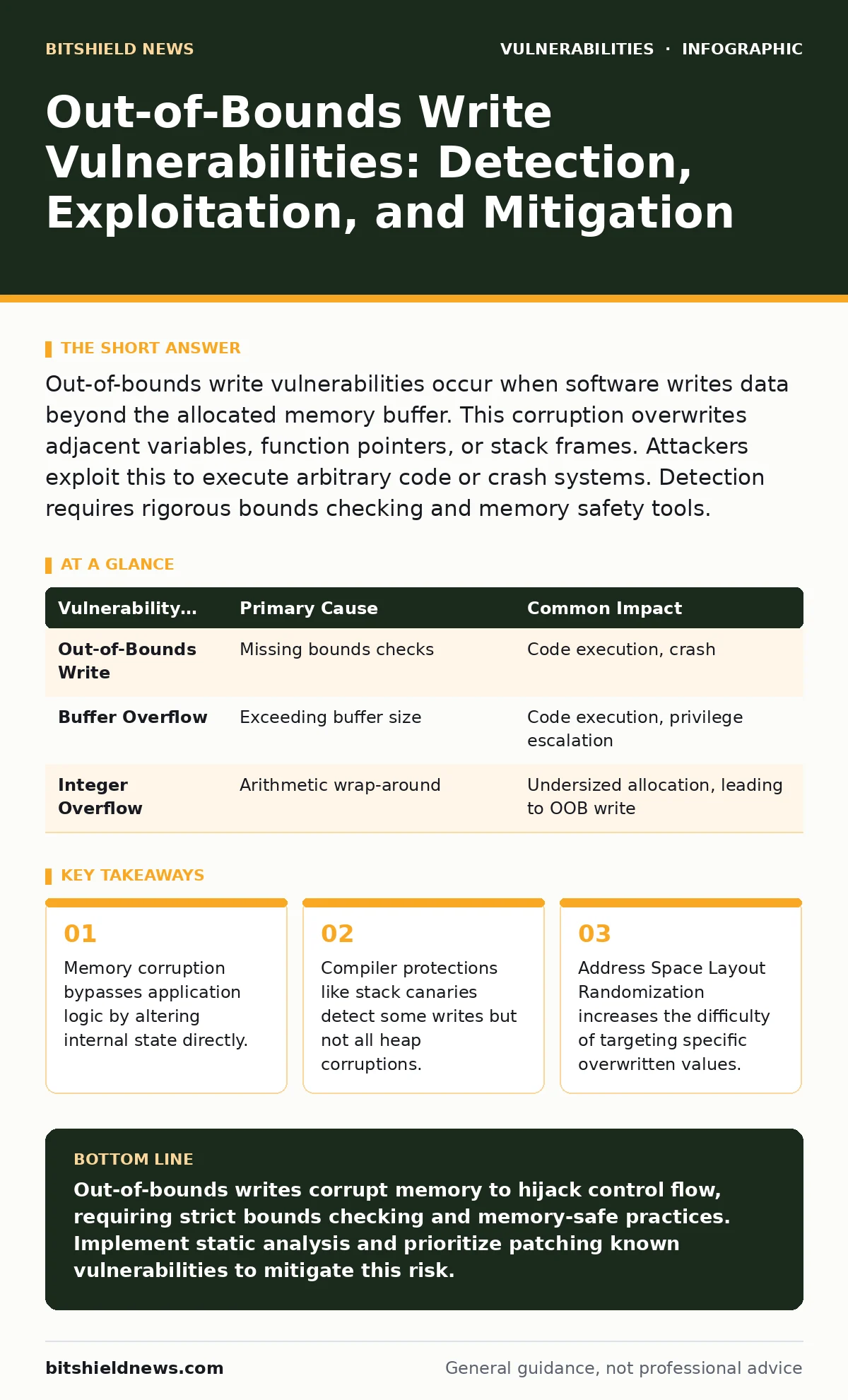
Out-of-bounds write vulnerabilities occur when software writes data beyond the allocated memory buffer. This corruption overwrites adjacent variables, function pointers, or stack frames. Attackers exploit this to execute arbitrary code or crash systems. Detection requires rigorous bounds checking and memory safety tools.
What is an out-of-bounds write vulnerability?
An out-of-bounds write vulnerability occurs when a program writes data to a memory location outside the intended buffer boundaries. This happens when the software fails to verify that the index or pointer remains within the allocated space. The write operation corrupts adjacent memory, which may contain other variables, control data, or executable instructions. This corruption can lead to unexpected behavior, crashes, or unauthorized code execution. Understanding this mechanism is foundational for securing software that manages memory manually.
How does an out-of-bounds write differ from a buffer overflow?
A buffer overflow is a specific type of out-of-bounds write where data exceeds the capacity of a contiguous memory block. Out-of-bounds writes are broader and include writing to invalid indices in arrays, structures, or linked lists. While buffer overflows often target stack or heap buffers, out-of-bounds writes can affect any memory region with improper indexing. This distinction matters because some mitigations protect against stack overflows but fail to catch heap-based or structure-based out-of-bounds writes.
What are the common causes of out-of-bounds writes?
Developers introduce these vulnerabilities through 3 primary errors: missing bounds checks, incorrect pointer arithmetic, and logic flaws in loop counters. Missing bounds checks occur when input length is not validated against buffer size. Incorrect pointer arithmetic happens when offsets are miscalculated, leading to writes beyond the target. Logic flaws in loop counters allow iterations to exceed array limits. These errors are common in languages that do not enforce memory safety, such as C and C++.
How do attackers exploit out-of-bounds writes?
Attackers exploit out-of-bounds writes by crafting input that overwrites critical control data, such as return addresses or function pointers. By controlling the overwritten value, they redirect execution to malicious code. This technique often involves shellcode placement or Return-Oriented Programming (ROP) chains. ROP chains reuse existing code snippets to bypass non-executable memory protections. Exploitation success depends on the stability of the corrupted memory layout and the ability to predict or leak addresses.
Why are out-of-bounds writes dangerous for system integrity?
Out-of-bounds writes compromise system integrity by allowing unauthorized modification of internal state. This can lead to privilege escalation, where a low-privileged user gains higher access. It can also cause denial of service by crashing the application. In networked systems, remote exploitation is possible if the vulnerable code processes untrusted input. The impact extends beyond the immediate application, potentially affecting the entire system if kernel-level memory is corrupted.
See also: Attack Surface Management: 8 Questions Answered for Secure Operations
How can developers prevent out-of-bounds writes?
Developers prevent out-of-bounds writes by enforcing strict bounds checking before every write operation. Use safe library functions that include length parameters, such as strncpy instead of strcpy. Validate all input lengths and indices against buffer sizes. Adopt memory-safe languages like Rust or Go for new development. For legacy code, implement static analysis tools to detect potential out-of-bounds accesses. Regular code reviews focusing on memory management are also effective.
What role does memory safety play in mitigation?
Memory safety ensures that programs cannot access or modify memory outside their allocated regions. Languages with built-in memory safety, such as Java or Python, prevent out-of-bounds writes through runtime checks. In unsafe languages, compiler features like Address Space Layout Randomization (ASLR) and stack canaries add layers of defense. ASLR randomizes memory locations, making it harder to predict targets. Stack canaries detect stack corruption before execution returns. These measures reduce the success rate of exploitation attempts.
How do out-of-bounds writes relate to other vulnerabilities?
Out-of-bounds writes often interact with integer overflow vulnerabilities, where a calculation wraps around to a smaller value, leading to an undersized buffer allocation. This combination allows the subsequent write to exceed the intended bounds. They also relate to pre-authentication vulnerabilities if the corrupted memory affects authentication logic. Understanding these relationships helps in designing comprehensive security strategies. For deeper insights, see our guide on integer overflow vulnerabilities.
| Vulnerability Type | Primary Cause | Common Impact |
|---|---|---|
| Out-of-Bounds Write | Missing bounds checks | Code execution, crash |
| Buffer Overflow | Exceeding buffer size | Code execution, privilege escalation |
| Integer Overflow | Arithmetic wrap-around | Undersized allocation, leading to OOB write |
What are the challenges in detecting out-of-bounds writes?
Detecting out-of-bounds writes is challenging because they may not cause immediate crashes. The corruption might remain latent until a specific condition triggers it. Dynamic analysis tools like fuzzing can trigger these conditions, but they require significant resources. Static analysis may produce false positives, especially in complex codebases. Furthermore, optimized code can obscure the original memory access patterns, making manual review difficult. Continuous monitoring and testing are necessary to uncover hidden issues.
How do security frameworks address out-of-bounds writes?
Security frameworks like the CISA Known Exploited Vulnerabilities catalog track actively exploited out-of-bounds write vulnerabilities. Organizations should prioritize patching these high-risk issues. Vulnerability Exploitability eXchange (VEX) documents help determine if a specific vulnerability affects your deployment. These frameworks provide structured data for risk assessment. Integrating this data into your vulnerability management process ensures timely mitigation. For more on VEX, see our guide on VEX documents.
What is the impact of out-of-bounds writes on cloud environments?
In cloud environments, out-of-bounds writes can lead to container escapes or host compromise. If a vulnerable service runs in a container, an attacker might overwrite memory to break out into the host system. This amplifies the impact, affecting other tenants on the same infrastructure. Cloud providers implement isolation mechanisms, but misconfigurations can weaken these barriers. Ensuring least privilege access for cloud services reduces the blast radius of such exploits.
How can organizations respond to an out-of-bounds write incident?
Organizations respond by isolating the affected system to prevent further exploitation. Analyze the memory dump to understand the extent of corruption. Identify the root cause by reviewing the code and input that triggered the vulnerability. Apply patches or workarounds immediately. Monitor for similar issues in other components. Post-incident, update development practices to prevent recurrence. This includes enhanced testing and code review processes.
What future trends affect out-of-bounds write security?
Future trends include the adoption of memory-safe languages in critical infrastructure. Hardware-assisted memory protection is also emerging, providing real-time checks at the processor level. These advancements reduce the reliance on software-based mitigations. However, legacy systems will remain vulnerable for years, requiring ongoing maintenance. Staying informed about new mitigation techniques is vital for long-term security.
How do out-of-bounds writes compare to clickjacking?
Out-of-bounds writes are server-side memory corruption issues, while clickjacking is a client-side UI redressing attack. Clickjacking tricks users into clicking hidden elements, whereas out-of-bounds writes exploit code logic errors. The remediation strategies differ significantly: clickjacking requires frame-busting headers, while out-of-bounds writes require code fixes. Understanding these distinctions helps in prioritizing security efforts. For more on clickjacking, see our dedicated guide.
Key takeaways
- Memory corruption bypasses application logic by altering internal state directly.
- Compiler protections like stack canaries detect some writes but not all heap corruptions.
- Address Space Layout Randomization increases the difficulty of targeting specific overwritten values.
Out-of-bounds writes corrupt memory to hijack control flow, requiring strict bounds checking and memory-safe practices. Implement static analysis and prioritize patching known vulnerabilities to mitigate this risk.
Frequently asked questions
Can a firewall prevent out-of-bounds write attacks?
A firewall filters network traffic but cannot inspect application-level memory operations. It may block malicious payloads, but it does not prevent the underlying code vulnerability from being exploited if the payload passes through.
Are out-of-bounds writes common in modern web applications?
They are less common in high-level languages like JavaScript or Python due to automatic memory management. However, they remain prevalent in applications using native modules, C/C++ backends, or legacy systems.
How do I know if my software has an out-of-bounds write?
Use static analysis tools to scan source code for missing bounds checks. Dynamic testing with fuzzing can also trigger these vulnerabilities. Reviewing compiler warnings and error logs for memory access violations is also helpful.
Is Address Space Layout Randomization enough to protect against out-of-bounds writes?
ASLR increases the difficulty of exploitation by randomizing memory addresses. However, it does not prevent the corruption itself. Attackers can still cause crashes or use information leaks to bypass ASLR, so it must be combined with other mitigations.
How this guide was produced: written by the BitShield News editorial team with AI assistance, checked against the public references listed below, and reviewed when the facts change. See our editorial policy or report an error.