
Pre-authentication vulnerabilities allow attackers to interact with system components before identity verification occurs. These flaws exist in the public-facing layer of your infrastructure. Attackers exploit them to bypass security boundaries, extract data, or execute code without needing valid credentials. You must treat all unauthenticated inputs as hostile and enforce strict input validation at the network edge.
Understanding the Pre-Authentication Attack Surface
Pre-authentication vulnerabilities exist in the portion of your application that accepts traffic before verifying user identity. This area is public by design, meaning anyone on the internet can interact with it. Developers often assume that because these endpoints do not return sensitive data, they require less rigorous security. This assumption creates a dangerous gap.
Attackers target these endpoints to bypass security controls that depend on authenticated sessions. The goal is not always immediate data theft. It is often to map the system, exhaust resources, or trigger secondary vulnerabilities that require no credentials. You must recognize that the public face of your application is the primary entry point for sophisticated attacks.
Stage 1: Reconnaissance and Enumeration
The attacker begins by interacting with public endpoints to gather information. They look for endpoints that reveal system details, such as version numbers, error messages, or directory structures. This stage does not require credentials. The attacker sends crafted requests to observe how the system responds. They may test for common file paths or API endpoints.
The objective is to identify which parts of the system are reachable and how they behave under unusual conditions. This information helps the attacker refine their strategy. They are building a map of the attack surface. You must ensure that your public endpoints do not leak metadata. Generic error messages and minimal response headers reduce the information available to the attacker.
Stage 2: Input Manipulation and Logic Exploitation
The attacker sends specially crafted inputs to the identified endpoints. These inputs are designed to trigger unexpected behavior in the application logic. They may contain malformed data, excessive length, or specific patterns that confuse the parser. The application processes this input before checking for authentication.
If the logic is flawed, the application may execute unintended actions. For example, it might perform a database query based on user-supplied data without sanitization. This stage exploits the trust the system places in incoming data. The attacker relies on the fact that security checks often happen too late in the processing pipeline. You must validate all input at the point of entry.
Stage 3: Bypassing Validation Controls
Many applications attempt to validate input but fail to do so comprehensively. The attacker exploits gaps in these validation rules. They may use encoding techniques to bypass simple filters. They might split malicious payloads across multiple requests to evade detection. The application may accept the input because it passes basic format checks.
However, the underlying logic still processes the malicious content. This stage highlights the difference between superficial validation and deep inspection. The attacker knows that security teams often focus on authenticated traffic. They exploit the blind spot in unauthenticated traffic handling. You must implement strict allowlists for input formats and reject anything that does not match expected patterns.
Stage 4: Impact and Secondary Exploitation
Once the initial input is accepted, the attacker achieves their goal. This might be data exfiltration, remote code execution, or denial of service. The impact depends on the specific vulnerability exploited. If the vulnerability allows code execution, the attacker may install a backdoor. If it allows data extraction, they may harvest sensitive information.
The attacker may also use this access to pivot to other systems. The initial pre-authentication flaw serves as the foothold. From there, they can escalate privileges or move laterally within the network. The damage occurs because the system failed to stop the attack at the boundary. You must assume that any pre-authentication vulnerability can lead to full system compromise.
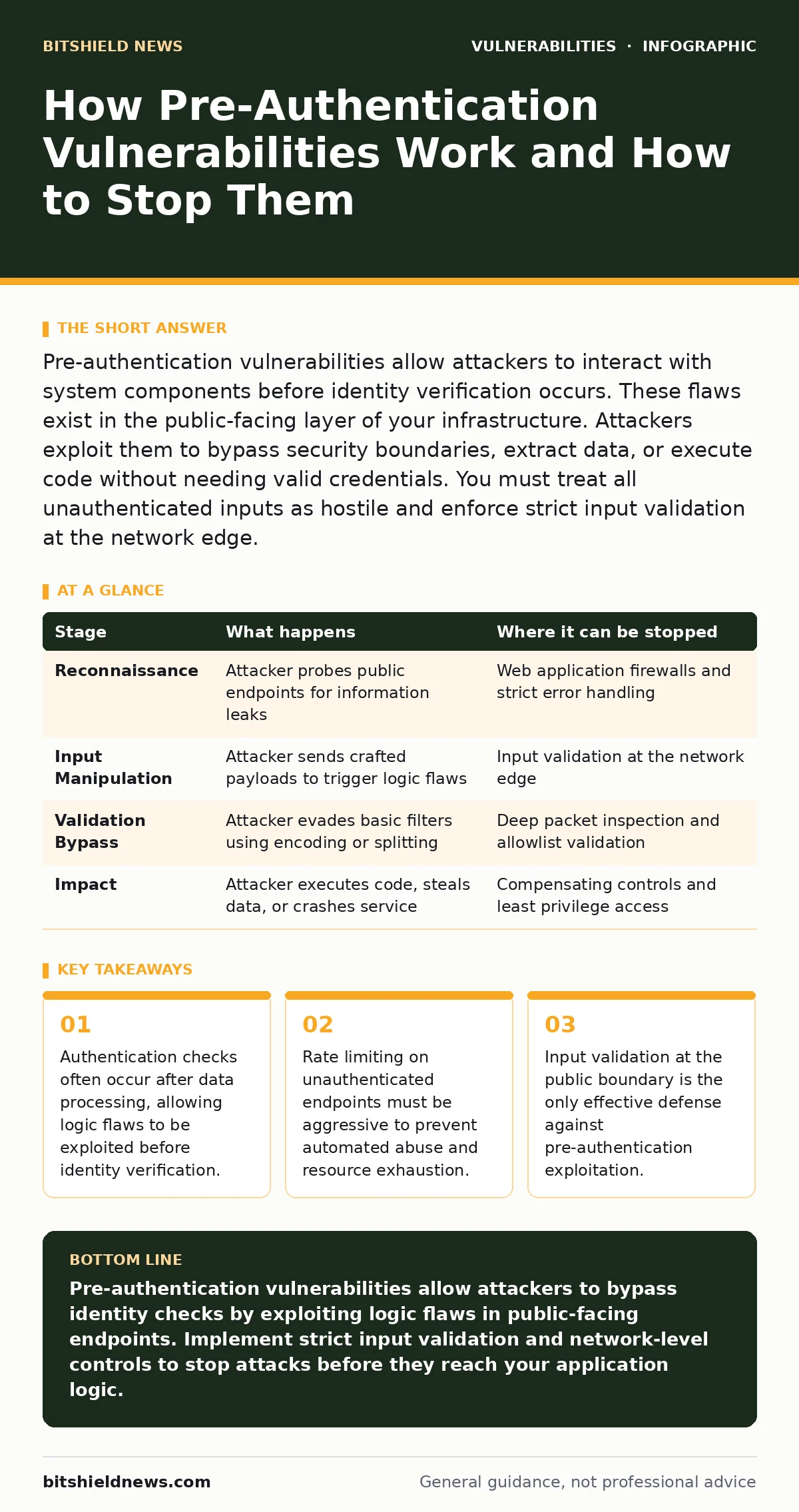
| Stage | What happens | Where it can be stopped |
|---|---|---|
| Reconnaissance | Attacker probes public endpoints for information leaks | Web application firewalls and strict error handling |
| Input Manipulation | Attacker sends crafted payloads to trigger logic flaws | Input validation at the network edge |
| Validation Bypass | Attacker evades basic filters using encoding or splitting | Deep packet inspection and allowlist validation |
| Impact | Attacker executes code, steals data, or crashes service | Compensating controls and least privilege access |
See also: Clickjacking Mistakes: 7 Errors That Expose Your Web Apps · Stop Directory Listing Exposure: A Prevention Checklist for Web Servers
Implementing Effective Input Validation
Input validation is the primary defense against pre-authentication vulnerabilities. You must validate every piece of data that enters your system from the outside. This includes HTTP headers, query parameters, and request bodies. Validation should occur before any processing or storage. Use strict allowlists that define exactly what is acceptable.
Reject any input that does not match the expected format. Do not rely on blocklists, as attackers can easily find ways to bypass them. For example, if you expect a numeric ID, ensure the input contains only digits. If you expect a specific string format, enforce that format rigorously. This approach prevents malformed data from reaching the application logic.
Leveraging Network-Level Controls
Network-level controls provide an additional layer of defense. Web application firewalls can filter out known attack patterns before they reach your application. They inspect traffic for signatures of common exploits. You should configure these tools to block suspicious requests automatically. Rate limiting is another critical control.
It prevents attackers from sending excessive requests to probe your system. Limit the number of requests an IP address can make within a specific time frame. This reduces the effectiveness of automated scanning and brute-force attempts. These controls do not replace application-level validation. They complement it by reducing the volume of malicious traffic that reaches your servers.
Handling Errors and Logging Securely
Error messages can reveal sensitive information about your system. Attackers use these messages to refine their attacks. You must ensure that your application returns generic error messages to users. Detailed error information should be logged internally but never exposed to the client. This prevents attackers from learning about internal structures or technologies.
Logging is essential for detecting and responding to attacks. You should log all requests to public endpoints, including failed attempts. Analyze these logs to identify patterns of abuse. This helps you update your firewall rules and validation logic. Secure logging ensures that you have the evidence needed to investigate incidents.
Monitoring and Incident Response
Continuous monitoring is necessary to detect pre-authentication attacks. You should monitor traffic patterns for anomalies. Look for spikes in traffic, unusual request patterns, or repeated failed attempts. Automated alerts can help you respond quickly to potential threats. When an attack is detected, you must have a plan to mitigate the damage. This may involve blocking specific IP addresses, updating firewall rules, or patching vulnerabilities. Incident response plans should include steps for containing and recovering from pre-authentication exploits. Regular testing of your defenses helps ensure they are effective. You must assume that attackers are constantly probing your systems.
Addressing Common Misconceptions
Many organizations believe that pre-authentication vulnerabilities are low risk because they do not involve credential theft. This is a dangerous misconception. These vulnerabilities can lead to full system compromise without ever needing a password. Attackers use them to bypass security controls entirely. Another misconception is that web application firewalls provide complete protection. These tools can be bypassed by sophisticated attacks. You must implement multiple layers of defense. Relying on a single control leaves you vulnerable. You must treat all unauthenticated traffic as hostile. This mindset ensures that you apply rigorous security measures to all parts of your application.
Integrating with Existing Security Frameworks
Pre-authentication security must be integrated into your overall security strategy. It should align with your existing frameworks and policies. This includes regular security assessments, code reviews, and penetration testing. You should also consider related topics such as authorization bypass vulnerabilities and LDAP injection.
These vulnerabilities often coexist with pre-authentication flaws. Addressing them together provides a more comprehensive defense. Compensating controls can help mitigate risks where technical fixes are not immediately possible. You must ensure that your security measures are updated regularly to address new threats. Continuous improvement is key to maintaining a secure environment.
Key takeaways
- Authentication checks often occur after data processing, allowing logic flaws to be exploited before identity verification.
- Rate limiting on unauthenticated endpoints must be aggressive to prevent automated abuse and resource exhaustion.
- Input validation at the public boundary is the only effective defense against pre-authentication exploitation.
Pre-authentication vulnerabilities allow attackers to bypass identity checks by exploiting logic flaws in public-facing endpoints. Implement strict input validation and network-level controls to stop attacks before they reach your application logic.
Frequently asked questions
What is the difference between authentication and authorization bypass?
Authentication verifies identity, while authorization determines permissions. Pre-authentication flaws bypass identity checks entirely, whereas authorization bypass allows a verified user to access resources they should not see.
Can rate limiting stop all pre-authentication attacks?
No, rate limiting only slows down automated attacks. It does not prevent sophisticated attackers from sending carefully crafted requests within the allowed limits. You must combine rate limiting with input validation.
Why is input validation more effective than blocklists?
Blocklists try to identify and block bad inputs, which attackers can easily bypass. Input validation defines exactly what is allowed, rejecting anything that does not match the strict criteria. This approach is more robust.
How do I detect pre-authentication exploitation attempts?
Monitor for unusual traffic patterns, such as spikes in request volume, repeated failed attempts, or requests with malformed data. Analyze logs for these anomalies and set up automated alerts.
How this guide was produced: written by the BitShield News editorial team with AI assistance, checked against the public references listed below, and reviewed when the facts change. See our editorial policy or report an error.