
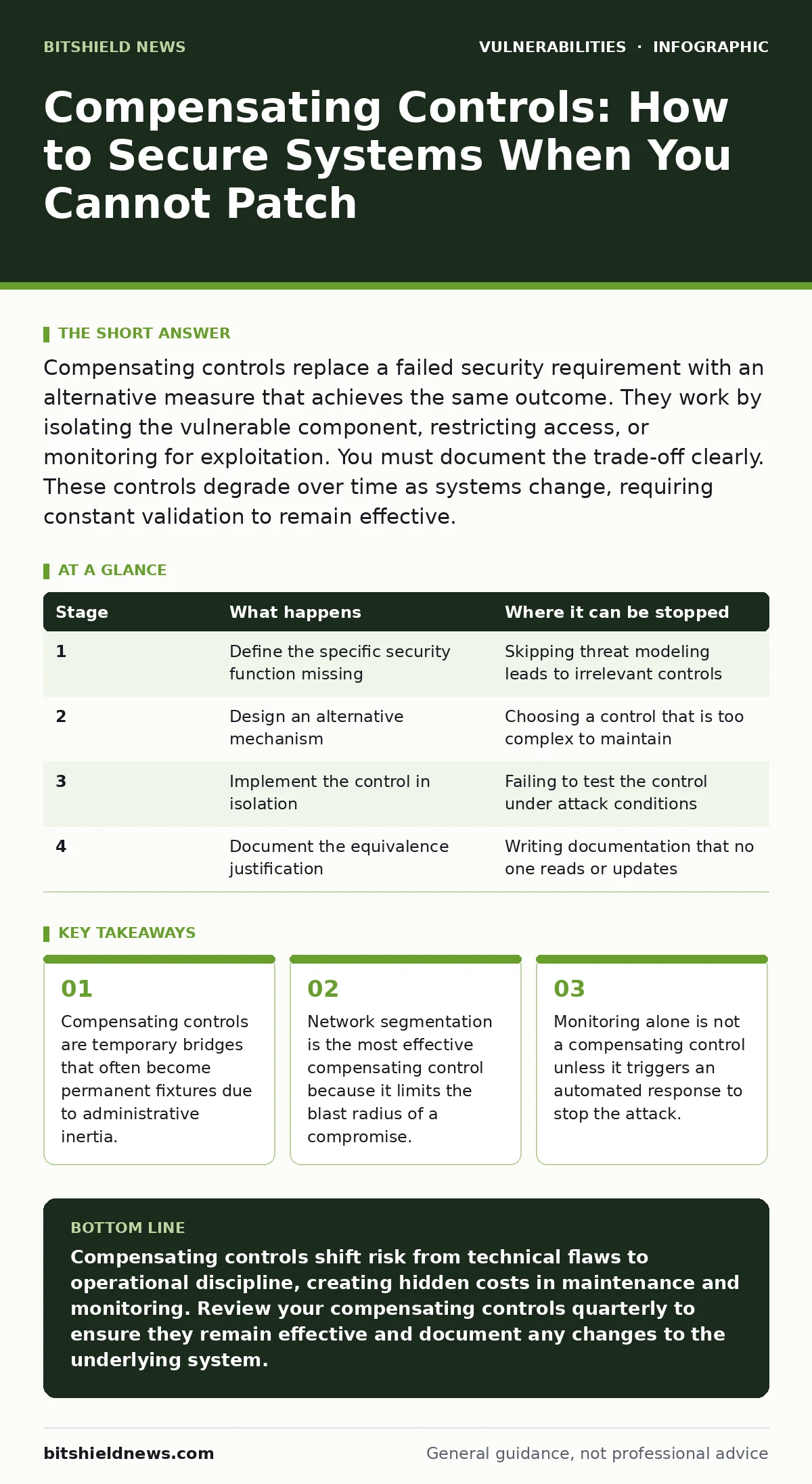
Compensating controls replace a failed security requirement with an alternative measure that achieves the same outcome. They work by isolating the vulnerable component, restricting access, or monitoring for exploitation. You must document the trade-off clearly. These controls degrade over time as systems change, requiring constant validation to remain effective.
The Logic of Risk Substitution
Compensating controls exist when you cannot implement a primary security requirement. This usually happens because the required patch breaks compatibility, the vendor has ceased support, or the architecture prevents the fix. You replace the missing control with an alternative that reduces risk to an acceptable level. The goal is not perfection. The goal is equivalence. You must prove that the alternative measure provides the same level of protection as the original requirement. This proof requires documentation and periodic review. Without documentation, the control is invisible to auditors and security teams. Visibility is the first requirement for any compensating control.
Imagine a legacy database that cannot accept a security update because it runs a custom application. The primary control is the patch. The compensating control might be isolating that database on a separate network segment. This isolation prevents external attackers from reaching the database directly. The risk shifts from software vulnerability to network configuration. If the network configuration fails, the risk returns. The control is only as strong as its weakest dependency.
Stage 1: Identify the Specific Gap
You start by defining exactly what the primary control was supposed to do. Vague goals lead to weak substitutes. If the primary control was "encrypt data at rest," the gap is "data is readable if the disk is stolen." You must articulate the threat model. Who is the attacker? What is their capability? What is the value of the data? This analysis determines the strength of the compensating control needed. A weak threat model allows for weak controls. A strong threat model demands robust alternatives. You cannot compromise on the analysis phase.
| Stage | What happens | Where it can be stopped |
|---|---|---|
| 1 | Define the specific security function missing | Skipping threat modeling leads to irrelevant controls |
| 2 | Design an alternative mechanism | Choosing a control that is too complex to maintain |
| 3 | Implement the control in isolation | Failing to test the control under attack conditions |
| 4 | Document the equivalence justification | Writing documentation that no one reads or updates |
Stage 2: Design the Alternative Mechanism
The design phase focuses on finding a control that addresses the same risk vector. Common mechanisms include network segmentation, strict access controls, or enhanced monitoring. Network segmentation restricts the attack surface by limiting which systems can communicate with the vulnerable component. Access controls ensure that only authorized users can interact with the vulnerable system. Monitoring detects exploitation attempts in real time. You must choose the mechanism that best fits your operational capacity. Complex controls fail when staff turnover occurs. Simple controls are easier to maintain but may have broader side effects.
Stage 3: Implement with Operational Constraints
Implementation requires careful integration with existing workflows. You must ensure that the compensating control does not break business processes. If the control blocks legitimate traffic, users will bypass it. Bypassing is the fastest way to nullify a compensating control. You should implement the control in a test environment first. Verify that it blocks the intended threats while allowing necessary operations. Test the control under load. Stress testing reveals edge cases where the control might fail. Document any limitations discovered during testing. These limitations become part of the risk acceptance record.
Stage 4: Validate Equivalence and Document
Validation proves that the compensating control meets the security requirement. You compare the residual risk with the original risk. If the residual risk is lower or equal, the control is valid. Documentation is critical. You must record the rationale, the design, the testing results, and the limitations. This document serves as evidence for auditors. It also informs future security decisions. If the system changes, the documentation helps assess whether the control is still valid. Regular reviews ensure that the control remains effective. Systems evolve. Controls that were valid yesterday may be obsolete today.
See also: How Emergency Stops Work in AI Systems: The Mechanism · What privacy impact assessments do for your data strategy
The Hidden Costs of Compensation
Compensating controls introduce operational overhead. They require continuous monitoring and maintenance. Staff must understand the control and its limitations. Training becomes more complex. You must train users on the alternative procedures. If the control relies on manual steps, human error becomes a significant risk. Human error is unpredictable and difficult to mitigate. Automated controls are preferred because they reduce reliance on human behavior. However, automation adds complexity to the infrastructure. Complexity increases the likelihood of configuration errors. You must balance the cost of the control against the risk it mitigates.
Limits and Failure Modes
Compensating controls have inherent limits. They do not fix the underlying vulnerability. The vulnerability remains exploitable if the control fails. Control failure can occur due to misconfiguration, software bugs, or deliberate bypass. You must monitor the control continuously. Alert on any deviation from expected behavior. Response procedures must be in place. If the control fails, you must have a plan to mitigate the risk immediately. This might involve taking the system offline. Downtime is a trade-off you must accept. The cost of downtime is often lower than the cost of a breach.
Integrating with Broader Security
Compensating controls do not exist in isolation. They interact with other security measures. For instance, web application firewalls can provide an additional layer of defense for vulnerable applications. VEX documents help identify which vulnerabilities are actually exploitable in your specific configuration.
Understanding pre-authentication vulnerabilities is critical because they allow attackers to bypass authentication entirely. OpenSSL vulnerabilities often require immediate compensating controls due to their widespread use. Citrix NetScaler vulnerabilities demonstrate the risk of complex infrastructure. Vulnerabilities in AI model serving frameworks highlight the need for input validation. Attack surface reduction is the ultimate goal. Patch Tuesday provides a regular cadence for addressing known issues. Compensating controls fill the gaps between these regular updates.
Conclusion of the Mechanism
Compensating controls are a necessary part of security management. They allow you to operate securely in the face of imperfect conditions. However, they are not a substitute for proper security engineering. They add complexity and cost. You must manage them carefully. Regular review and documentation are non-negotiable. The goal is to minimize the number of compensating controls over time.
Each control represents a technical debt. Paying down this debt improves the overall security posture. You should aim to eliminate the need for compensation by addressing the root cause. This might involve significant investment. The investment is often worth it. Security is a continuous process. Compensating controls are a tool in that process. Use them wisely.
Key takeaways
- Compensating controls are temporary bridges that often become permanent fixtures due to administrative inertia.
- Network segmentation is the most effective compensating control because it limits the blast radius of a compromise.
- Monitoring alone is not a compensating control unless it triggers an automated response to stop the attack.
Compensating controls shift risk from technical flaws to operational discipline, creating hidden costs in maintenance and monitoring. Review your compensating controls quarterly to ensure they remain effective and document any changes to the underlying system.
Frequently asked questions
How do you prove a compensating control is equivalent to the original requirement?
You document the threat model, the control design, and testing results. You compare the residual risk to the original risk. Auditors review this documentation to verify equivalence.
Can monitoring alone serve as a compensating control?
Only if the monitoring triggers an automated response. Passive logging is not a control because it does not prevent or stop the attack. Active intervention is required for equivalence.
How long should a compensating control remain in place?
As short as possible. You should have a timeline for removing the control. Permanent compensating controls indicate a failure to address the root cause. Plan for remediation or replacement.
What happens if a compensating control fails?
The original risk returns. You must have incident response procedures in place. This might involve isolating the system or taking it offline. The impact depends on the control's effectiveness.
How this guide was produced: written by the BitShield News editorial team with AI assistance, checked against the public references listed below, and reviewed when the facts change. See our editorial policy or report an error.