
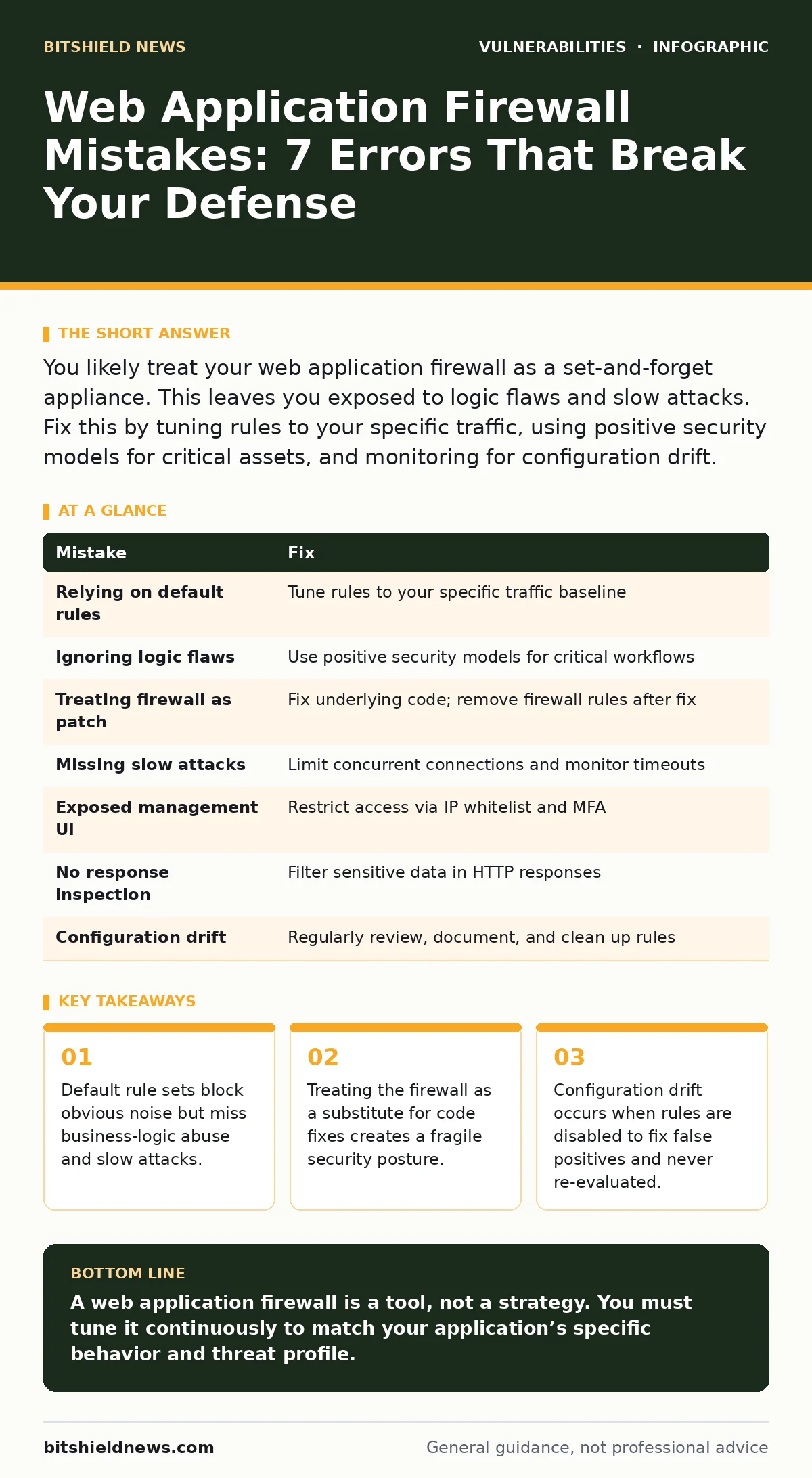
You likely treat your web application firewall as a set-and-forget appliance. This leaves you exposed to logic flaws and slow attacks. Fix this by tuning rules to your specific traffic, using positive security models for critical assets, and monitoring for configuration drift.
Web application firewalls sit between your users and your application servers. They inspect HTTP requests for malicious patterns. Many operators install them once and assume protection is automatic. This assumption creates blind spots that attackers exploit. You must treat the firewall as a dynamic control that requires constant tuning.
Mistake 1: Relying on Default Rule Sets Without Tuning
Default rule sets are broad. They catch common injection attempts but also block legitimate traffic. When you leave them untouched, you generate high noise levels. Your team ignores alerts because most are false positives. Real attacks hide in the noise you have learned to ignore.
Why it hurts:
Attackers adapt to default signatures quickly. They use encoded payloads or unusual parameter names to bypass generic filters. You lose visibility into unique threats targeting your specific application logic.
The fix:
Start with a strict mode for a short period to establish a baseline. Review every blocked request. Whitelist legitimate business traffic explicitly. Move to a hybrid mode where known-good traffic passes without inspection, while everything else is scanned. This reduces noise and highlights anomalies.
Mistake 2: Ignoring Business Logic Flaws
Firewalls excel at detecting syntax errors in code injection. They struggle with logical errors. Suppose your application allows a user to change their password by providing an old password. A firewall sees valid syntax. It does not know that the user is bypassing authentication steps.
Why it hurts:
Logic flaws bypass signature-based detection entirely. An attacker can manipulate session states or transaction amounts without triggering alerts. You remain vulnerable to account takeover and financial fraud even with a perfect signature database.
The fix:
Implement positive security models for critical workflows. Define exactly what valid input looks like for sensitive operations. Block anything that deviates from this strict definition. Combine this with backend validation. Never rely on the perimeter device to enforce business rules.
Mistake 3: Using the Firewall as a Patch Substitute
Developers sometimes delay fixing vulnerabilities because they believe the firewall handles them. This is a dangerous misconception. The firewall filters requests, but it does not fix the underlying code. If the firewall misconfigures or fails, the vulnerability is exposed.
Why it hurts:
You create a single point of failure. If an attacker finds a bypass technique, your entire application is compromised. You also accumulate technical debt. Unpatched code becomes harder to maintain and more likely to introduce new bugs.
The fix:
Treat the firewall as a temporary shield, not a permanent cure. Track every vulnerability the firewall mitigates. Schedule immediate remediation for the underlying code. Remove the firewall rule once the code is fixed. This keeps your defense surface small and manageable.
Mistake 4: Neglecting Slow and Low Attacks
Most firewalls focus on high-volume or high-intensity attacks. They expect bursts of traffic. Slow and low attacks, like Slowloris, send minimal data over long periods. They keep connections open to exhaust server resources. The firewall sees normal, low-rate traffic and allows it through.
Why it hurts:
Your application server runs out of available connections. Legitimate users cannot access the site. The attack requires minimal bandwidth, making it hard to detect with volume-based thresholds. You experience denial of service without triggering traditional alerts.
The fix:
Configure connection timeout settings aggressively. Limit the number of concurrent connections per IP address. Monitor for connections that remain open but send no data. Terminate these sessions proactively. This protects your server resources from exhaustion.
Mistake 5: Failing to Secure the Management Interface
The firewall itself is a powerful device. It has a management interface for configuration. If this interface is exposed to the public internet, attackers can target it directly. They may attempt brute-force login or exploit vulnerabilities in the management console.
Why it hurts:
Compromising the management interface gives an attacker full control. They can disable rules, exfiltrate logs, or redirect traffic. Your entire security posture collapses. This is often easier than attacking the application behind the firewall.
The fix:
Restrict access to the management interface using IP whitelisting. Only allow connections from trusted administrative networks. Use multi-factor authentication for all administrative accounts. Enable detailed logging for all management actions. Review these logs regularly for unauthorized access attempts.
See also: Clickjacking Mistakes: 7 Errors That Expose Your Web Apps · Stop Directory Listing Exposure: A Prevention Checklist for Web Servers
Mistake 6: Overlooking HTTP Response Inspection
Most firewalls inspect incoming requests. They check for injection attempts in the URL or body. Few inspect outgoing responses. This allows data exfiltration to go unnoticed. If your application leaks sensitive data in error messages or headers, the firewall lets it pass.
Why it hurts:
Attackers can harvest database schemas, internal IP addresses, or user data through error pages. This information helps them craft more precise attacks. You lose control over what leaves your network perimeter.
The fix:
Enable response filtering where possible. Block sensitive data patterns in HTTP responses. Ensure your application returns generic error messages to users. This prevents information leakage. Refer to best practices for HTTP security headers to control how browsers handle your content.
Mistake 7: Ignoring Configuration Drift
Over time, rules are disabled to fix false positives. New rules are added to address new threats. Old rules are never removed. The configuration becomes messy and inefficient. You no longer know what the firewall is actually protecting against.
Why it hurts:
Drift leads to rule conflicts and performance degradation. Critical protections may be accidentally disabled. Auditing becomes impossible. You cannot prove compliance or security effectiveness.
The fix:
Schedule regular rule reviews. Remove unused or outdated rules. Document every change. Use version control for firewall configurations. Test changes in a staging environment before applying them to production. This keeps your configuration clean and effective.
| Mistake | Fix |
|---|---|
| Relying on default rules | Tune rules to your specific traffic baseline |
| Ignoring logic flaws | Use positive security models for critical workflows |
| Treating firewall as patch | Fix underlying code; remove firewall rules after fix |
| Missing slow attacks | Limit concurrent connections and monitor timeouts |
| Exposed management UI | Restrict access via IP whitelist and MFA |
| No response inspection | Filter sensitive data in HTTP responses |
| Configuration drift | Regularly review, document, and clean up rules |
Key takeaways
- Default rule sets block obvious noise but miss business-logic abuse and slow attacks.
- Treating the firewall as a substitute for code fixes creates a fragile security posture.
- Configuration drift occurs when rules are disabled to fix false positives and never re-evaluated.
A web application firewall is a tool, not a strategy. You must tune it continuously to match your application’s specific behavior and threat profile.
Frequently asked questions
Does a web application firewall protect against credential stuffing?
It can help by detecting high-volume login attempts, but it cannot stop distributed attacks using valid credentials. You need rate limiting and multi-factor authentication for full protection.
Should I use a cloud-based or on-premise firewall?
Cloud-based solutions offer easier updates and global coverage. On-premise solutions provide more control over data and latency. Choose based on your compliance needs and network architecture.
How do I handle false positives without weakening security?
Investigate every false positive. If it is legitimate traffic, create a specific whitelist rule. Do not disable broad rules. Document the exception and review it quarterly.
Can a firewall prevent LDAP injection?
It can detect common injection patterns, but it may miss complex logic flaws. You must sanitize inputs at the application level. The firewall provides a secondary layer of defense.
How this guide was produced: written by the BitShield News editorial team with AI assistance, checked against the public references listed below, and reviewed when the facts change. See our editorial policy or report an error.