File metadata is hidden data embedded in documents that records creation details, editing history, and device information. You must strip this data before sharing files externally to prevent accidental leakage of internal infrastructure details and personal information that standard sharing methods do remove.
What is file metadata and why does it exist?
File metadata is structured data stored alongside the visible content of a digital file. It acts as a digital fingerprint, recording when a file was created, who edited it, and what software generated it. Operating systems use this information to organize files and enable features like search and version history. While useful for local management, this data becomes a liability when files leave your controlled environment.
What specific information does metadata reveal?
Metadata typically includes the original author’s name, last modifier, creation date, and software version. It often contains internal network paths, such as directory structures that include employee names or department codes. Some files store GPS coordinates, camera settings, or even deleted text from previous edits. This depth of detail allows an observer to reconstruct the workflow and environment where the file originated.
How does metadata survive file transfers?
When you email or upload a file, the metadata travels with the binary data. Standard transfer protocols do not inspect or strip this hidden layer. Even if you rename the file, the internal tags remain intact. This persistence means that a document shared via encrypted email still carries its original creation story unless you explicitly sanitize it before sending.
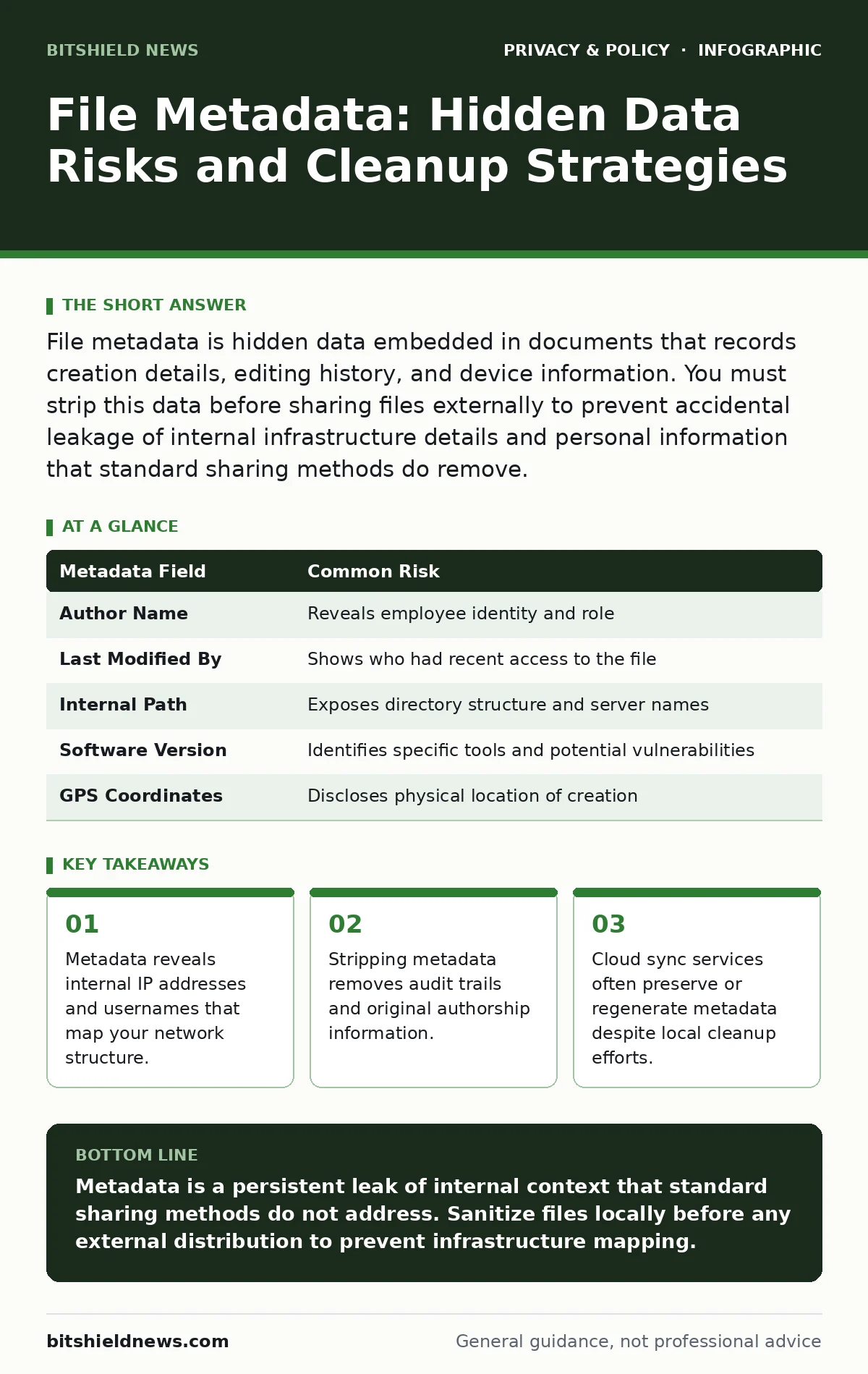
| Metadata Field | Common Risk |
|---|---|
| Author Name | Reveals employee identity and role |
| Last Modified By | Shows who had recent access to the file |
| Internal Path | Exposes directory structure and server names |
| Software Version | Identifies specific tools and potential vulnerabilities |
| GPS Coordinates | Discloses physical location of creation |
Why is metadata dangerous for organizations?
Exposing metadata allows attackers to map your internal infrastructure without active penetration testing. Knowing the software versions used can help them identify unpatched vulnerabilities. Internal paths may reveal project codenames or sensitive directory hierarchies. This passive reconnaissance reduces the effort required for targeted attacks, making your organization a lower-hanging fruit for adversaries.
Does saving as PDF remove metadata?
Converting a document to PDF does not automatically strip metadata. Many conversion tools preserve the original author and creation dates in the new file. Some PDF creators even add their own metadata, layering new identifiers on top of the old ones. You must use a dedicated sanitization tool or manually remove properties to ensure the PDF is clean.
How do cloud services handle metadata?
Cloud storage platforms often sync metadata along with file content. When you upload a file, the service may index this data for searchability, making it accessible to the provider. Some services regenerate metadata upon upload, creating a new timestamp that conflicts with the original. This behavior complicates compliance efforts, as the data exists in multiple copies with varying levels of exposure.
Can you trust online metadata removers?
Online tools that strip metadata require you to upload your sensitive document to a remote server. This process exposes the file content to the tool’s operators and potential interceptors. Even if the service claims to delete files after processing, you cannot verify their storage practices. For high-sensitivity documents, local processing is the only method that guarantees the data never leaves your control.
What is the impact on right to be forgotten requests?
Metadata can complicate data deletion requests under privacy regulations. Even if the visible content is removed, residual metadata in backups or cached versions may persist. This hidden data can still identify the individual, violating the spirit of the request. Organizations must audit their storage systems for orphaned metadata tags to fully comply with deletion mandates.
How does metadata affect online tracking?
While online tracking usually relies on cookies and scripts, file metadata can link anonymous activities to specific individuals. If you post a file with your name embedded in the metadata, it connects that content to your identity. This linkage bypasses browser-level protections, as the identifying information is part of the payload itself. Combining this with tracker blockers does not help if the file itself carries the identifier.
How to sanitize files safely?
Use local tools that process files without network access. Many operating systems include built-in commands to strip properties. For bulk operations, scripts can automate the removal of specific metadata fields. Always verify the result by inspecting the file properties again. Regular sanitization should be part of your file sharing workflow, not an afterthought.
Does encryption protect metadata?
Encryption hides the file content from unauthorized viewers, but it does not remove metadata. The metadata remains accessible to anyone with the decryption key. In some cases, encryption headers themselves may contain metadata about the encryption algorithm or key size. This means that encrypted email protects the message body, but the attachment’s metadata may still be visible to the recipient.
Key takeaways
- Metadata reveals internal IP addresses and usernames that map your network structure.
- Stripping metadata removes audit trails and original authorship information.
- Cloud sync services often preserve or regenerate metadata despite local cleanup efforts.
Metadata is a persistent leak of internal context that standard sharing methods do not address. Sanitize files locally before any external distribution to prevent infrastructure mapping.
Frequently asked questions
Does deleting a file remove its metadata?
No, deleting a file removes the pointer to the data, but the metadata may remain on the storage medium until overwritten. Forensic tools can often recover this hidden data.
Can I hide metadata from cloud providers?
You cannot prevent cloud providers from seeing metadata if you upload the file. They index it for storage management. Only local storage keeps metadata private from the provider.
Do ad blockers help with metadata exposure?
No, **ad blockers** prevent advertising scripts from running in browsers. They have no effect on the metadata embedded within files you download or upload.
Is metadata the same as a digital signature?
No, a digital signature verifies authenticity and integrity. Metadata describes the file’s history and properties. A signed file can still contain misleading or private metadata.
How this guide was produced: written by the BitShield News editorial team with AI assistance, checked against the public references listed below, and reviewed when the facts change. See our editorial policy or report an error.