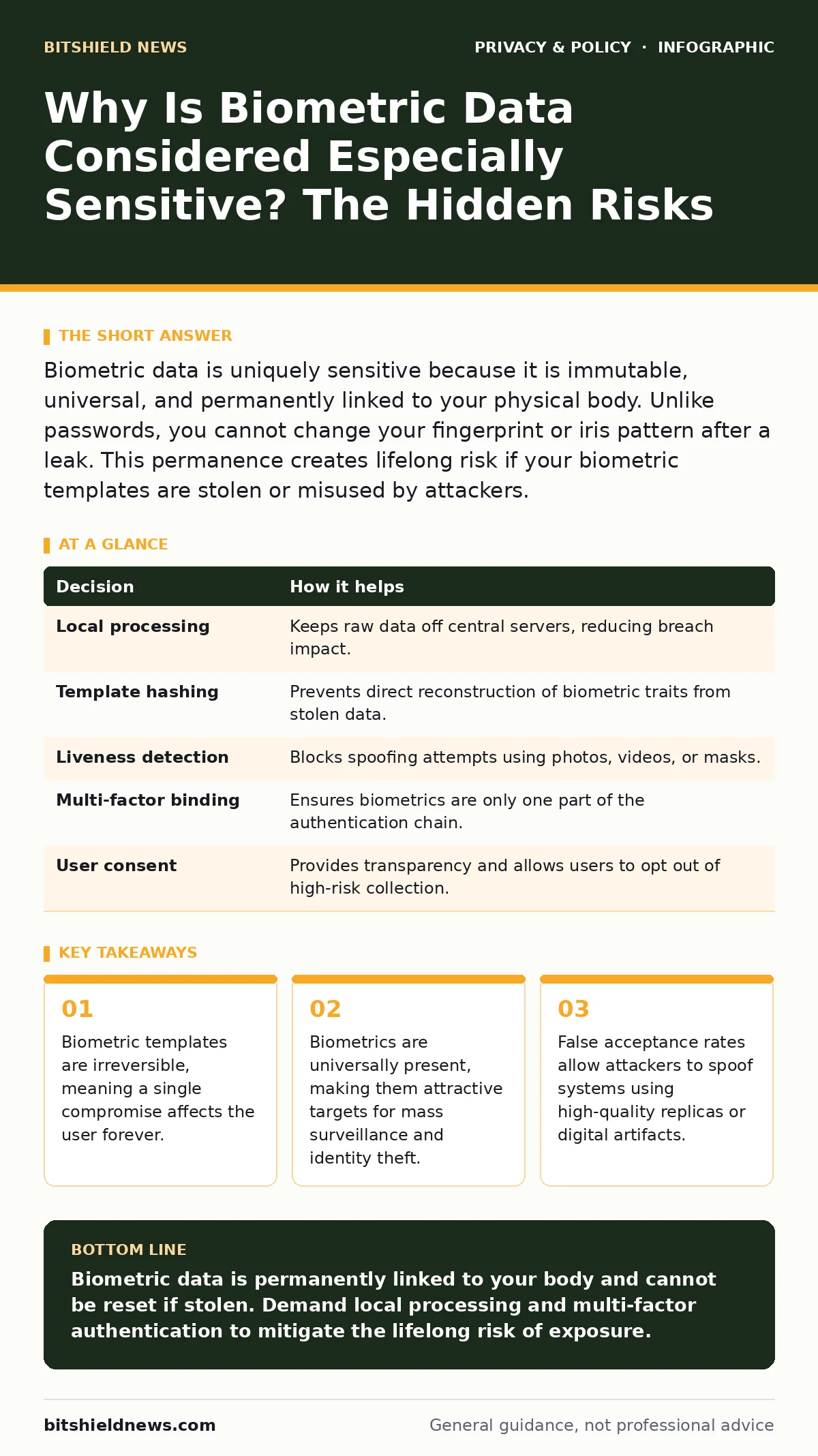
Biometric data is uniquely sensitive because it is immutable, universal, and permanently linked to your physical body. Unlike passwords, you cannot change your fingerprint or iris pattern after a leak. This permanence creates lifelong risk if your biometric templates are stolen or misused by attackers.
Why Is Biometric Data Considered Especially Sensitive
Biometric data is considered especially sensitive because it possesses three distinct characteristics that amplify risk beyond standard personal data. First, biometric traits are immutable. You can change a password, revoke a credit card, or get a new phone number. You cannot change your fingerprint, your facial structure, or your iris pattern. If a database containing hashed passwords is breached, administrators can force a reset. If a database containing biometric templates is breached, the victims must live with the exposure indefinitely.
Second, biometric data is universally present. Everyone has a face and fingers. Attackers do not need to guess or steal a secret; they only need to capture a physical trait. This lowers the barrier for entry for malicious actors. Third, biometric data is permanently linked to the individual. It cannot be separated from the person. This linkage removes the layer of abstraction that protects identity in traditional authentication. When you use a password, you are presenting a secret that is not you. When you use a biometric, you are presenting yourself.
The Irreversibility Problem
The core danger lies in the inability to revoke access. Passwords operate on a principle of revocation. If a secret is compromised, the system invalidates it and issues a new one. Biometrics operate on a principle of verification. The system checks if the input matches the stored template. If the template is stolen, the attacker now possesses the key to every system that uses that specific biometric trait.
Imagine a scenario where a vendor stores raw biometric images instead of encrypted templates. An attacker steals these images. The attacker can now create high-fidelity masks or 3D prints. These physical replicas can bypass many static scanning systems. The victim cannot simply "change" their face. The victim must rely on the system’s ability to detect liveness, which is not always effective. This permanence shifts the burden of security from the user to the infrastructure, which often fails to keep pace with spoofing techniques.
Universal Presence and Low Friction
Biometrics are attractive because they are always available. You do not carry a password manager in your pocket. You carry your body. This convenience creates a massive attack surface. Attackers can harvest biometric data from social media photos, public videos, or even low-resolution security camera footage. The effort to acquire the data is minimal compared to the value gained.
This universal presence also enables cross-system correlation. If an attacker obtains your facial template from one breached service, they may attempt to use it on another service that uses facial recognition for login. Traditional passwords are siloed. A password stolen from a forum is useless on a banking app. Biometrics are not siloed. Your face is your face everywhere. This lack of compartmentalization means a single breach can ripple across multiple digital identities.
Template Storage and Hashing Weaknesses
Many organizations misunderstand how to store biometric data. They treat biometric templates like passwords, applying standard hashing algorithms. This approach is flawed. Biometric data is not discrete. It is continuous and varies slightly with each scan. To match a new scan to the stored template, the system must use probabilistic matching, not exact hashing. This requirement often leads to storing more detailed data than necessary.
Some systems store the raw image for convenience or future feature expansion. This is a critical error. Raw images can be reconstructed into usable forms. Derived templates, which are mathematical representations of specific features, are harder to reverse-engineer. However, even templates can be vulnerable if the matching algorithm is weak. Attackers can generate synthetic templates that trick the matching algorithm into accepting them as valid. This is known as a template attack. It bypasses the need for the actual physical trait entirely.
Contrast: Proper Implementation vs. Negligence
Consider two hypothetical teams managing user authentication. Team A collects biometric data, stores raw images on a centralized server, and transmits them over unencrypted channels. Team B captures the biometric data locally on the user’s device, converts it into a mathematical template, and never transmits the raw data. Team B uses liveness detection to ensure the input is from a live person.
Team A creates a single point of failure. If the server is breached, all users are compromised. Team B distributes the risk. If the server is breached, the attacker gets nothing useful. The templates remain on the devices. This architecture respects the sensitivity of the data by minimizing its exposure. It also aligns with the principle of least privilege. The central server does not need to know what the user looks like; it only needs to verify that the device has authenticated the user.
Decision Framework for Biometric Use
Organizations must evaluate the necessity of biometrics against the permanence of the risk. Use this table to guide your architectural decisions.
| Decision | How it helps |
|---|---|
| Local processing | Keeps raw data off central servers, reducing breach impact. |
| Template hashing | Prevents direct reconstruction of biometric traits from stolen data. |
| Liveness detection | Blocks spoofing attempts using photos, videos, or masks. |
| Multi-factor binding | Ensures biometrics are only one part of the authentication chain. |
| User consent | Provides transparency and allows users to opt out of high-risk collection. |
What Goes Wrong Otherwise
Without these safeguards, biometric systems become liabilities. False acceptance rates allow unauthorized access. False rejection rates lock out legitimate users, causing operational friction. Attackers exploit these errors. They craft inputs that sit on the boundary between acceptance and rejection. This is known as an adversarial example attack.
Furthermore, biometric data can be used for tracking. Unlike cookies or browser fingerprinting, which can be cleared or blocked, biometric traits are constant. If a retailer uses facial recognition to track shoppers, that data can be linked to other databases. This creates a persistent profile of behavior that the user cannot erase. The privacy implications extend far beyond authentication. They touch on freedom of movement and association.
What to Do With That Knowledge
You must treat biometric data with higher scrutiny than standard personal data. Demand that vendors explain how they store and transmit this data. If they store raw images, do not use the service. Insist on local processing where possible. This keeps the data close to the source and out of central databases.
Educate your users about the permanence of biometric compromise. They should understand that giving up a fingerprint is not like giving up a password. It is a permanent grant of access to their physical identity. Encourage the use of multi-factor authentication. Biometrics should verify the user, but a second factor, such as a hardware key or a code, should authorize the action. This separation limits the damage if the biometric factor is compromised.
For deeper context on how digital identifiers persist, see our guide on browser fingerprinting. To understand the broader implications of data collection, read about digital privacy rights. For insights on how metadata can reveal more than intended, check out file metadata. Understanding personal data classification is also necessary for proper handling.
Key takeaways
- Biometric templates are irreversible, meaning a single compromise affects the user forever.
- Biometrics are universally present, making them attractive targets for mass surveillance and identity theft.
- False acceptance rates allow attackers to spoof systems using high-quality replicas or digital artifacts.
Biometric data is permanently linked to your body and cannot be reset if stolen. Demand local processing and multi-factor authentication to mitigate the lifelong risk of exposure.
Frequently asked questions
Can biometric data be encrypted?
Yes, biometric templates can be encrypted, but encryption does not solve the problem of irreversible compromise. If the encryption key is stolen, the biometric data is exposed forever.
Is facial recognition safer than fingerprint scanning?
Facial recognition is easier to spoof using photos or videos. Fingerprint scanning is harder to spoof remotely but can be bypassed with lifted prints. Both have distinct risks.
Do biometrics replace passwords?
Biometrics should not replace passwords entirely. They should serve as one factor in a multi-factor authentication system. Relying solely on biometrics removes the ability to revoke access.
How do I know if my biometrics are safe?
Check if the service processes data locally on your device. If the raw data is sent to a cloud server, the risk is significantly higher. Look for transparency reports and security certifications.
How this guide was produced: written by the BitShield News editorial team with AI assistance, checked against the public references listed below, and reviewed when the facts change. See our editorial policy or report an error.