
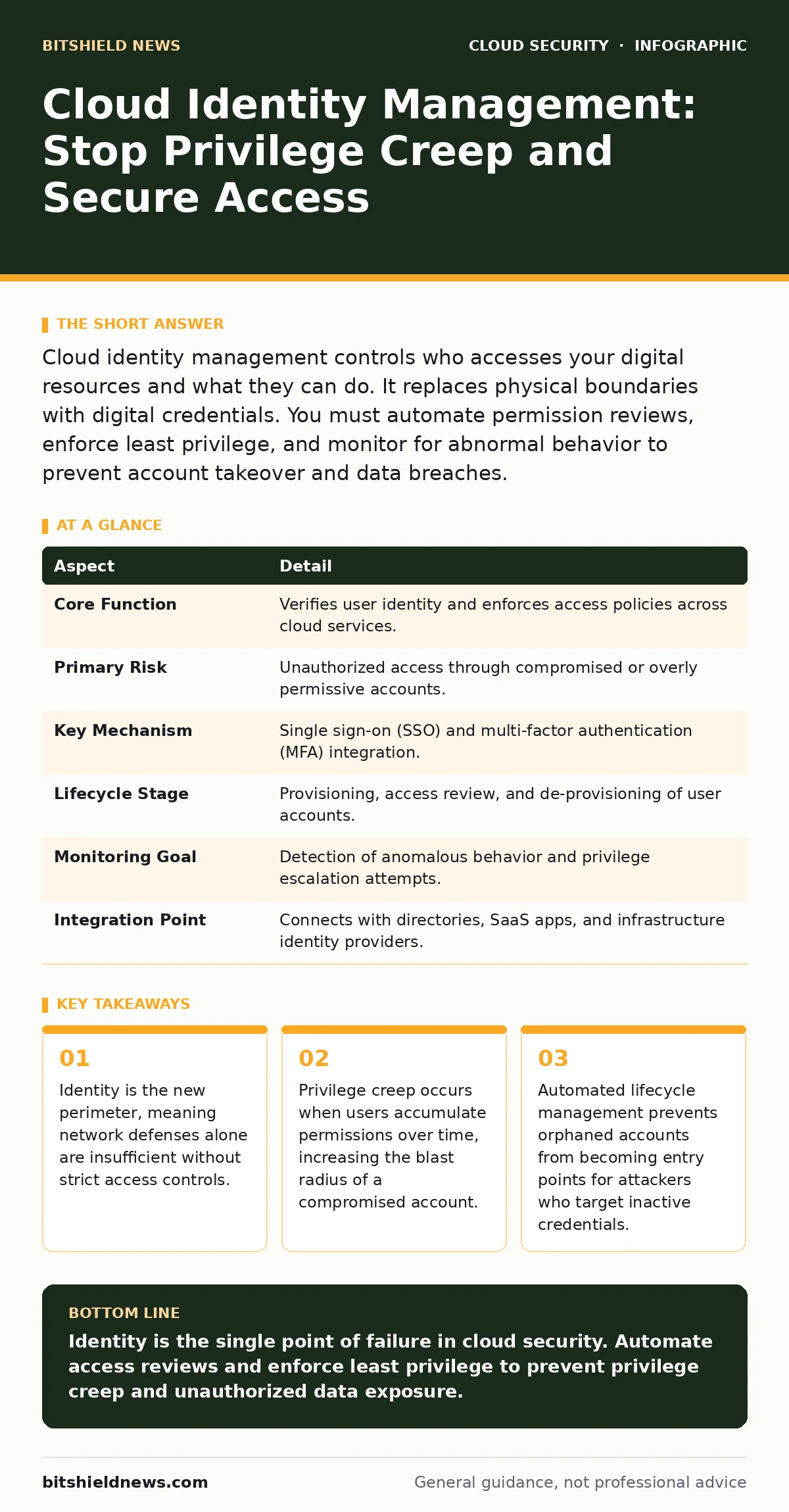
Cloud identity management controls who accesses your digital resources and what they can do. It replaces physical boundaries with digital credentials. You must automate permission reviews, enforce least privilege, and monitor for abnormal behavior to prevent account takeover and data breaches.
The Digital Keycard Analogy
Imagine a large office building where every employee holds a master keycard. This card opens every door, including the server room, the executive suite, and the breakroom. When an employee leaves, the security team forgets to collect the card. The former employee still has full access to the building. This is how most cloud environments operate today. You grant broad access to get work done, then struggle to remove it later. Cloud identity management solves this by issuing virtual keycards that expire, change permissions, and log every door they open.
What Is Cloud Identity Management?
Cloud identity management is the system that verifies who you are and what you are allowed to do in a cloud environment. It replaces the old model of trusting network location with a model of verifying individual credentials. This shift is necessary because modern applications live on the internet, not behind a corporate firewall. The system handles authentication, which proves your identity, and authorization, which determines your access rights. Without this layer, your data is open to anyone who guesses a password or steals a session token.
| Aspect | Detail |
|---|---|
| Core Function | Verifies user identity and enforces access policies across cloud services. |
| Primary Risk | Unauthorized access through compromised or overly permissive accounts. |
| Key Mechanism | Single sign-on (SSO) and multi-factor authentication (MFA) integration. |
| Lifecycle Stage | Provisioning, access review, and de-provisioning of user accounts. |
| Monitoring Goal | Detection of anomalous behavior and privilege escalation attempts. |
| Integration Point | Connects with directories, SaaS apps, and infrastructure identity providers. |
How Cloud Identity Management Works
The system operates through a continuous loop of verification and enforcement. First, a user attempts to access a resource. The identity provider checks the credentials against a directory service. If the credentials are valid, the system issues a secure token. This token contains claims, which are statements about the user’s permissions. The application reads these claims to decide whether to grant access. This process happens in milliseconds and occurs every time a user logs in or requests sensitive data. You must ensure that these tokens are short-lived and that the applications validate them correctly.
The Role of Least Privilege
Least privilege means giving users only the permissions they need to perform their specific job. Nothing more. This principle reduces the damage if an account is compromised. An attacker who steals a developer’s account cannot access financial records if the developer never had that permission. Implementing least privilege requires mapping roles to tasks. You must define what a marketing manager can do versus what a database administrator can do. Then you assign users to these roles rather than granting individual permissions. This makes management scalable and auditable.
Who Is Affected by Poor Identity Governance?
Every person with a cloud account is affected, but the impact varies by role. Developers often request broad permissions to test applications, creating security gaps. Administrators hold high-value targets for attackers because their accounts can change system settings. External contractors are especially risky because their access is often temporary and poorly monitored. When a contractor leaves, their account may remain active for months. This creates a backdoor that attackers can find during reconnaissance. You must treat external identities with the same rigor as internal employees.
What People Usually Get Wrong
Many organizations believe that enabling multi-factor authentication solves identity security. It does not. MFA prevents unauthorized login, but it does not prevent a legitimate user from accessing data they should not see. If an employee has excessive permissions, MFA will help them log in securely to steal data. Another common mistake is relying on manual spreadsheets to track access. These lists become outdated quickly and cannot enforce policies in real time. You need automated systems that sync with your HR records. When an employee is terminated in HR, their cloud access must be revoked immediately.
The Hidden Cost of Permission Sprawl
Permission sprawl occurs when users accumulate permissions over time. They keep old permissions even after their job changes. This is called privilege creep. It is difficult to detect because each individual permission seems reasonable. Collectively, they create a powerful account that can move laterally across your environment. Attackers exploit this by finding accounts with unusual combinations of permissions. You must conduct regular access reviews to identify and remove unused permissions. This process is tedious but necessary to maintain a secure posture.
See also: What Is Disaster Recovery in Cloud Computing: A Practical Blueprint
How To Implement Effective Controls
Start by inventorying all cloud identities. Include employees, contractors, and service accounts. Service accounts are used by applications to interact with other systems. They often have high privileges and weak passwords. Next, enforce least privilege by defining roles. Map users to these roles and remove direct permissions. Implement just-in-time access for high-risk tasks. This grants temporary elevation only when needed. Monitor for anomalies using behavioral analytics. Look for logins from unusual locations or at strange times. Finally, automate the lifecycle. Connect your identity system to your HR platform. Provision and de-provision accounts automatically based on employment status.
Integrating With Other Security Layers
Identity management does not work in isolation. It must connect with your broader security architecture. For instance, secure access service edge (SASE) platforms rely on identity context to make routing decisions. If you do not provide accurate identity information, the SASE platform cannot enforce security policies correctly. Similarly, cloud guardrails depend on identity tags to apply configurations. If an identity lacks proper labels, the guardrails may fail to protect the resource. You must also consider cloud encryption. Encryption protects data at rest, but identity management controls who holds the keys. Without strict key management, encryption is just a delay tactic for attackers.
The Long-Term View
Identity governance is not a one-time project. It is a continuous process. As your organization grows, so does the complexity of your identity landscape. New applications, new partners, and new regulations require constant adjustment. You must build a culture of security awareness. Users must understand why they need to request permissions and why they must review them. Leaders must prioritize identity security over convenience. The cost of a breach far exceeds the cost of proper governance. By treating identity as the primary control, you shift the burden from perimeter defenses to the source of trust. This makes your security posture resilient against changing threats.
Refer to our guide on identity as the new perimeter for deeper context on why network boundaries are fading. Also review cloud migration security to ensure you do not carry legacy identity flaws into the cloud. For application-specific risks, see container image scanning and insecure container images to understand how identity intersects with deployment pipelines.
Key takeaways
- Identity is the new perimeter, meaning network defenses alone are insufficient without strict access controls.
- Privilege creep occurs when users accumulate permissions over time, increasing the blast radius of a compromised account.
- Automated lifecycle management prevents orphaned accounts from becoming entry points for attackers who target inactive credentials.
Identity is the single point of failure in cloud security. Automate access reviews and enforce least privilege to prevent privilege creep and unauthorized data exposure.
Frequently asked questions
What is the difference between identity management and access control?
Identity management handles the creation and maintenance of user accounts and credentials. Access control determines what those accounts are allowed to do. Identity management answers who you are; access control answers what you can do.
How often should I review user permissions?
You should review permissions quarterly for standard users and monthly for privileged accounts. Automated tools can flag unused permissions in real time, reducing the manual burden of periodic reviews.
Can I use the same identity system for on-premises and cloud?
Yes, most modern identity providers support hybrid environments. They synchronize with on-premises directories while managing cloud-native identities. This ensures consistent policies across all environments.
What happens if I lose my identity provider credentials?
You lose administrative access to your cloud environment. This is why you must maintain break-glass accounts with separate credentials. These accounts are for emergency use only and should be stored securely offline.
How this guide was produced: written by the BitShield News editorial team with AI assistance, checked against the public references listed below, and reviewed when the facts change. See our editorial policy or report an error.