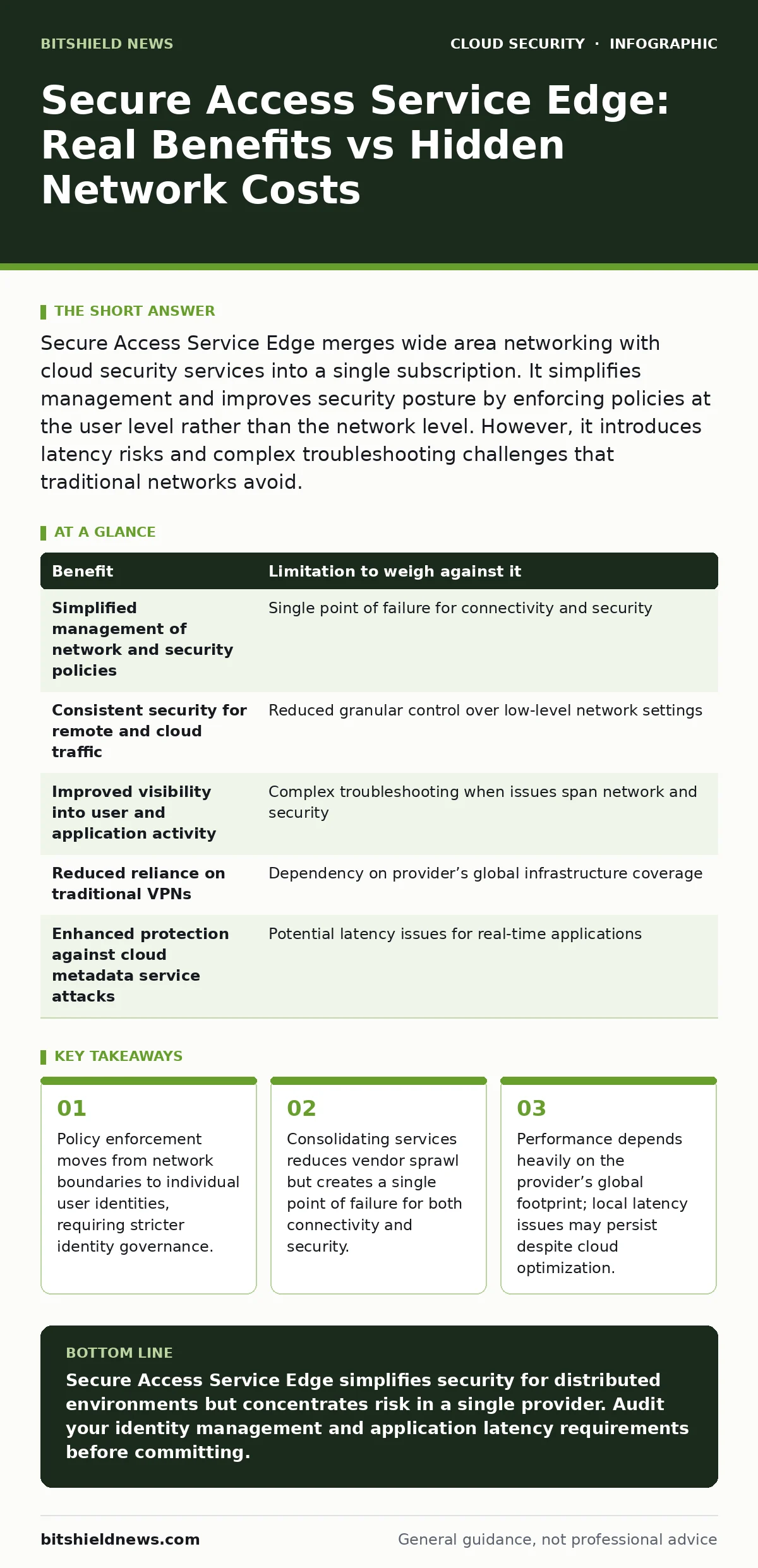
Secure Access Service Edge merges wide area networking with cloud security services into a single subscription. It simplifies management and improves security posture by enforcing policies at the user level rather than the network level. However, it introduces latency risks and complex troubleshooting challenges that traditional networks avoid.
The Architecture Shift from Perimeter to User
Traditional network security relies on a fixed perimeter. Firewalls sit at the edge of your data center, inspecting traffic that enters or leaves that specific location. This model breaks down when employees work remotely or when applications reside in public clouds. Traffic no longer flows through a predictable choke point.
Secure Access Service Edge changes this dynamic. It combines Software-Defined Wide Area Networking and Cloud-Access Security Broker capabilities into a unified service. Instead of backhauling traffic to a central office for inspection, the service inspects traffic near the user or the cloud application. This approach aligns with the concept of identity as the new perimeter, where access decisions are based on who the user is, not where they are connected.
Concrete Benefits of Consolidated Security
The primary advantage is simplified management. You manage one set of policies for both network routing and security enforcement. This reduces the operational overhead of coordinating between separate firewall vendors and network equipment providers. Updates and patches apply uniformly across the entire service, eliminating version mismatches between devices.
Security posture improves because every connection is inspected. In traditional setups, direct-to-cloud traffic often bypasses on-premises security tools. This creates blind spots where attackers can exploit leaked cloud access keys or interact with unsecured cloud databases without triggering alerts. The integrated service ensures all traffic, regardless of destination, passes through security controls.
Visibility increases significantly. You gain a single pane of glass for monitoring network performance and security events. This holistic view helps identify anomalies that might appear benign when viewed in isolation. For example, unusual data egress combined with specific authentication patterns becomes easier to detect.
Honest Limitations and Hidden Costs
Consolidation brings risk concentration. If the service provider experiences an outage, you lose both connectivity and security enforcement simultaneously. Traditional networks allow you to route around security failures, keeping basic connectivity alive. This model ties your fate to the provider’s infrastructure reliability.
Troubleshooting becomes more complex. When an issue occurs, it is difficult to determine if the cause is network routing, application performance, or a security policy block. You lose granular control over low-level network settings. Custom configurations that worked on standalone firewalls may not translate directly to the cloud-native service.
Latency remains a variable. While the service routes traffic optimally, it cannot eliminate the speed of light. If your users are in regions with sparse service provider coverage, performance may degrade. This is particularly problematic for applications sensitive to jitter or delay.
Trade-Offs in Policy Enforcement
Policy enforcement shifts from IP addresses to user identities. This requires robust identity management. If your identity as the new perimeter strategy is weak, the service cannot protect you effectively. You must ensure that authentication mechanisms are strict and that multi-factor authentication is enforced for all users.
This shift also impacts cloud guardrails. You must define clear boundaries for what users can access and how they can interact with cloud resources. Without precise guardrails, users may inadvertently expose sensitive data or create insecure connections. The service enforces these rules, but you must define them correctly.
Performance and Infrastructure Dependencies
The service relies on a global network of points of presence. Your experience depends on how well these points cover your user base and application locations. If your applications are hosted in niche cloud regions or on-premises data centers without direct cloud interconnect, performance may suffer.
You must also consider the impact on cloud migration security. As you move applications to the cloud, you need to ensure that the service can inspect traffic to those new locations. This may require additional configuration or direct connections to cloud providers.
Latency spikes can occur during peak usage times if the service provider’s infrastructure is congested. You have limited ability to prioritize traffic compared to dedicated hardware appliances. This can affect critical business applications that require guaranteed bandwidth.
See also: What Is Disaster Recovery in Cloud Computing: A Practical Blueprint
When It Is Worth It
This architecture is ideal for organizations with a distributed workforce. If your employees work from home, branch offices, or while traveling, the service provides consistent security and performance. It eliminates the need for expensive VPN connections and complex routing configurations.
It is also suitable for companies heavily invested in public cloud services. If most of your applications run in major cloud platforms, the service can optimize traffic flow and enforce security policies directly within the cloud environment. This reduces the risk of configuration drift that often occurs when managing separate security tools.
When It Is Not
Avoid this model if your applications require ultra-low latency or strict real-time performance. Financial trading platforms, industrial control systems, or high-frequency video editing workflows may not tolerate the additional processing overhead. Dedicated hardware appliances or direct cloud interconnects may be better options.
It is also not suitable if you lack mature identity management. If you cannot enforce strong authentication and granular access controls, the service cannot function effectively. You must have a solid foundation for identity as the new perimeter before implementing this architecture.
Organizations with highly customized network requirements may find the service too restrictive. If you need deep packet inspection capabilities or custom routing protocols that the service does not support, you will face significant limitations.
Comparing Benefits and Limitations
| Benefit | Limitation to weigh against it |
|---|---|
| Simplified management of network and security policies | Single point of failure for connectivity and security |
| Consistent security for remote and cloud traffic | Reduced granular control over low-level network settings |
| Improved visibility into user and application activity | Complex troubleshooting when issues span network and security |
| Reduced reliance on traditional VPNs | Dependency on provider’s global infrastructure coverage |
| Enhanced protection against cloud metadata service attacks | Potential latency issues for real-time applications |
Final Considerations for Implementation
Before adopting this service, audit your current network and security architecture. Identify applications that are sensitive to latency or require specific routing protocols. Ensure your identity management system is robust and ready to support user-centric policies.
Pilot the service with a small group of users and non-critical applications. Monitor performance and security metrics closely. This allows you to identify issues before committing to a full-scale deployment. Remember that cloud encryption remains your responsibility, even if the service provides transport-level security.
Key takeaways
- Policy enforcement moves from network boundaries to individual user identities, requiring stricter identity governance.
- Consolidating services reduces vendor sprawl but creates a single point of failure for both connectivity and security.
- Performance depends heavily on the provider’s global footprint; local latency issues may persist despite cloud optimization.
Secure Access Service Edge simplifies security for distributed environments but concentrates risk in a single provider. Audit your identity management and application latency requirements before committing.
Frequently asked questions
Does Secure Access Service Edge replace firewalls?
It replaces traditional perimeter firewalls by integrating firewall capabilities into the cloud service, but you may still need host-based firewalls for endpoint protection.
How does it handle data privacy?
The service can inspect traffic for threats, but you must configure it to avoid exposing sensitive data to the provider, often by using local inspection nodes or ensuring data is encrypted end-to-end.
Can I use it with on-premises applications?
Yes, but you may need to set up direct connections or use client software to route traffic through the service, which can introduce latency for internal applications.
What happens if the service goes down?
Connectivity and security enforcement are lost simultaneously, potentially locking out users and exposing traffic to threats until the service is restored.
How this guide was produced: written by the BitShield News editorial team with AI assistance, checked against the public references listed below, and reviewed when the facts change. See our editorial policy or report an error.