
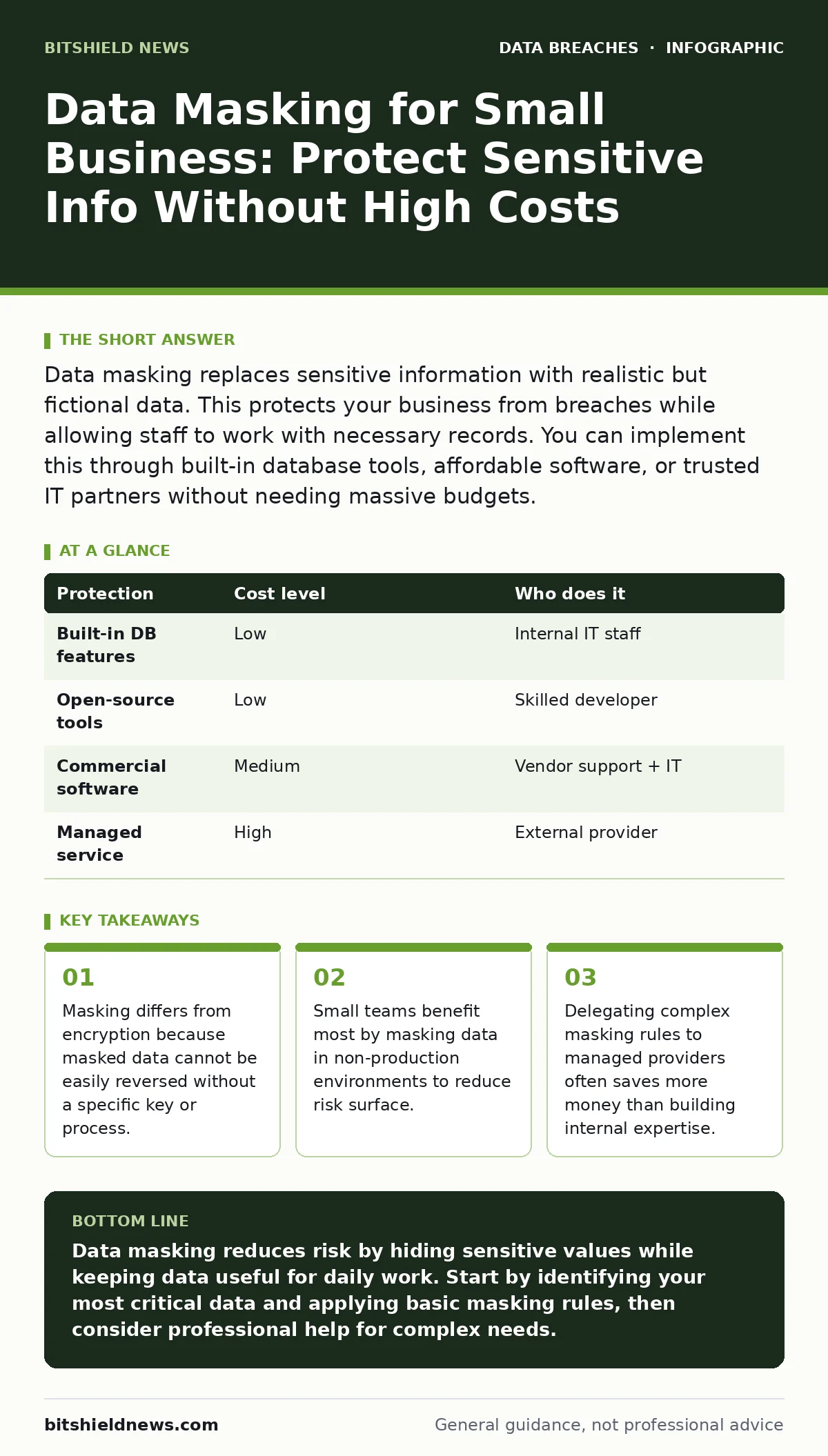
Data masking replaces sensitive information with realistic but fictional data. This protects your business from breaches while allowing staff to work with necessary records. You can implement this through built-in database tools, affordable software, or trusted IT partners without needing massive budgets.
The Hidden Risk in Small Teams
Small organizations often believe their size protects them from sophisticated attacks. This belief is dangerous. Attackers scan for weak points regardless of company size. Small teams usually have fewer security staff, meaning one mistake can compromise everything. Data masking addresses this by altering sensitive data so it remains useful for work but useless to thieves.
You might think encryption is enough. Encryption at rest protects data sitting on a disk, but it does not help when an employee views the data. If an employee sees real social security numbers or credit card details, that data is exposed in their memory and potentially on their screen. Masking changes the display value. The original data stays safe in the database, but the user never sees the truth.
Why Masking Matters at Scale
The value of masking grows as your data interactions increase. Every time you share data with a vendor, every time you use a testing environment, you increase your exposure. Without masking, you must grant full access to live data. This violates the principle of least privilege. Least privilege means giving users only the access they strictly need to do their job.
Consider a development team. They need to test new software features. Using real customer data in a test environment is a major security flaw. Test environments are often less secure than production systems. If a hacker breaches the test server, they get real data. Masking allows developers to use realistic data structures without the actual sensitive values. This keeps your development cycle fast and your security posture strong.
Another non-obvious benefit is compliance. Many regulations require protecting personal data. Masking helps you meet these requirements without slowing down business operations. You can share reports with auditors or partners without revealing individual identities. This reduces legal risk and builds trust with your clients.
Affordable Implementation Methods
You do not need expensive enterprise software to start masking. Many small businesses can use tools they already own. Database management systems often include built-in masking features. These features allow you to define rules for how data appears. For example, you can mask all but the last four digits of a credit card number.
Open-source tools are another option. These tools are free but require technical knowledge to configure. If you have a skilled IT person, this can be a cost-effective path. However, the hidden cost is maintenance. You must keep the tool updated and manage the rules as your data changes.
Commercial software providers offer user-friendly masking solutions. These are more expensive but easier to use. They often include pre-built templates for common data types. This saves time and reduces the chance of human error. Choose a solution that fits your budget and technical capability. Do not buy more than you need. Start with the most sensitive data and expand from there.
| Protection | Cost level | Who does it |
|---|---|---|
| Built-in DB features | Low | Internal IT staff |
| Open-source tools | Low | Skilled developer |
| Commercial software | Medium | Vendor support + IT |
| Managed service | High | External provider |
What to Delegate to Experts
Trying to do everything in-house can backfire. Security requires constant attention. If your IT staff is busy fixing printers or resetting passwords, they may miss critical updates. Delegating data protection tasks to a managed service provider can free up your team. These providers specialize in security. They stay current with threats and best practices.
When you delegate masking, you are not just outsourcing a task. You are gaining expertise. Providers can help you design a strategy that fits your specific needs. They can identify data you did not know was sensitive. They can also ensure your masking rules are applied consistently across all systems.
However, delegation does not mean abdication. You must still understand what is being protected. You cannot outsource accountability. Work with your provider to define clear policies. Review their reports regularly. Ensure they are following your rules. This partnership approach gives you the best of both worlds: professional expertise and internal control.
Questions for Your IT Provider
Before hiring help, you need to ask the right questions. Many providers claim to offer security, but their capabilities vary. You must verify their specific experience with data protection. Do not accept vague answers. Push for details.
- How do you identify sensitive data in our systems?
- What masking techniques do you use for different data types?
- Can you show us an example of masked data?
- How do you handle data that needs to be unmasked for specific tasks?
- What is your process for updating masking rules as our data changes?
These questions reveal their depth of knowledge. A good provider will explain their methods clearly. They will discuss trade-offs and limitations. They will not promise perfect security. They will focus on reducing risk to an acceptable level.
See also: What is Personal Data: Definition, Scope and Control Tactics · What privacy impact assessments do for your data strategy
Common Pitfalls to Avoid
One common mistake is masking too much. If you mask data that employees need to see, you hinder productivity. For example, if a support agent cannot see a customer's name, they cannot personalize their service. Find a balance. Mask only the sensitive parts of the data. Allow access to non-sensitive identifiers.
Another mistake is ignoring data in transit. Masking usually focuses on data at rest or on screen. But data moving between systems is also vulnerable. Ensure you use secure file sharing protocols when moving masked data. This prevents interception during transfer.
The Human Element
Technology alone cannot stop breaches. People make mistakes. They click on phishing links. They share passwords. They leave laptops unlocked. Data masking reduces the damage of these mistakes. If an employee inadvertently shares a file, the masked data is harmless.
Train your staff on why masking is used. Explain that it is not about distrust. It is about protecting their work and the company's reputation. When employees understand the purpose, they are more likely to follow the rules. Encourage them to report any concerns about data access. Open communication strengthens your security culture.
Looking Beyond Masking
Data masking is one layer of defense. It works best when combined with other measures. For instance, app permission management ensures users only access what they need. This limits the spread of data within your organization. Similarly, protecting against stolen session tokens prevents attackers from hijacking user accounts to view data.
You should also consider data minimization. Collect only the data you truly need. The less data you hold, the less you need to mask. This reduces complexity and cost. It also lowers the impact of a breach. By combining masking with these other practices, you create a strong security foundation.
Key takeaways
- Masking differs from encryption because masked data cannot be easily reversed without a specific key or process.
- Small teams benefit most by masking data in non-production environments to reduce risk surface.
- Delegating complex masking rules to managed providers often saves more money than building internal expertise.
Data masking reduces risk by hiding sensitive values while keeping data useful for daily work. Start by identifying your most critical data and applying basic masking rules, then consider professional help for complex needs.
Frequently asked questions
Does data masking slow down my database?
Static masking can take time to process large datasets. Dynamic masking happens in real-time and may add slight latency, but modern systems handle this efficiently.
Can masked data be reversed?
If done correctly, masked data cannot be reversed. The original value is replaced with a fake one. Only the original data in the secure database remains intact.
Is masking the same as anonymization?
No. Anonymization removes all identifying information permanently. Masking hides specific values but keeps the data structure intact for testing or analysis.
Do I need to mask data for every employee?
No. Apply masking based on job roles. Only mask data for users who do not strictly need to see the real values to perform their duties.
How this guide was produced: written by the BitShield News editorial team with AI assistance, checked against the public references listed below, and reviewed when the facts change. See our editorial policy or report an error.