
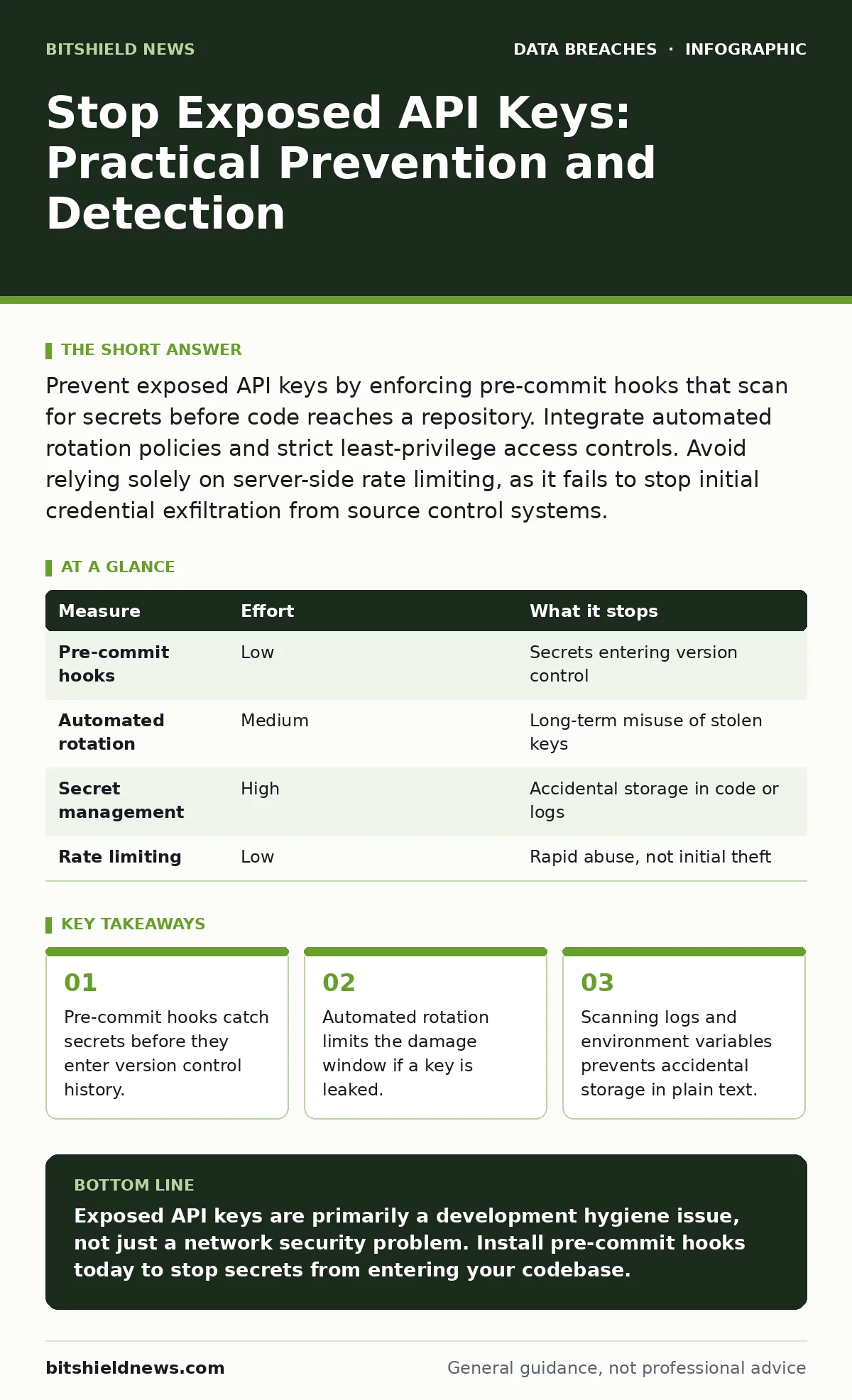
Prevent exposed API keys by enforcing pre-commit hooks that scan for secrets before code reaches a repository. Integrate automated rotation policies and strict least-privilege access controls. Avoid relying solely on server-side rate limiting, as it fails to stop initial credential exfiltration from source control systems.
The Hidden Cost of Static Secrets
Imagine a developer hardcodes an API key into a script to test a new feature. The test passes, but the key remains in the file. Weeks later, that file is pushed to a public repository. You now have an exposed credential that allows unauthorized access to your infrastructure. This scenario is common because static secrets are invisible until they are misused.
Static secrets are fixed strings that grant access to services. Unlike dynamic tokens, they do not expire automatically. This permanence creates a long-tail risk. Once leaked, the key remains valid until someone manually revokes it. During that window, attackers can scrape data or inject malicious code. The cost of remediation often exceeds the cost of prevention.
You must treat every API key as a potential breach vector. The goal is not to eliminate keys, but to control their lifecycle. This requires shifting security left in the development process. By catching errors early, you reduce the blast radius of a potential leak.
Pre-Commit Scanning as First Line of Defense
Pre-commit hooks are scripts that run before code is saved to a repository. They check for patterns that look like secrets, such as long alphanumeric strings. If a hook detects a potential key, it blocks the commit. This stops the secret from ever entering version control history.
This measure is highly effective because it addresses the root cause. Most exposures happen when developers forget to remove hardcoded credentials. Pre-commit hooks automate this check. They enforce a consistent standard across all team members.
The effort is low, but the impact is high. You install the hook once, and it runs every time. It does not require changes to the application logic. It simply adds a safety net. This is the single most important step you can take to prevent exposure.
Automated Rotation and Short-Lived Tokens
Static keys are dangerous because they last forever. Dynamic tokens, also known as short-lived credentials, expire after a set time. Even if an attacker steals a dynamic token, its usefulness is limited. This reduces the window of opportunity for misuse.
Automated rotation systems generate new credentials regularly. They update the applications that use them without manual intervention. This requires integration with identity providers that support dynamic credentials. Not all services offer this feature, but those that do provide a significant security advantage.
Suppose an attacker steals a credential that expires in one hour. They have only sixty minutes to exploit it. This forces them to act quickly, increasing the chance of detection. It also limits the amount of data they can exfiltrate. This is a critical layer of defense for high-value targets.
Environment Variable Management
Environment variables are system-level settings that store configuration data. They allow applications to access secrets without hardcoding them. However, they are not inherently secure. If you print these variables to logs or error messages, the secrets become visible.
You must ensure that your application does not output environment variables in plain text. This includes debugging logs, crash reports, and API responses. A single misconfigured log entry can expose dozens of secrets. This is a common oversight in development environments.
Use secret management tools to store and retrieve credentials. These tools encrypt the data at rest and provide audit trails. They also integrate with infrastructure as code tools. This ensures that secrets are never stored in configuration files or scripts. This approach aligns with best practices for data masking in sensitive environments.
What Does Not Work: Rate Limiting Alone
Many organizations rely on rate limiting to protect API endpoints. Rate limiting restricts the number of requests a user can make in a given time. While this helps prevent abuse, it does not prevent exposure. An attacker can steal a key and use it within the allowed limits.
Rate limiting assumes the key is secret. If the key is exposed, the assumption fails. The attacker can perform slow, steady exfiltration that stays under the radar. This makes detection difficult. You cannot rely on rate limiting as a primary defense against credential theft.
Imagine a bot that makes one request per minute. It stays well within the rate limit. Over weeks, it can extract significant data. This type of attack is hard to detect because it looks like normal traffic. You need additional controls to identify anomalous behavior.
| Measure | Effort | What it stops |
|---|---|---|
| Pre-commit hooks | Low | Secrets entering version control |
| Automated rotation | Medium | Long-term misuse of stolen keys |
| Secret management | High | Accidental storage in code or logs |
| Rate limiting | Low | Rapid abuse, not initial theft |
Detecting Anomalous Usage Patterns
You cannot prevent every leak. Therefore, you must detect when a key is misused. Security telemetry provides visibility into API usage. It tracks who is accessing what, when, and from where. This data allows you to spot anomalies.
Suppose a key is typically used from a specific region. Suddenly, requests come from a different country. This is a red flag. Automated alerts can notify you of such changes. This allows you to revoke the key before significant damage occurs.
You should also monitor for unusual access times. If a key is used during off-hours, it may indicate compromise. Combine this with security telemetry to build a comprehensive picture. This helps you distinguish between legitimate use and malicious activity.
The Role of Least Privilege
Even if a key is exposed, its damage depends on its permissions. Least privilege means giving a key only the access it needs. A key used for reading data should not have write permissions. This limits the impact of a breach.
Review your API keys regularly. Remove unused keys and reduce permissions on active ones. This is a manual process, but it is necessary. It ensures that no single key has excessive power. This aligns with principles of data minimization in access control.
Imagine a key with full administrative access is leaked. An attacker can delete databases or modify configurations. If that same key only had read access, the attacker could only view data. The damage is contained. This is a critical risk reduction strategy.
Closing Checklist for Today
You do not need to overhaul your entire infrastructure today. Start with these three actions to immediately reduce risk. They are quick wins that provide tangible security benefits.
- Install a pre-commit hook that scans for secrets. This stops most leaks at the source.
- Identify one high-value API key and enable automated rotation. This limits the damage window.
- Review your logging configuration to ensure secrets are not printed. This prevents accidental exposure.
These steps are foundational. They address the most common causes of API key exposure. Implement them first, then expand to other measures. This phased approach ensures sustainable security improvements.
Key takeaways
- Pre-commit hooks catch secrets before they enter version control history.
- Automated rotation limits the damage window if a key is leaked.
- Scanning logs and environment variables prevents accidental storage in plain text.
Exposed API keys are primarily a development hygiene issue, not just a network security problem. Install pre-commit hooks today to stop secrets from entering your codebase.
Frequently asked questions
Can I use a single API key for multiple environments?
No, you should use separate keys for each environment. This isolates breaches and simplifies rotation. Using one key everywhere increases the blast radius of a leak.
How often should I rotate API keys?
Rotate keys as frequently as your infrastructure allows. Daily or weekly rotation is ideal for high-value services. Less frequent rotation increases the risk window for stolen credentials.
What is the difference between a secret and a token?
A secret is a long-lived credential, while a token is often short-lived. Tokens are better for security because they expire automatically. Secrets require manual rotation and are harder to manage.
Do I need a dedicated secret management tool?
Yes, dedicated tools provide encryption, audit trails, and integration. They are more secure than storing secrets in environment variables alone. They also simplify rotation and access control.
How this guide was produced: written by the BitShield News editorial team with AI assistance, checked against the public references listed below, and reviewed when the facts change. See our editorial policy or report an error.